

174
M. Heshmat et al.
N
N
M
R
t-Bu
R
N
N
M
R
t-Bu
R
N
N
M
R
t-Bu
R
+
H
H
H
N
N
M
R
t-Bu
R
H
+
-
1,4-addition
H-H
1,4-addition
H-H
N
N
M
R
t-Bu
R
H
H
H
N
N
M
R
t-Bu
R
H
H
H
H
H
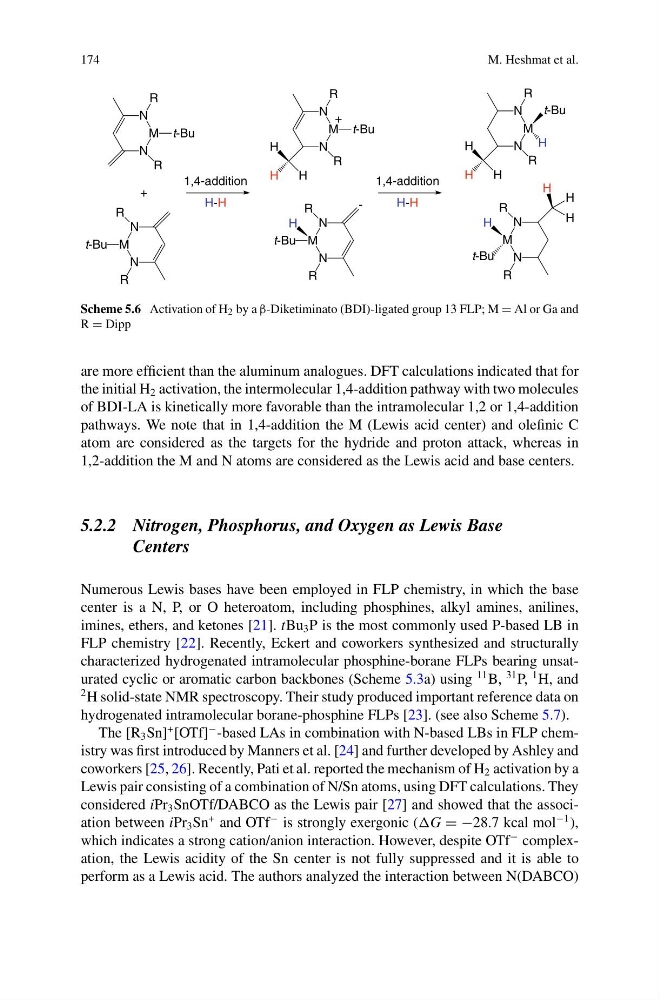
Scheme 5.6 Activation of H 2 by a β-Diketiminato (BDI)-ligated group 13 FLP; M = Al or Ga and
R = Dipp
are more efficient than the aluminum analogues. DFT calculations indicated that for
the initial H 2 activation, the intermolecular 1,4-addition pathway with two molecules
of BDI-LA is kinetically more favorable than the intramolecular 1,2 or 1,4-addition
pathways. We note that in 1,4-addition the M (Lewis acid center) and olefinic C
atom are considered as the targets for the hydride and proton attack, whereas in
1,2-addition the M and N atoms are considered as the Lewis acid and base centers.
5.2.2 Nitrogen, Phosphorus, and Oxygen as Lewis Base
Centers
Numerous Lewis bases have been employed in FLP chemistry, in which the base
center is a N, P, or O heteroatom, including phosphines, alkyl amines, anilines,
imines, ethers, and ketones [21]. tBu 3 P is the most commonly used P-based LB in
FLP chemistry [22]. Recently, Eckert and coworkers synthesized and structurally
characterized hydrogenated intramolecular phosphine-borane FLPs bearing unsaturated cyclic or aromatic carbon backbones (Scheme 5.3a) using
11 B,
31 P,
1 H, and
2 H solid-state NMR spectroscopy. Their study produced important reference data on
hydrogenated intramolecular borane-phosphine FLPs [23]. (see also Scheme 5.7).
The [R 3 Sn]
+ [OTf]
− -based LAs in combination with N-based LBs in FLP chemistry was first introduced by Manners et al. [24] and further developed by Ashley and
coworkers [25, 26]. Recently, Pati et al. reported the mechanism of H 2 activation by a
Lewis pair consisting of a combination of N/Sn atoms, using DFT calculations. They
considered iPr 3 SnOTf/DABCO as the Lewis pair [27] and showed that the association between iPr 3 Sn
+ and OTf
− is strongly exergonic ( = −28.7 kcal mol
−1 ),
which indicates a strong cation/anion interaction. However, despite OTf
− complexation, the Lewis acidity of the Sn center is not fully suppressed and it is able to
perform as a Lewis acid. The authors analyzed the interaction between N(DABCO)
M. Heshmat et al.
N
N
M
R
t-Bu
R
N
N
M
R
t-Bu
R
N
N
M
R
t-Bu
R
+
H
H
H
N
N
M
R
t-Bu
R
H
+
-
1,4-addition
H-H
1,4-addition
H-H
N
N
M
R
t-Bu
R
H
H
H
N
N
M
R
t-Bu
R
H
H
H
H
H
Scheme 5.6 Activation of H 2 by a β-Diketiminato (BDI)-ligated group 13 FLP; M = Al or Ga and
R = Dipp
are more efficient than the aluminum analogues. DFT calculations indicated that for
the initial H 2 activation, the intermolecular 1,4-addition pathway with two molecules
of BDI-LA is kinetically more favorable than the intramolecular 1,2 or 1,4-addition
pathways. We note that in 1,4-addition the M (Lewis acid center) and olefinic C
atom are considered as the targets for the hydride and proton attack, whereas in
1,2-addition the M and N atoms are considered as the Lewis acid and base centers.
5.2.2 Nitrogen, Phosphorus, and Oxygen as Lewis Base
Centers
Numerous Lewis bases have been employed in FLP chemistry, in which the base
center is a N, P, or O heteroatom, including phosphines, alkyl amines, anilines,
imines, ethers, and ketones [21]. tBu 3 P is the most commonly used P-based LB in
FLP chemistry [22]. Recently, Eckert and coworkers synthesized and structurally
characterized hydrogenated intramolecular phosphine-borane FLPs bearing unsaturated cyclic or aromatic carbon backbones (Scheme 5.3a) using
11 B,
31 P,
1 H, and
2 H solid-state NMR spectroscopy. Their study produced important reference data on
hydrogenated intramolecular borane-phosphine FLPs [23]. (see also Scheme 5.7).
The [R 3 Sn]
+ [OTf]
− -based LAs in combination with N-based LBs in FLP chemistry was first introduced by Manners et al. [24] and further developed by Ashley and
coworkers [25, 26]. Recently, Pati et al. reported the mechanism of H 2 activation by a
Lewis pair consisting of a combination of N/Sn atoms, using DFT calculations. They
considered iPr 3 SnOTf/DABCO as the Lewis pair [27] and showed that the association between iPr 3 Sn
+ and OTf
− is strongly exergonic ( = −28.7 kcal mol
−1 ),
which indicates a strong cation/anion interaction. However, despite OTf
− complexation, the Lewis acidity of the Sn center is not fully suppressed and it is able to
perform as a Lewis acid. The authors analyzed the interaction between N(DABCO)