

5 Mechanistic Insight into the Hydrogen Activation by Frustrated Lewis Pairs
175
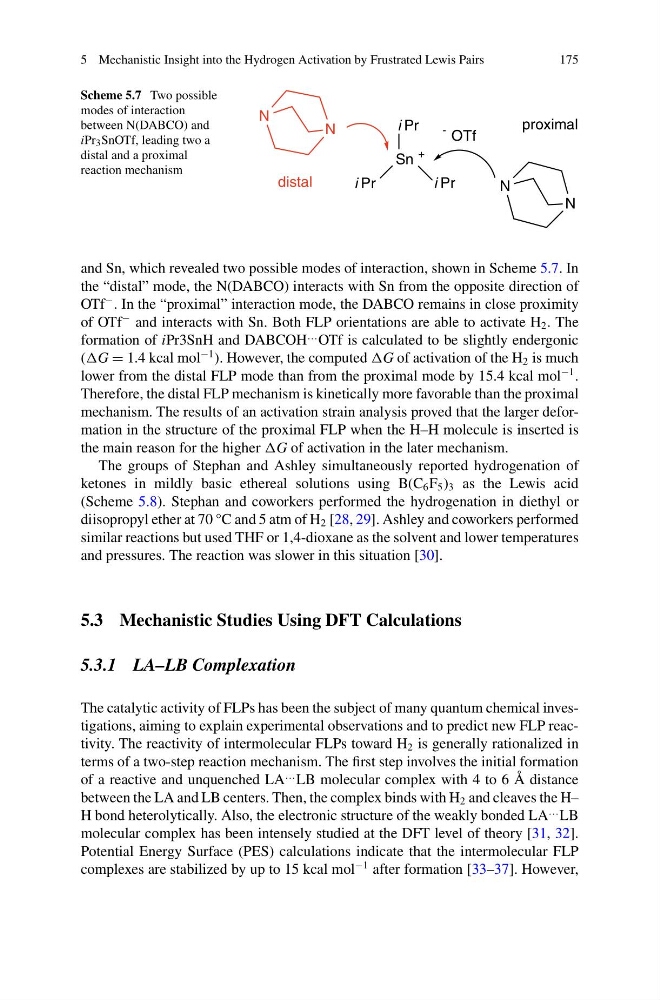
Scheme 5.7 Two possible
modes of interaction
between N(DABCO) and
iPr 3 SnOTf, leading two a
distal and a proximal
reaction mechanism
Sn
+
i Pr
i Pr
i Pr
- OTf
N
N
N
N
distal
proximal
and Sn, which revealed two possible modes of interaction, shown in Scheme 5.7. In
the “distal” mode, the N(DABCO) interacts with Sn from the opposite direction of
OTf
− . In the “proximal” interaction mode, the DABCO remains in close proximity
of OTf
− and interacts with Sn. Both FLP orientations are able to activate H 2 . The
formation of iPr3SnH and DABCOH
… OTf is calculated to be slightly endergonic
( = 1.4 kcal mol
−1 ). However, the computed of activation of the H 2 is much
lower from the distal FLP mode than from the proximal mode by 15.4 kcal mol
−1 .
Therefore, the distal FLP mechanism is kinetically more favorable than the proximal
mechanism. The results of an activation strain analysis proved that the larger deformation in the structure of the proximal FLP when the H–H molecule is inserted is
the main reason for the higher of activation in the later mechanism.
The groups of Stephan and Ashley simultaneously reported hydrogenation of
ketones in mildly basic ethereal solutions using B(C 6 F 5 ) 3 as the Lewis acid
(Scheme 5.8). Stephan and coworkers performed the hydrogenation in diethyl or
diisopropyl ether at 70 °C and 5 atm of H 2 [28, 29]. Ashley and coworkers performed
similar reactions but used THF or 1,4-dioxane as the solvent and lower temperatures
and pressures. The reaction was slower in this situation [30].
5.3 Mechanistic Studies Using DFT Calculations
5.3.1 LA–LB Complexation
The catalytic activity of FLPs has been the subject of many quantum chemical investigations, aiming to explain experimental observations and to predict new FLP reactivity. The reactivity of intermolecular FLPs toward H 2 is generally rationalized in
terms of a two-step reaction mechanism. The first step involves the initial formation
of a reactive and unquenched LA
… LB molecular complex with 4 to 6 Å distance
between the LA and LB centers. Then, the complex binds with H 2 and cleaves the H–
H bond heterolytically. Also, the electronic structure of the weakly bonded LA
… LB
molecular complex has been intensely studied at the DFT level of theory [31, 32].
Potential Energy Surface (PES) calculations indicate that the intermolecular FLP
complexes are stabilized by up to 15 kcal mol
−1 after formation [33–37]. However,
175
Scheme 5.7 Two possible
modes of interaction
between N(DABCO) and
iPr 3 SnOTf, leading two a
distal and a proximal
reaction mechanism
Sn
+
i Pr
i Pr
i Pr
- OTf
N
N
N
N
distal
proximal
and Sn, which revealed two possible modes of interaction, shown in Scheme 5.7. In
the “distal” mode, the N(DABCO) interacts with Sn from the opposite direction of
OTf
− . In the “proximal” interaction mode, the DABCO remains in close proximity
of OTf
− and interacts with Sn. Both FLP orientations are able to activate H 2 . The
formation of iPr3SnH and DABCOH
… OTf is calculated to be slightly endergonic
( = 1.4 kcal mol
−1 ). However, the computed of activation of the H 2 is much
lower from the distal FLP mode than from the proximal mode by 15.4 kcal mol
−1 .
Therefore, the distal FLP mechanism is kinetically more favorable than the proximal
mechanism. The results of an activation strain analysis proved that the larger deformation in the structure of the proximal FLP when the H–H molecule is inserted is
the main reason for the higher of activation in the later mechanism.
The groups of Stephan and Ashley simultaneously reported hydrogenation of
ketones in mildly basic ethereal solutions using B(C 6 F 5 ) 3 as the Lewis acid
(Scheme 5.8). Stephan and coworkers performed the hydrogenation in diethyl or
diisopropyl ether at 70 °C and 5 atm of H 2 [28, 29]. Ashley and coworkers performed
similar reactions but used THF or 1,4-dioxane as the solvent and lower temperatures
and pressures. The reaction was slower in this situation [30].
5.3 Mechanistic Studies Using DFT Calculations
5.3.1 LA–LB Complexation
The catalytic activity of FLPs has been the subject of many quantum chemical investigations, aiming to explain experimental observations and to predict new FLP reactivity. The reactivity of intermolecular FLPs toward H 2 is generally rationalized in
terms of a two-step reaction mechanism. The first step involves the initial formation
of a reactive and unquenched LA
… LB molecular complex with 4 to 6 Å distance
between the LA and LB centers. Then, the complex binds with H 2 and cleaves the H–
H bond heterolytically. Also, the electronic structure of the weakly bonded LA
… LB
molecular complex has been intensely studied at the DFT level of theory [31, 32].
Potential Energy Surface (PES) calculations indicate that the intermolecular FLP
complexes are stabilized by up to 15 kcal mol
−1 after formation [33–37]. However,