

5 Mechanistic Insight into the Hydrogen Activation by Frustrated Lewis Pairs
173
N
CR
E
R 2
C
RC
R 2 C
C
R
CR 2
R
C
R 2 C
R 2 C
N
CR 2
E
R 2
C
RC
R 2 C
C
R
RC
R
C
R 2 C
R 2 C
N
CR
E
R 2
C
RC
R 2 C
C
R
CR 2
R
C
R 2 C
R 2 C
(a)
(b)
(c)
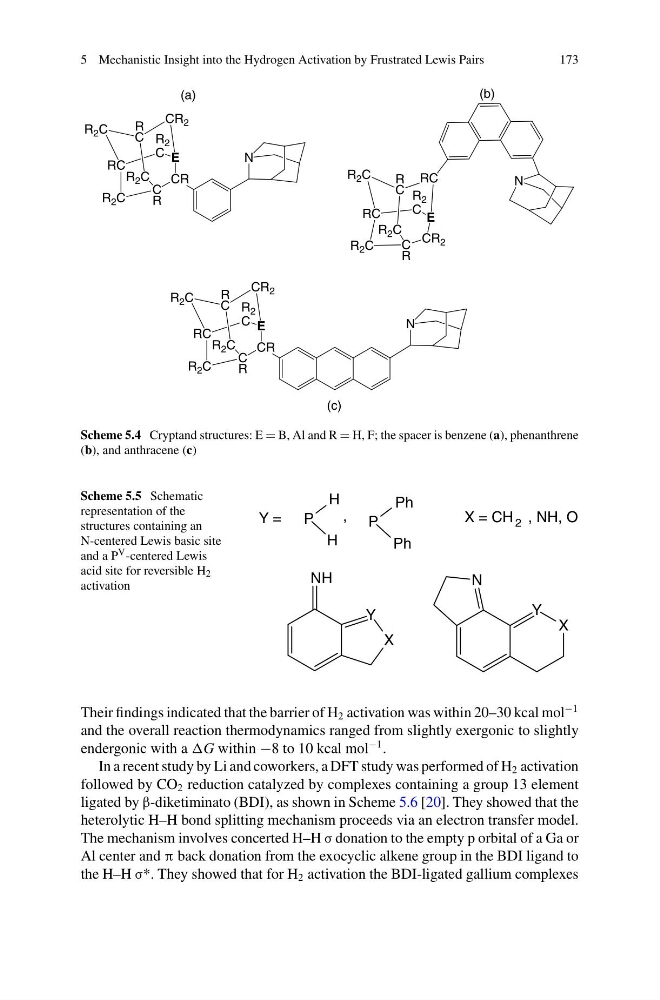
Scheme 5.4 Cryptand structures: E = B, Al and R = H, F; the spacer is benzene (a), phenanthrene
(b), and anthracene (c)
Scheme 5.5 Schematic
representation of the
structures containing an
N-centered Lewis basic site
and a P V -centered Lewis
acid site for reversible H 2
activation
X
Y
NH
N
X
Y
P
Ph
Ph
Y = P
H
H
X = CH 2 , NH, O
,
Their findings indicated that the barrier of H 2 activation was within 20–30 kcal mol
−1
and the overall reaction thermodynamics ranged from slightly exergonic to slightly
endergonic with a within −8 to 10 kcal mol
−1 .
In a recent study by Li and coworkers, a DFT study was performed of H 2 activation
followed by CO 2 reduction catalyzed by complexes containing a group 13 element
ligated by β-diketiminato (BDI), as shown in Scheme 5.6 [20]. They showed that the
heterolytic H–H bond splitting mechanism proceeds via an electron transfer model.
The mechanism involves concerted H–H σ donation to the empty p orbital of a Ga or
Al center and π back donation from the exocyclic alkene group in the BDI ligand to
the H–H σ*. They showed that for H 2 activation the BDI-ligated gallium complexes
173
N
CR
E
R 2
C
RC
R 2 C
C
R
CR 2
R
C
R 2 C
R 2 C
N
CR 2
E
R 2
C
RC
R 2 C
C
R
RC
R
C
R 2 C
R 2 C
N
CR
E
R 2
C
RC
R 2 C
C
R
CR 2
R
C
R 2 C
R 2 C
(a)
(b)
(c)
Scheme 5.4 Cryptand structures: E = B, Al and R = H, F; the spacer is benzene (a), phenanthrene
(b), and anthracene (c)
Scheme 5.5 Schematic
representation of the
structures containing an
N-centered Lewis basic site
and a P V -centered Lewis
acid site for reversible H 2
activation
X
Y
NH
N
X
Y
P
Ph
Ph
Y = P
H
H
X = CH 2 , NH, O
,
Their findings indicated that the barrier of H 2 activation was within 20–30 kcal mol
−1
and the overall reaction thermodynamics ranged from slightly exergonic to slightly
endergonic with a within −8 to 10 kcal mol
−1 .
In a recent study by Li and coworkers, a DFT study was performed of H 2 activation
followed by CO 2 reduction catalyzed by complexes containing a group 13 element
ligated by β-diketiminato (BDI), as shown in Scheme 5.6 [20]. They showed that the
heterolytic H–H bond splitting mechanism proceeds via an electron transfer model.
The mechanism involves concerted H–H σ donation to the empty p orbital of a Ga or
Al center and π back donation from the exocyclic alkene group in the BDI ligand to
the H–H σ*. They showed that for H 2 activation the BDI-ligated gallium complexes