

146
Y. Soltani and F.-G. Fontaine
NHMe 2
B
Ar
NMe 2
B
Ar
- H-H
Int44
F
F
F
F
F
F
F
F
S
S
Me
N
Me
24 h, 80 °C
24 h, 80 °C
24 h, -10 °C
1 h, rt
<5 min, 60 °C
24 h, -10 °C
1 h, rt
<5 min, 60 °C
24 h, -10 °C
1 h, rt
<5 min, 60 °C
H
C 6 F 5
C 6 F 5
NMe 2
B
C 6 F 5
17
H
Ar-H (neat)
>95%
Ar
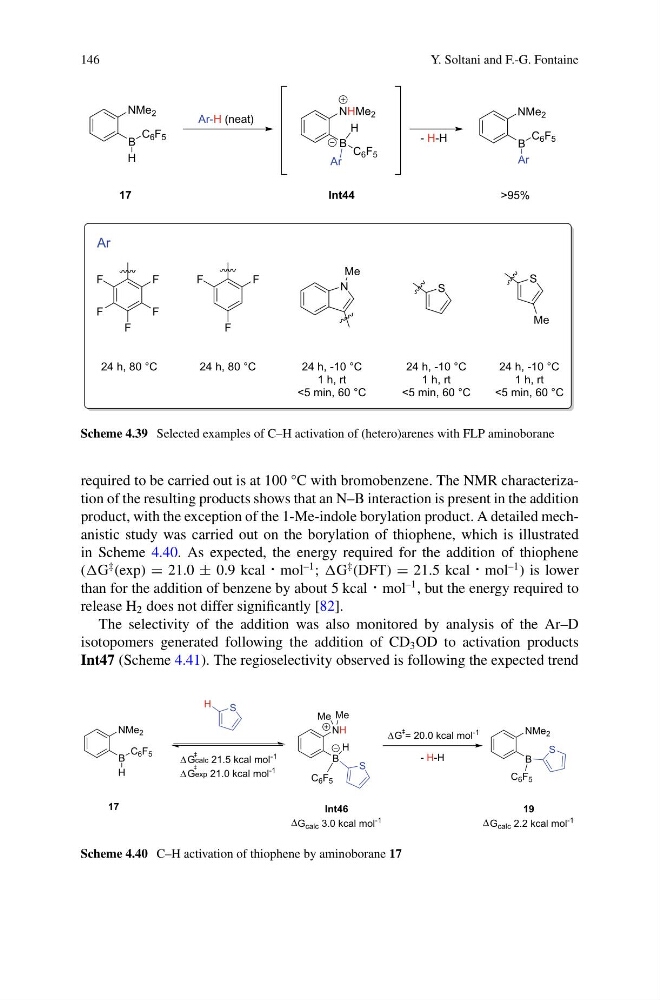
Scheme 4.39 Selected examples of C–H activation of (hetero)arenes with FLP aminoborane
required to be carried out is at 100 °C with bromobenzene. The NMR characterization of the resulting products shows that an N–B interaction is present in the addition
product, with the exception of the 1-Me-indole borylation product. A detailed mechanistic study was carried out on the borylation of thiophene, which is illustrated
in Scheme 4.40. As expected, the energy required for the addition of thiophene
(
‡ (exp) = 21.0 ± 0.9 kcal‧mol
–1 ;
‡ (DFT) = 21.5 kcal‧mol
–1 ) is lower
than for the addition of benzene by about 5 kcal‧mol
–1 , but the energy required to
release H 2 does not differ significantly [82].
The selectivity of the addition was also monitored by analysis of the Ar–D
isotopomers generated following the addition of CD 3 OD to activation products
Int47 (Scheme 4.41). The regioselectivity observed is following the expected trend
NMe 2
B
C 6 F 5
S
NH
B
C 6 F 5
S
NMe 2
B
C 6 F 5
S
G = 20.0 kcal mol
-1
- H-H
19
G calc 2.2 kcal mol
-1
Int46
G calc 3.0 kcal mol
-1
Gcalc 21.5 kcal mol
-1
Gexp 21.0 kcal mol
-1
H
H
H
17
Me Me
Δ
Δ
Δ
Δ
Δ
Scheme 4.40 C–H activation of thiophene by aminoborane 17
Y. Soltani and F.-G. Fontaine
NHMe 2
B
Ar
NMe 2
B
Ar
- H-H
Int44
F
F
F
F
F
F
F
F
S
S
Me
N
Me
24 h, 80 °C
24 h, 80 °C
24 h, -10 °C
1 h, rt
<5 min, 60 °C
24 h, -10 °C
1 h, rt
<5 min, 60 °C
24 h, -10 °C
1 h, rt
<5 min, 60 °C
H
C 6 F 5
C 6 F 5
NMe 2
B
C 6 F 5
17
H
Ar-H (neat)
>95%
Ar
Scheme 4.39 Selected examples of C–H activation of (hetero)arenes with FLP aminoborane
required to be carried out is at 100 °C with bromobenzene. The NMR characterization of the resulting products shows that an N–B interaction is present in the addition
product, with the exception of the 1-Me-indole borylation product. A detailed mechanistic study was carried out on the borylation of thiophene, which is illustrated
in Scheme 4.40. As expected, the energy required for the addition of thiophene
(
‡ (exp) = 21.0 ± 0.9 kcal‧mol
–1 ;
‡ (DFT) = 21.5 kcal‧mol
–1 ) is lower
than for the addition of benzene by about 5 kcal‧mol
–1 , but the energy required to
release H 2 does not differ significantly [82].
The selectivity of the addition was also monitored by analysis of the Ar–D
isotopomers generated following the addition of CD 3 OD to activation products
Int47 (Scheme 4.41). The regioselectivity observed is following the expected trend
NMe 2
B
C 6 F 5
S
NH
B
C 6 F 5
S
NMe 2
B
C 6 F 5
S
G = 20.0 kcal mol
-1
- H-H
19
G calc 2.2 kcal mol
-1
Int46
G calc 3.0 kcal mol
-1
Gcalc 21.5 kcal mol
-1
Gexp 21.0 kcal mol
-1
H
H
H
17
Me Me
Δ
Δ
Δ
Δ
Δ
Scheme 4.40 C–H activation of thiophene by aminoborane 17