

4 FLP-Mediated C–H-Activation
145
4.6.1 C–H Activation of Arenes with Aminoborane FLPs
Parallel to the work of Fontaine, Repo and co-workers used stoichiometric amounts
of various 2-aminophenylborane derivatives to activate the C–H bonds of arenes
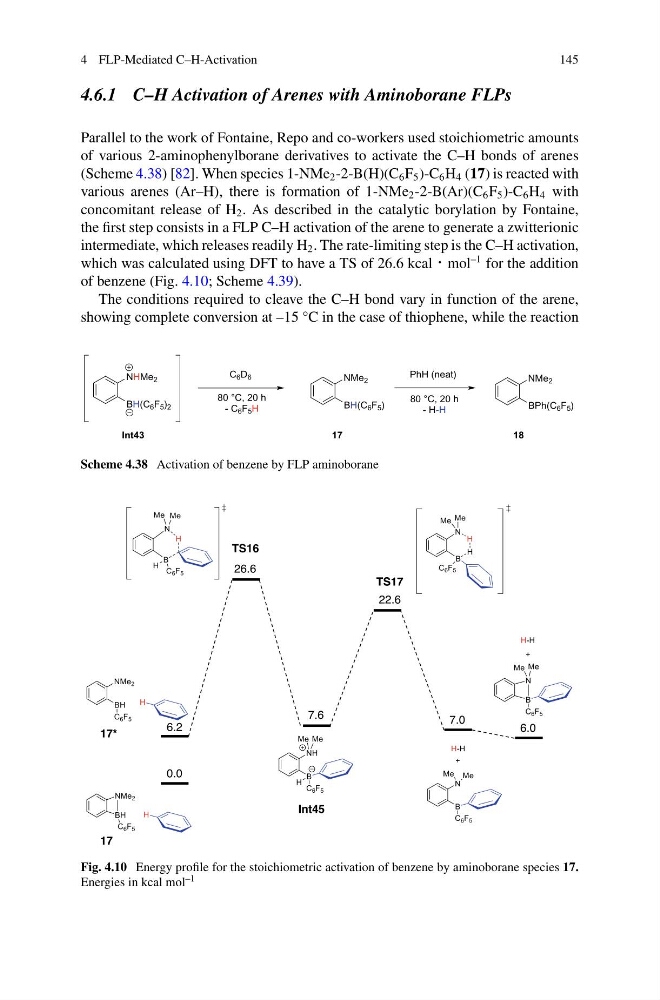
(Scheme 4.38) [82]. When species 1-NMe 2 -2-B(H)(C 6 F 5 )-C 6 H 4 (17) is reacted with
various arenes (Ar–H), there is formation of 1-NMe 2 -2-B(Ar)(C 6 F 5 )-C 6 H 4 with
concomitant release of H 2 . As described in the catalytic borylation by Fontaine,
the first step consists in a FLP C–H activation of the arene to generate a zwitterionic
intermediate, which releases readily H 2 . The rate-limiting step is the C–H activation,
which was calculated using DFT to have a TS of 26.6 kcal‧mol
–1 for the addition
of benzene (Fig. 4.10; Scheme 4.39).
The conditions required to cleave the C–H bond vary in function of the arene,
showing complete conversion at –15 °C in the case of thiophene, while the reaction
NHMe 2
BH(C 6 F 5 ) 2
80 °C, 20 h
- C 6 F 5 H
NMe 2
BH(C 6 F 5 )
PhH (neat)
80 °C, 20 h
- H-H
NMe 2
BPh(C 6 F 5 )
17
Int43
18
C 6 D 6
Scheme 4.38 Activation of benzene by FLP aminoborane
Fig. 4.10 Energy profile for the stoichiometric activation of benzene by aminoborane species 17.
Energies in kcal mol –1
145
4.6.1 C–H Activation of Arenes with Aminoborane FLPs
Parallel to the work of Fontaine, Repo and co-workers used stoichiometric amounts
of various 2-aminophenylborane derivatives to activate the C–H bonds of arenes
(Scheme 4.38) [82]. When species 1-NMe 2 -2-B(H)(C 6 F 5 )-C 6 H 4 (17) is reacted with
various arenes (Ar–H), there is formation of 1-NMe 2 -2-B(Ar)(C 6 F 5 )-C 6 H 4 with
concomitant release of H 2 . As described in the catalytic borylation by Fontaine,
the first step consists in a FLP C–H activation of the arene to generate a zwitterionic
intermediate, which releases readily H 2 . The rate-limiting step is the C–H activation,
which was calculated using DFT to have a TS of 26.6 kcal‧mol
–1 for the addition
of benzene (Fig. 4.10; Scheme 4.39).
The conditions required to cleave the C–H bond vary in function of the arene,
showing complete conversion at –15 °C in the case of thiophene, while the reaction
NHMe 2
BH(C 6 F 5 ) 2
80 °C, 20 h
- C 6 F 5 H
NMe 2
BH(C 6 F 5 )
PhH (neat)
80 °C, 20 h
- H-H
NMe 2
BPh(C 6 F 5 )
17
Int43
18
C 6 D 6
Scheme 4.38 Activation of benzene by FLP aminoborane
Fig. 4.10 Energy profile for the stoichiometric activation of benzene by aminoborane species 17.
Energies in kcal mol –1