

144
Y. Soltani and F.-G. Fontaine
B
[N]
H
H
B H
H
[N]
16
0 (0)
BH 2
[N]
B
[N]
H
H
N
Me
H
BH
[N]
N Me
HBPin
N
Me
BPin
Int41
3.3 (-4.9)
16*
7.1 (13.0)
N
Me
H-H
TS14
24.4 (14.6)
Int42
0.5 (4.3)
TS15
14.2 (4.1)
-1.8 (-6.5)
k H / k D = 1.8
Overall:
k H / k D = 1.9
H
N
B
H
N
Me
H H
N
B
N
Me
H
H
BPin
TS15
TS14
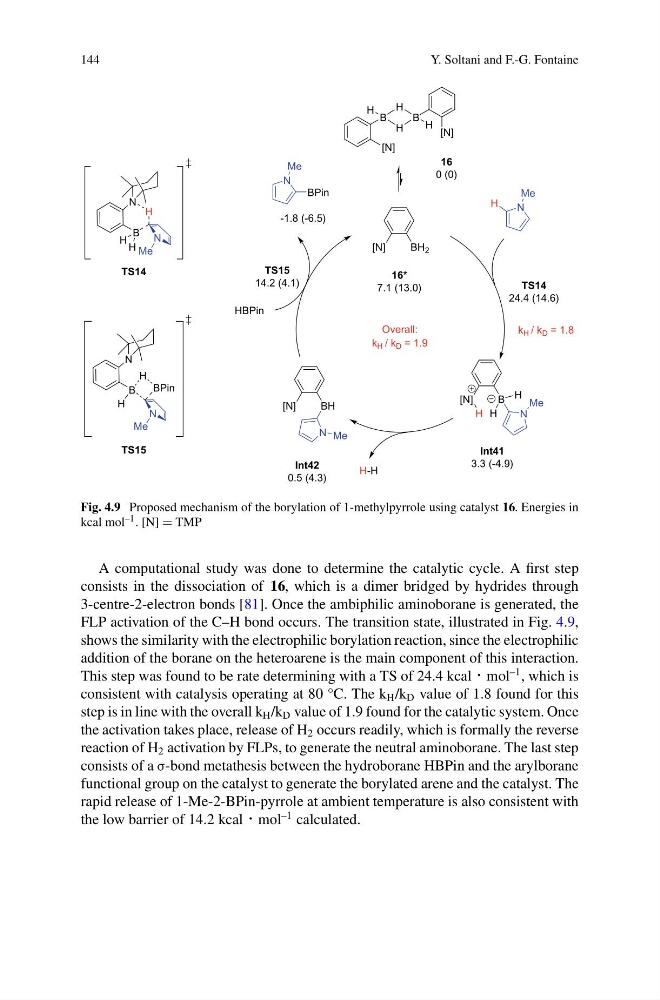
Fig. 4.9 Proposed mechanism of the borylation of 1-methylpyrrole using catalyst 16. Energies in
kcal mol –1 . [N] = TMP
A computational study was done to determine the catalytic cycle. A first step
consists in the dissociation of 16, which is a dimer bridged by hydrides through
3-centre-2-electron bonds [81]. Once the ambiphilic aminoborane is generated, the
FLP activation of the C–H bond occurs. The transition state, illustrated in Fig. 4.9,
shows the similarity with the electrophilic borylation reaction, since the electrophilic
addition of the borane on the heteroarene is the main component of this interaction.
This step was found to be rate determining with a TS of 24.4 kcal‧mol
–1 , which is
consistent with catalysis operating at 80 °C. The k H /k D value of 1.8 found for this
step is in line with the overall k H /k D value of 1.9 found for the catalytic system. Once
the activation takes place, release of H 2 occurs readily, which is formally the reverse
reaction of H 2 activation by FLPs, to generate the neutral aminoborane. The last step
consists of a σ-bond metathesis between the hydroborane HBPin and the arylborane
functional group on the catalyst to generate the borylated arene and the catalyst. The
rapid release of 1-Me-2-BPin-pyrrole at ambient temperature is also consistent with
the low barrier of 14.2 kcal‧mol
–1 calculated.
Y. Soltani and F.-G. Fontaine
B
[N]
H
H
B H
H
[N]
16
0 (0)
BH 2
[N]
B
[N]
H
H
N
Me
H
BH
[N]
N Me
HBPin
N
Me
BPin
Int41
3.3 (-4.9)
16*
7.1 (13.0)
N
Me
H-H
TS14
24.4 (14.6)
Int42
0.5 (4.3)
TS15
14.2 (4.1)
-1.8 (-6.5)
k H / k D = 1.8
Overall:
k H / k D = 1.9
H
N
B
H
N
Me
H H
N
B
N
Me
H
H
BPin
TS15
TS14
Fig. 4.9 Proposed mechanism of the borylation of 1-methylpyrrole using catalyst 16. Energies in
kcal mol –1 . [N] = TMP
A computational study was done to determine the catalytic cycle. A first step
consists in the dissociation of 16, which is a dimer bridged by hydrides through
3-centre-2-electron bonds [81]. Once the ambiphilic aminoborane is generated, the
FLP activation of the C–H bond occurs. The transition state, illustrated in Fig. 4.9,
shows the similarity with the electrophilic borylation reaction, since the electrophilic
addition of the borane on the heteroarene is the main component of this interaction.
This step was found to be rate determining with a TS of 24.4 kcal‧mol
–1 , which is
consistent with catalysis operating at 80 °C. The k H /k D value of 1.8 found for this
step is in line with the overall k H /k D value of 1.9 found for the catalytic system. Once
the activation takes place, release of H 2 occurs readily, which is formally the reverse
reaction of H 2 activation by FLPs, to generate the neutral aminoborane. The last step
consists of a σ-bond metathesis between the hydroborane HBPin and the arylborane
functional group on the catalyst to generate the borylated arene and the catalyst. The
rapid release of 1-Me-2-BPin-pyrrole at ambient temperature is also consistent with
the low barrier of 14.2 kcal‧mol
–1 calculated.