

4 FLP-Mediated C–H-Activation
139
steric hindrance of the PMP is required for this chemistry to proceed, since even
di-iso-propylethylamine and 2,6-di-tert-butylpyridine did not react with terminal
alkynes. However, this approach did operate with a large range of terminal alkynes,
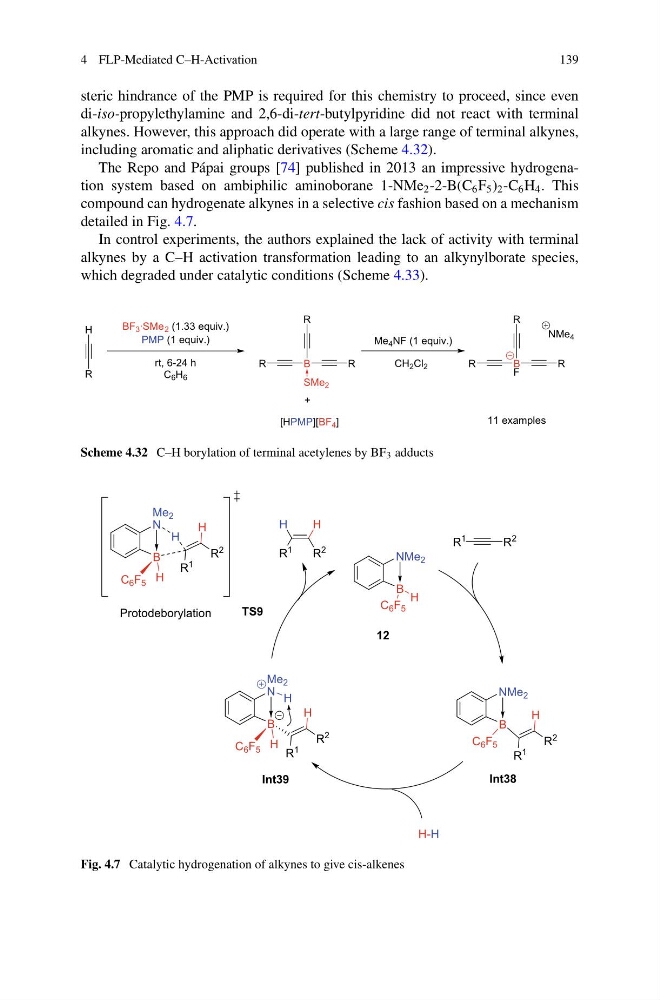
including aromatic and aliphatic derivatives (Scheme 4.32).
The Repo and Pápai groups [74] published in 2013 an impressive hydrogenation system based on ambiphilic aminoborane 1-NMe 2 -2-B(C 6 F 5 ) 2 -C 6 H 4 . This
compound can hydrogenate alkynes in a selective cis fashion based on a mechanism
detailed in Fig. 4.7.
In control experiments, the authors explained the lack of activity with terminal
alkynes by a C–H activation transformation leading to an alkynylborate species,
which degraded under catalytic conditions (Scheme 4.33).
H
R
BF 3 ·SMe 2 (1.33 equiv.)
PMP (1 equiv.)
rt, 6-24 h
C 6 H 6
B
SMe 2
R
R
R
[HPMP][BF 4 ]
+
Me 4 NF (1 equiv.)
B
F
R
R
R
NMe 4
CH 2 Cl 2
11 examples
Scheme 4.32 C–H borylation of terminal acetylenes by BF 3 adducts
Me 2
N
B
C 6 F 5
R
1
R
2
H
H
H
NMe 2
B
C 6 F 5
R
1
R
2
H
NMe 2
B H
C 6 F 5
R
2
R
1
H-H
R
1
H
H
R
2
12
Int38
Int39
TS9
Me 2
N
B
C 6 F 5
R
1
R
2
H
H
H
Protodeborylation
Fig. 4.7 Catalytic hydrogenation of alkynes to give cis-alkenes
139
steric hindrance of the PMP is required for this chemistry to proceed, since even
di-iso-propylethylamine and 2,6-di-tert-butylpyridine did not react with terminal
alkynes. However, this approach did operate with a large range of terminal alkynes,
including aromatic and aliphatic derivatives (Scheme 4.32).
The Repo and Pápai groups [74] published in 2013 an impressive hydrogenation system based on ambiphilic aminoborane 1-NMe 2 -2-B(C 6 F 5 ) 2 -C 6 H 4 . This
compound can hydrogenate alkynes in a selective cis fashion based on a mechanism
detailed in Fig. 4.7.
In control experiments, the authors explained the lack of activity with terminal
alkynes by a C–H activation transformation leading to an alkynylborate species,
which degraded under catalytic conditions (Scheme 4.33).
H
R
BF 3 ·SMe 2 (1.33 equiv.)
PMP (1 equiv.)
rt, 6-24 h
C 6 H 6
B
SMe 2
R
R
R
[HPMP][BF 4 ]
+
Me 4 NF (1 equiv.)
B
F
R
R
R
NMe 4
CH 2 Cl 2
11 examples
Scheme 4.32 C–H borylation of terminal acetylenes by BF 3 adducts
Me 2
N
B
C 6 F 5
R
1
R
2
H
H
H
NMe 2
B
C 6 F 5
R
1
R
2
H
NMe 2
B H
C 6 F 5
R
2
R
1
H-H
R
1
H
H
R
2
12
Int38
Int39
TS9
Me 2
N
B
C 6 F 5
R
1
R
2
H
H
H
Protodeborylation
Fig. 4.7 Catalytic hydrogenation of alkynes to give cis-alkenes