

138
Y. Soltani and F.-G. Fontaine
acid to generate intermediate Int35, which will generate 9 after an aryl migration
reminiscent of a Wagner-Meerwein rearrangement.
In 2012, Stephan demonstrated that similar FLP reactivity was observed with
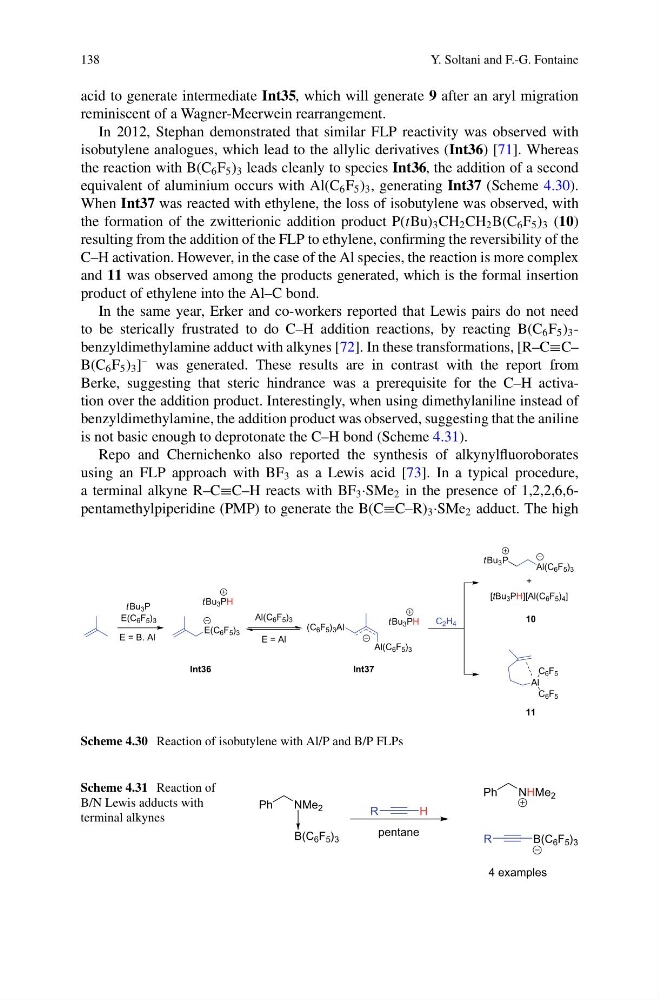
isobutylene analogues, which lead to the allylic derivatives (Int36) [71]. Whereas
the reaction with B(C 6 F 5 ) 3 leads cleanly to species Int36, the addition of a second
equivalent of aluminium occurs with Al(C 6 F 5 ) 3 , generating Int37 (Scheme 4.30).
When Int37 was reacted with ethylene, the loss of isobutylene was observed, with
the formation of the zwitterionic addition product P(tBu) 3 CH 2 CH 2 B(C 6 F 5 ) 3 (10)
resulting from the addition of the FLP to ethylene, confirming the reversibility of the
C–H activation. However, in the case of the Al species, the reaction is more complex
and 11 was observed among the products generated, which is the formal insertion
product of ethylene into the Al–C bond.
In the same year, Erker and co-workers reported that Lewis pairs do not need
to be sterically frustrated to do C–H addition reactions, by reacting B(C 6 F 5 ) 3 -
benzyldimethylamine adduct with alkynes [72]. In these transformations, [R–C≡C–
B(C 6 F 5 ) 3 ]
– was generated. These results are in contrast with the report from
Berke, suggesting that steric hindrance was a prerequisite for the C–H activation over the addition product. Interestingly, when using dimethylaniline instead of
benzyldimethylamine, the addition product was observed, suggesting that the aniline
is not basic enough to deprotonate the C–H bond (Scheme 4.31).
Repo and Chernichenko also reported the synthesis of alkynylfluoroborates
using an FLP approach with BF 3 as a Lewis acid [73]. In a typical procedure,
a terminal alkyne R–C≡C–H reacts with BF 3 ·SMe 2 in the presence of 1,2,2,6,6pentamethylpiperidine (PMP) to generate the B(C≡C–R) 3 ·SMe 2 adduct. The high
E = B. Al
Al(C 6 F 5 ) 3
tBu 3 P
E(C 6 F 5 ) 3
Al(C 6 F 5 ) 3
P
tBu 3
Al
C 6 F 5
C 6 F 5
[tBu 3 PH][Al(C 6 F 5 ) 4 ]
+
E(C 6 F 5 ) 3
tBu 3 PH
Int36
E = Al
(C 6 F 5 ) 3 Al
Al(C 6 F 5 ) 3
tBu 3 PH
Int37
10
11
C 2 H 4
Scheme 4.30 Reaction of isobutylene with Al/P and B/P FLPs
Scheme 4.31 Reaction of
B/N Lewis adducts with
terminal alkynes
Ph
NMe 2
B(C 6 F 5 ) 3
R
pentane
Ph
NHMe 2
R
B(C 6 F 5 ) 3
H
4 examples
Y. Soltani and F.-G. Fontaine
acid to generate intermediate Int35, which will generate 9 after an aryl migration
reminiscent of a Wagner-Meerwein rearrangement.
In 2012, Stephan demonstrated that similar FLP reactivity was observed with
isobutylene analogues, which lead to the allylic derivatives (Int36) [71]. Whereas
the reaction with B(C 6 F 5 ) 3 leads cleanly to species Int36, the addition of a second
equivalent of aluminium occurs with Al(C 6 F 5 ) 3 , generating Int37 (Scheme 4.30).
When Int37 was reacted with ethylene, the loss of isobutylene was observed, with
the formation of the zwitterionic addition product P(tBu) 3 CH 2 CH 2 B(C 6 F 5 ) 3 (10)
resulting from the addition of the FLP to ethylene, confirming the reversibility of the
C–H activation. However, in the case of the Al species, the reaction is more complex
and 11 was observed among the products generated, which is the formal insertion
product of ethylene into the Al–C bond.
In the same year, Erker and co-workers reported that Lewis pairs do not need
to be sterically frustrated to do C–H addition reactions, by reacting B(C 6 F 5 ) 3 -
benzyldimethylamine adduct with alkynes [72]. In these transformations, [R–C≡C–
B(C 6 F 5 ) 3 ]
– was generated. These results are in contrast with the report from
Berke, suggesting that steric hindrance was a prerequisite for the C–H activation over the addition product. Interestingly, when using dimethylaniline instead of
benzyldimethylamine, the addition product was observed, suggesting that the aniline
is not basic enough to deprotonate the C–H bond (Scheme 4.31).
Repo and Chernichenko also reported the synthesis of alkynylfluoroborates
using an FLP approach with BF 3 as a Lewis acid [73]. In a typical procedure,
a terminal alkyne R–C≡C–H reacts with BF 3 ·SMe 2 in the presence of 1,2,2,6,6pentamethylpiperidine (PMP) to generate the B(C≡C–R) 3 ·SMe 2 adduct. The high
E = B. Al
Al(C 6 F 5 ) 3
tBu 3 P
E(C 6 F 5 ) 3
Al(C 6 F 5 ) 3
P
tBu 3
Al
C 6 F 5
C 6 F 5
[tBu 3 PH][Al(C 6 F 5 ) 4 ]
+
E(C 6 F 5 ) 3
tBu 3 PH
Int36
E = Al
(C 6 F 5 ) 3 Al
Al(C 6 F 5 ) 3
tBu 3 PH
Int37
10
11
C 2 H 4
Scheme 4.30 Reaction of isobutylene with Al/P and B/P FLPs
Scheme 4.31 Reaction of
B/N Lewis adducts with
terminal alkynes
Ph
NMe 2
B(C 6 F 5 ) 3
R
pentane
Ph
NHMe 2
R
B(C 6 F 5 ) 3
H
4 examples