

134
Y. Soltani and F.-G. Fontaine
N
R
3
R
2
R
1
B(C 6 F 5 ) 3 (2.5 mol%)
Ph 2 SiH 2 (3 equiv.)
120 °C, 24 h
PhCl
N
SiPh 2 H
R
3
R
2
R
1
N
Me
SiPh 2 H
N
Me
N
alkyl
alkyl
SiPh 2 H
N
Me
Ph
SiPh 2 H
N
SiPh 2 H
N
Me
Me
SiPh 2 H
N
Me
Me
SiPh 2 H
N
Ph
Ph
SiPh 2 H
N
Me
Me
Me
SiPh 2 H
N
alkyl
alkyl
SiPh 2 H
R
N
alkyl
alkyl
SiPh 2 H
R
N
Me
Et
SiPh 2 H
N
Me
OTIPS
N
Et
Et
SiPh 2 H
N
O
41%
2 examples
86-90%
90%
45%
<10%
0%
75%
54%
73%
n
7 examples
71-82%
8 examples
35-92%
3 examples
60-63%
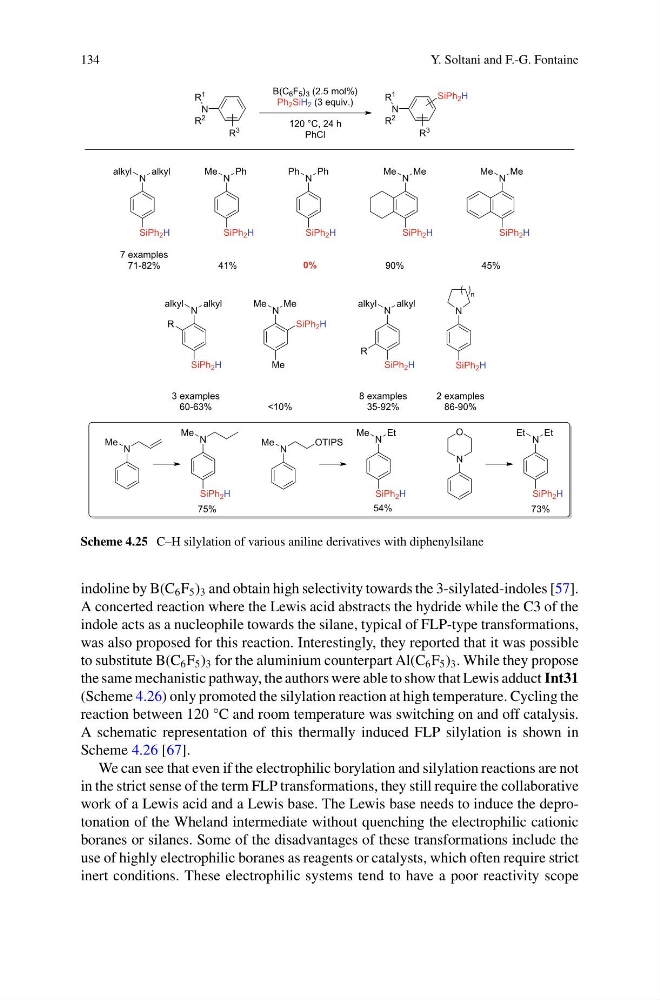
Scheme 4.25 C–H silylation of various aniline derivatives with diphenylsilane
indoline by B(C 6 F 5 ) 3 and obtain high selectivity towards the 3-silylated-indoles [57].
A concerted reaction where the Lewis acid abstracts the hydride while the C3 of the
indole acts as a nucleophile towards the silane, typical of FLP-type transformations,
was also proposed for this reaction. Interestingly, they reported that it was possible
to substitute B(C 6 F 5 ) 3 for the aluminium counterpart Al(C 6 F 5 ) 3 . While they propose
the same mechanistic pathway, the authors were able to show that Lewis adduct Int31
(Scheme 4.26) only promoted the silylation reaction at high temperature. Cycling the
reaction between 120 °C and room temperature was switching on and off catalysis.
A schematic representation of this thermally induced FLP silylation is shown in
Scheme 4.26 [67].
We can see that even if the electrophilic borylation and silylation reactions are not
in the strict sense of the term FLP transformations, they still require the collaborative
work of a Lewis acid and a Lewis base. The Lewis base needs to induce the deprotonation of the Wheland intermediate without quenching the electrophilic cationic
boranes or silanes. Some of the disadvantages of these transformations include the
use of highly electrophilic boranes as reagents or catalysts, which often require strict
inert conditions. These electrophilic systems tend to have a poor reactivity scope
Y. Soltani and F.-G. Fontaine
N
R
3
R
2
R
1
B(C 6 F 5 ) 3 (2.5 mol%)
Ph 2 SiH 2 (3 equiv.)
120 °C, 24 h
PhCl
N
SiPh 2 H
R
3
R
2
R
1
N
Me
SiPh 2 H
N
Me
N
alkyl
alkyl
SiPh 2 H
N
Me
Ph
SiPh 2 H
N
SiPh 2 H
N
Me
Me
SiPh 2 H
N
Me
Me
SiPh 2 H
N
Ph
Ph
SiPh 2 H
N
Me
Me
Me
SiPh 2 H
N
alkyl
alkyl
SiPh 2 H
R
N
alkyl
alkyl
SiPh 2 H
R
N
Me
Et
SiPh 2 H
N
Me
OTIPS
N
Et
Et
SiPh 2 H
N
O
41%
2 examples
86-90%
90%
45%
<10%
0%
75%
54%
73%
n
7 examples
71-82%
8 examples
35-92%
3 examples
60-63%
Scheme 4.25 C–H silylation of various aniline derivatives with diphenylsilane
indoline by B(C 6 F 5 ) 3 and obtain high selectivity towards the 3-silylated-indoles [57].
A concerted reaction where the Lewis acid abstracts the hydride while the C3 of the
indole acts as a nucleophile towards the silane, typical of FLP-type transformations,
was also proposed for this reaction. Interestingly, they reported that it was possible
to substitute B(C 6 F 5 ) 3 for the aluminium counterpart Al(C 6 F 5 ) 3 . While they propose
the same mechanistic pathway, the authors were able to show that Lewis adduct Int31
(Scheme 4.26) only promoted the silylation reaction at high temperature. Cycling the
reaction between 120 °C and room temperature was switching on and off catalysis.
A schematic representation of this thermally induced FLP silylation is shown in
Scheme 4.26 [67].
We can see that even if the electrophilic borylation and silylation reactions are not
in the strict sense of the term FLP transformations, they still require the collaborative
work of a Lewis acid and a Lewis base. The Lewis base needs to induce the deprotonation of the Wheland intermediate without quenching the electrophilic cationic
boranes or silanes. Some of the disadvantages of these transformations include the
use of highly electrophilic boranes as reagents or catalysts, which often require strict
inert conditions. These electrophilic systems tend to have a poor reactivity scope