

4 FLP-Mediated C–H-Activation
133
B(C 6 F 5 ) 3 (1 equiv.)
Cl 2 -py (1 equiv.)
Ph 3 SiH (1 equiv.)
20 °C, CH 2 Cl 2
E
E
SiPh 3
E
SiPh 3
+
N
TIPS
S
tBu
N
TIPS
59%
19%
54%
32%
42%
45%
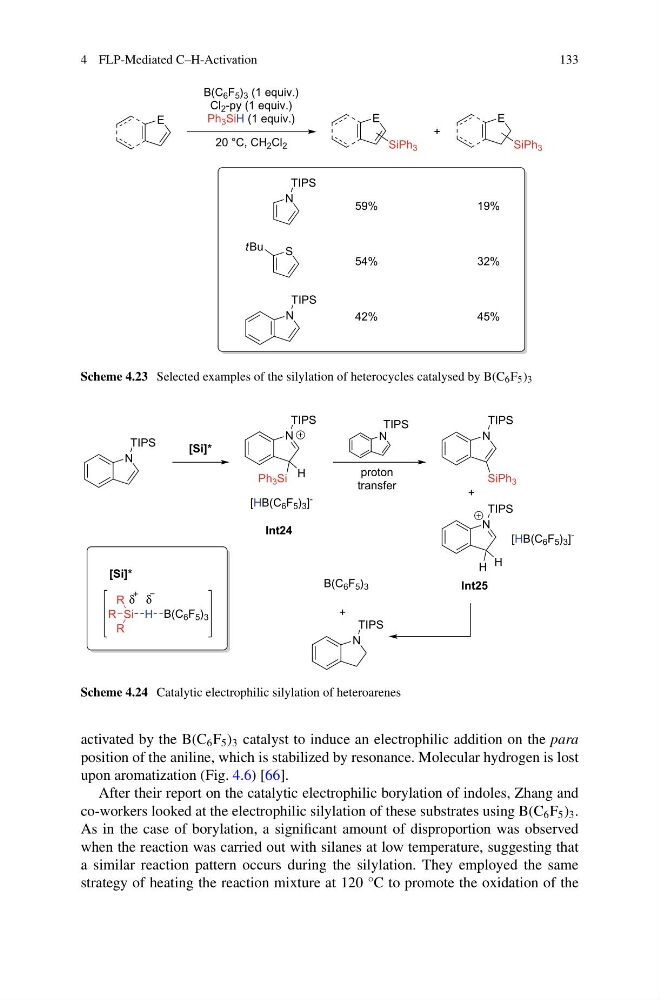
Scheme 4.23 Selected examples of the silylation of heterocycles catalysed by B(C 6 F 5 ) 3
N
TIPS
[Si]*
[Si]*
N
TIPS
Ph 3 Si H
N
TIPS
N
TIPS
N
TIPS
H H
[HB(C 6 F 5 ) 3 ]
-
+
[HB(C 6 F 5 ) 3 ]
-
N
TIPS
+
B(C 6 F 5 ) 3
Si H
R
R
R
B(C 6 F 5 ) 3
proton
transfer
SiPh 3
Int24
Int25
δ δ
Scheme 4.24 Catalytic electrophilic silylation of heteroarenes
activated by the B(C 6 F 5 ) 3 catalyst to induce an electrophilic addition on the para
position of the aniline, which is stabilized by resonance. Molecular hydrogen is lost
upon aromatization (Fig. 4.6) [66].
After their report on the catalytic electrophilic borylation of indoles, Zhang and
co-workers looked at the electrophilic silylation of these substrates using B(C 6 F 5 ) 3 .
As in the case of borylation, a significant amount of disproportion was observed
when the reaction was carried out with silanes at low temperature, suggesting that
a similar reaction pattern occurs during the silylation. They employed the same
strategy of heating the reaction mixture at 120 °C to promote the oxidation of the
133
B(C 6 F 5 ) 3 (1 equiv.)
Cl 2 -py (1 equiv.)
Ph 3 SiH (1 equiv.)
20 °C, CH 2 Cl 2
E
E
SiPh 3
E
SiPh 3
+
N
TIPS
S
tBu
N
TIPS
59%
19%
54%
32%
42%
45%
Scheme 4.23 Selected examples of the silylation of heterocycles catalysed by B(C 6 F 5 ) 3
N
TIPS
[Si]*
[Si]*
N
TIPS
Ph 3 Si H
N
TIPS
N
TIPS
N
TIPS
H H
[HB(C 6 F 5 ) 3 ]
-
+
[HB(C 6 F 5 ) 3 ]
-
N
TIPS
+
B(C 6 F 5 ) 3
Si H
R
R
R
B(C 6 F 5 ) 3
proton
transfer
SiPh 3
Int24
Int25
δ δ
Scheme 4.24 Catalytic electrophilic silylation of heteroarenes
activated by the B(C 6 F 5 ) 3 catalyst to induce an electrophilic addition on the para
position of the aniline, which is stabilized by resonance. Molecular hydrogen is lost
upon aromatization (Fig. 4.6) [66].
After their report on the catalytic electrophilic borylation of indoles, Zhang and
co-workers looked at the electrophilic silylation of these substrates using B(C 6 F 5 ) 3 .
As in the case of borylation, a significant amount of disproportion was observed
when the reaction was carried out with silanes at low temperature, suggesting that
a similar reaction pattern occurs during the silylation. They employed the same
strategy of heating the reaction mixture at 120 °C to promote the oxidation of the