

132
Y. Soltani and F.-G. Fontaine
SiPh 2 H
tBu
tBu
oxidant
base
rt, CH 2 Cl 2
-Ph 3 CH
SiPh 2
t Bu
tBu
Ar
SiPh 2
HO
Ar
SiPh 2
O
SiPh 2
Ar
+
+
Ar:
t Bu
tBu
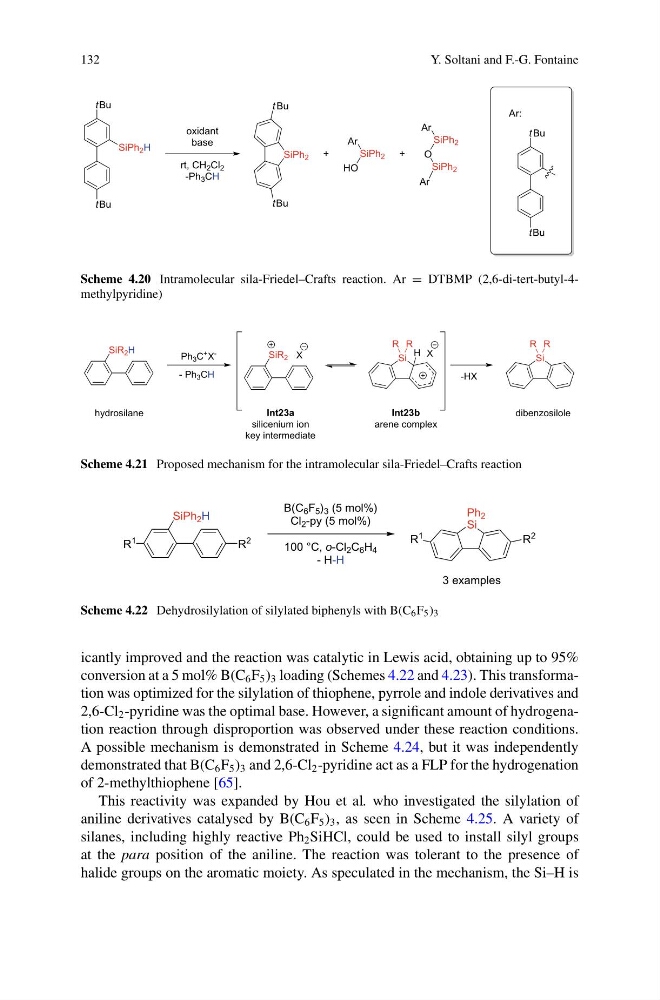
Scheme 4.20 Intramolecular sila-Friedel–Crafts reaction. Ar = DTBMP (2,6-di-tert-butyl-4methylpyridine)
Si
R R
SiR 2 H
SiR 2
Si
R
R
H
Ph 3 C
+ X
-
-HX
dibenzosilole
Int23b
arene complex
Int23a
silicenium ion
key intermediate
hydrosilane
X
X
- Ph 3 CH
Scheme 4.21 Proposed mechanism for the intramolecular sila-Friedel–Crafts reaction
SiPh 2 H
R
1
B(C 6 F 5 ) 3 (5 mol%)
Cl 2 -py (5 mol%)
100 °C, o-Cl 2 C 6 H 4
- H-H
Ph 2
Si
R
1
R
2
R
2
3 examples
Scheme 4.22 Dehydrosilylation of silylated biphenyls with B(C 6 F 5 ) 3
icantly improved and the reaction was catalytic in Lewis acid, obtaining up to 95%
conversion at a 5 mol% B(C 6 F 5 ) 3 loading (Schemes 4.22 and 4.23). This transformation was optimized for the silylation of thiophene, pyrrole and indole derivatives and
2,6-Cl 2 -pyridine was the optimal base. However, a significant amount of hydrogenation reaction through disproportion was observed under these reaction conditions.
A possible mechanism is demonstrated in Scheme 4.24, but it was independently
demonstrated that B(C 6 F 5 ) 3 and 2,6-Cl 2 -pyridine act as a FLP for the hydrogenation
of 2-methylthiophene [65].
This reactivity was expanded by Hou et al. who investigated the silylation of
aniline derivatives catalysed by B(C 6 F 5 ) 3 , as seen in Scheme 4.25. A variety of
silanes, including highly reactive Ph 2 SiHCl, could be used to install silyl groups
at the para position of the aniline. The reaction was tolerant to the presence of
halide groups on the aromatic moiety. As speculated in the mechanism, the Si–H is
Y. Soltani and F.-G. Fontaine
SiPh 2 H
tBu
tBu
oxidant
base
rt, CH 2 Cl 2
-Ph 3 CH
SiPh 2
t Bu
tBu
Ar
SiPh 2
HO
Ar
SiPh 2
O
SiPh 2
Ar
+
+
Ar:
t Bu
tBu
Scheme 4.20 Intramolecular sila-Friedel–Crafts reaction. Ar = DTBMP (2,6-di-tert-butyl-4methylpyridine)
Si
R R
SiR 2 H
SiR 2
Si
R
R
H
Ph 3 C
+ X
-
-HX
dibenzosilole
Int23b
arene complex
Int23a
silicenium ion
key intermediate
hydrosilane
X
X
- Ph 3 CH
Scheme 4.21 Proposed mechanism for the intramolecular sila-Friedel–Crafts reaction
SiPh 2 H
R
1
B(C 6 F 5 ) 3 (5 mol%)
Cl 2 -py (5 mol%)
100 °C, o-Cl 2 C 6 H 4
- H-H
Ph 2
Si
R
1
R
2
R
2
3 examples
Scheme 4.22 Dehydrosilylation of silylated biphenyls with B(C 6 F 5 ) 3
icantly improved and the reaction was catalytic in Lewis acid, obtaining up to 95%
conversion at a 5 mol% B(C 6 F 5 ) 3 loading (Schemes 4.22 and 4.23). This transformation was optimized for the silylation of thiophene, pyrrole and indole derivatives and
2,6-Cl 2 -pyridine was the optimal base. However, a significant amount of hydrogenation reaction through disproportion was observed under these reaction conditions.
A possible mechanism is demonstrated in Scheme 4.24, but it was independently
demonstrated that B(C 6 F 5 ) 3 and 2,6-Cl 2 -pyridine act as a FLP for the hydrogenation
of 2-methylthiophene [65].
This reactivity was expanded by Hou et al. who investigated the silylation of
aniline derivatives catalysed by B(C 6 F 5 ) 3 , as seen in Scheme 4.25. A variety of
silanes, including highly reactive Ph 2 SiHCl, could be used to install silyl groups
at the para position of the aniline. The reaction was tolerant to the presence of
halide groups on the aromatic moiety. As speculated in the mechanism, the Si–H is