

4 FLP-Mediated C–H-Activation
131
N
R
1
R
2
BF 3 ·OEt 2 (20 mol%)
B 2 Pin 2 (2 equiv.)
140 °C, 16 h
n-Octane / THF
N
R
1
R
2
BPin
18 examples
BF 3
N
Me
N
Me
H
H BF 3
B 2 Pin 2
N
Me
H
H BF 3
BPin
BPin
N
Me
BPin
H
PinB BF 3
Int19
Int20
Int21
Int21
Int22
HBPin +
N
Me
BPin
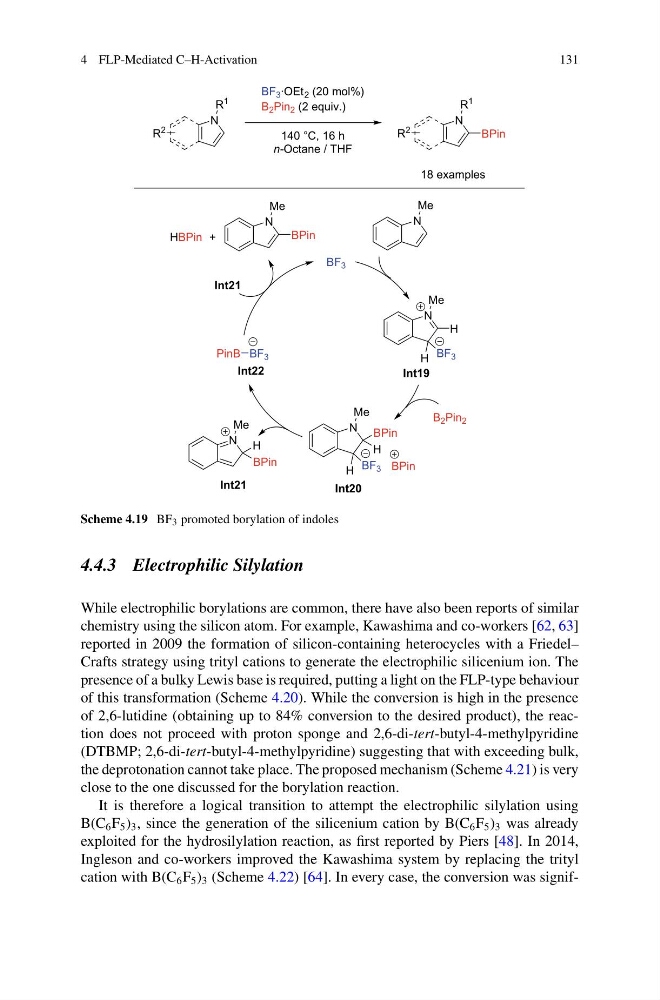
Scheme 4.19 BF 3 promoted borylation of indoles
4.4.3 Electrophilic Silylation
While electrophilic borylations are common, there have also been reports of similar
chemistry using the silicon atom. For example, Kawashima and co-workers [62, 63]
reported in 2009 the formation of silicon-containing heterocycles with a Friedel–
Crafts strategy using trityl cations to generate the electrophilic silicenium ion. The
presence of a bulky Lewis base is required, putting a light on the FLP-type behaviour
of this transformation (Scheme 4.20). While the conversion is high in the presence
of 2,6-lutidine (obtaining up to 84% conversion to the desired product), the reaction does not proceed with proton sponge and 2,6-di-tert-butyl-4-methylpyridine
(DTBMP; 2,6-di-tert-butyl-4-methylpyridine) suggesting that with exceeding bulk,
the deprotonation cannot take place. The proposed mechanism (Scheme 4.21) is very
close to the one discussed for the borylation reaction.
It is therefore a logical transition to attempt the electrophilic silylation using
B(C 6 F 5 ) 3 , since the generation of the silicenium cation by B(C 6 F 5 ) 3 was already
exploited for the hydrosilylation reaction, as first reported by Piers [48]. In 2014,
Ingleson and co-workers improved the Kawashima system by replacing the trityl
cation with B(C 6 F 5 ) 3 (Scheme 4.22) [64]. In every case, the conversion was signif-
131
N
R
1
R
2
BF 3 ·OEt 2 (20 mol%)
B 2 Pin 2 (2 equiv.)
140 °C, 16 h
n-Octane / THF
N
R
1
R
2
BPin
18 examples
BF 3
N
Me
N
Me
H
H BF 3
B 2 Pin 2
N
Me
H
H BF 3
BPin
BPin
N
Me
BPin
H
PinB BF 3
Int19
Int20
Int21
Int21
Int22
HBPin +
N
Me
BPin
Scheme 4.19 BF 3 promoted borylation of indoles
4.4.3 Electrophilic Silylation
While electrophilic borylations are common, there have also been reports of similar
chemistry using the silicon atom. For example, Kawashima and co-workers [62, 63]
reported in 2009 the formation of silicon-containing heterocycles with a Friedel–
Crafts strategy using trityl cations to generate the electrophilic silicenium ion. The
presence of a bulky Lewis base is required, putting a light on the FLP-type behaviour
of this transformation (Scheme 4.20). While the conversion is high in the presence
of 2,6-lutidine (obtaining up to 84% conversion to the desired product), the reaction does not proceed with proton sponge and 2,6-di-tert-butyl-4-methylpyridine
(DTBMP; 2,6-di-tert-butyl-4-methylpyridine) suggesting that with exceeding bulk,
the deprotonation cannot take place. The proposed mechanism (Scheme 4.21) is very
close to the one discussed for the borylation reaction.
It is therefore a logical transition to attempt the electrophilic silylation using
B(C 6 F 5 ) 3 , since the generation of the silicenium cation by B(C 6 F 5 ) 3 was already
exploited for the hydrosilylation reaction, as first reported by Piers [48]. In 2014,
Ingleson and co-workers improved the Kawashima system by replacing the trityl
cation with B(C 6 F 5 ) 3 (Scheme 4.22) [64]. In every case, the conversion was signif-