

130
Y. Soltani and F.-G. Fontaine
under these harsh conditions, the presence of the diborylated indoles, with a second
boron moiety at the 5-position, is also observed.
As observed in the reactions above, the electrophilic borylation of indoles using
Lewis acid catalysts usually occurs at the 3-position. In an elegant strategy, Zhang
and co-workers were able to borylate indoles selectively at the 2-position using boron
trifluoride etherate (BF 3 ·OEt 2 ) as a catalyst in the presence of diboranes (B 2 Pin 2 ).
Using this strategy, the Lewis acid BF 3 attacks the 3-position as expected, to generate
the indolinium Int19, which then reacts with B 2 Pin 2 to install the BPin moiety at the
2-position, with release of [BPinBF 3 ]
– [58] (Scheme 4.19).
While no mechanistic detail on this key step was given, it is logical to assume that
the fluoride of Int19 is nucleophilic enough to activate the diborane and promote
this transformation, which is closely related to the generation of boron nucleophiles
promoted by the metal-free activation of diboranes using alkoxylates [59–61]. The
protic intermediate Int21 can then react with Int22 to generate HBPin and release
the catalyst BF 3 . Some control experiments have demonstrated the reversibility of
the borylation at the 3-position, which can readily revert to the indole. However, the
2-borylated indole, the thermodynamically favoured product, is stable at 140 °C for
16 h. Test experiments have also shown that the reaction can be carried out in the
presence of BCl 3 and BBr 3 in polar solvents, but does not work in the presence of
B(C 6 F 5 ) 3 .
a) B(C 6 F 5 ) 3 (5 mol%)
HBCat (0.55 equiv.)
rt, 2 h, C 6 D 6
b) B(C 6 F 5 ) 3 (5 mol%)
HBCat (1.5 equiv.)
120 °C, 8 h, C 6 D 6
a) or b)
N
Me
R
BCat
N
Me
Me
11 examples
a) 44-49%
b) 69-98%
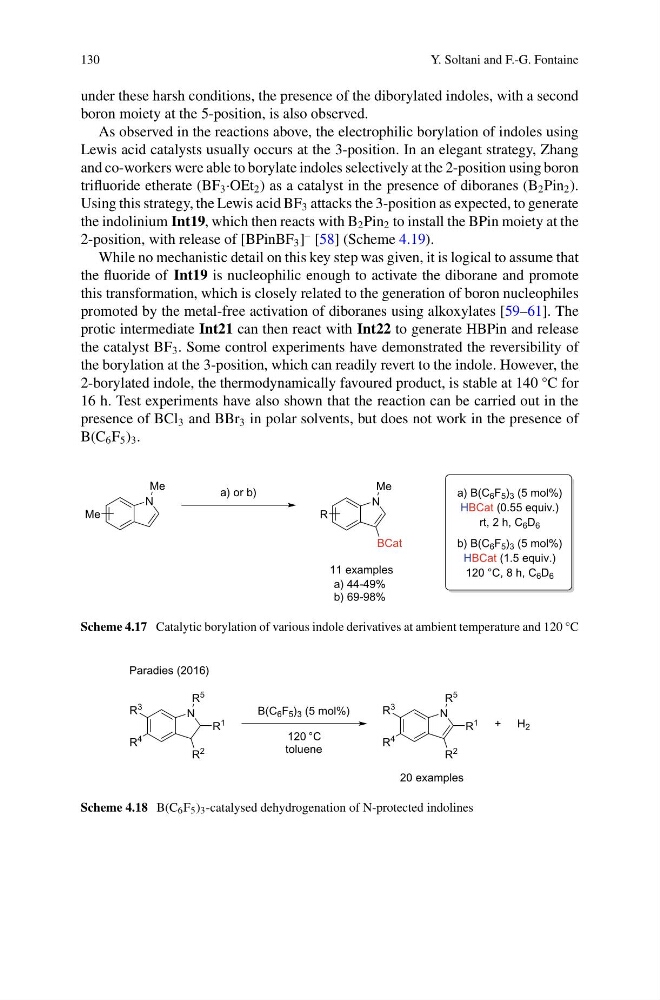
Scheme 4.17 Catalytic borylation of various indole derivatives at ambient temperature and 120 °C
N
R
5
R
1
R
2
R
4
R
3
B(C 6 F 5 ) 3 (5 mol%)
120 °C
toluene
N
R
5
R
1
R
2
R
4
R
3
H 2
+
20 examples
Paradies (2016)
Scheme 4.18 B(C 6 F 5 ) 3 -catalysed dehydrogenation of N-protected indolines
Y. Soltani and F.-G. Fontaine
under these harsh conditions, the presence of the diborylated indoles, with a second
boron moiety at the 5-position, is also observed.
As observed in the reactions above, the electrophilic borylation of indoles using
Lewis acid catalysts usually occurs at the 3-position. In an elegant strategy, Zhang
and co-workers were able to borylate indoles selectively at the 2-position using boron
trifluoride etherate (BF 3 ·OEt 2 ) as a catalyst in the presence of diboranes (B 2 Pin 2 ).
Using this strategy, the Lewis acid BF 3 attacks the 3-position as expected, to generate
the indolinium Int19, which then reacts with B 2 Pin 2 to install the BPin moiety at the
2-position, with release of [BPinBF 3 ]
– [58] (Scheme 4.19).
While no mechanistic detail on this key step was given, it is logical to assume that
the fluoride of Int19 is nucleophilic enough to activate the diborane and promote
this transformation, which is closely related to the generation of boron nucleophiles
promoted by the metal-free activation of diboranes using alkoxylates [59–61]. The
protic intermediate Int21 can then react with Int22 to generate HBPin and release
the catalyst BF 3 . Some control experiments have demonstrated the reversibility of
the borylation at the 3-position, which can readily revert to the indole. However, the
2-borylated indole, the thermodynamically favoured product, is stable at 140 °C for
16 h. Test experiments have also shown that the reaction can be carried out in the
presence of BCl 3 and BBr 3 in polar solvents, but does not work in the presence of
B(C 6 F 5 ) 3 .
a) B(C 6 F 5 ) 3 (5 mol%)
HBCat (0.55 equiv.)
rt, 2 h, C 6 D 6
b) B(C 6 F 5 ) 3 (5 mol%)
HBCat (1.5 equiv.)
120 °C, 8 h, C 6 D 6
a) or b)
N
Me
R
BCat
N
Me
Me
11 examples
a) 44-49%
b) 69-98%
Scheme 4.17 Catalytic borylation of various indole derivatives at ambient temperature and 120 °C
N
R
5
R
1
R
2
R
4
R
3
B(C 6 F 5 ) 3 (5 mol%)
120 °C
toluene
N
R
5
R
1
R
2
R
4
R
3
H 2
+
20 examples
Paradies (2016)
Scheme 4.18 B(C 6 F 5 ) 3 -catalysed dehydrogenation of N-protected indolines