

4 FLP-Mediated C–H-Activation
129
Starting with the N-Me-indole deuterated at the 3-position, it was proposed that the
activation of HBCat leads to the formation of the borenium, which can attack the
3-position of the indole to generate intermediate Int13. Following the abstraction
of the deuterium by the hydroborate anion and generation of HD, which was spectroscopically observed, the 3-BCat-indole was generated. Another possible pathway
involves another indole acting as a nucleophile to abstract the deuteride and generate
the same borylated product, but also intermediate Int14, which in turn can lead to
the D 2 -indoline product.
It should be noted that the reduction of indole to indoline is a typical reaction
pattern observed in the presence of hydroboranes [54, 55]. Zhang and co-workers [56]
studied in more detail the disproportionation reaction of methyl-protected indoles
with B(C 6 F 5 ) 3 in the absence of an additional base. Through a series of isotopic
labelling and NMR monitoring experiments, they were able to confirm the role of the
indoline as a side product, reducing the yield of the desired 3-borylated indoles. One
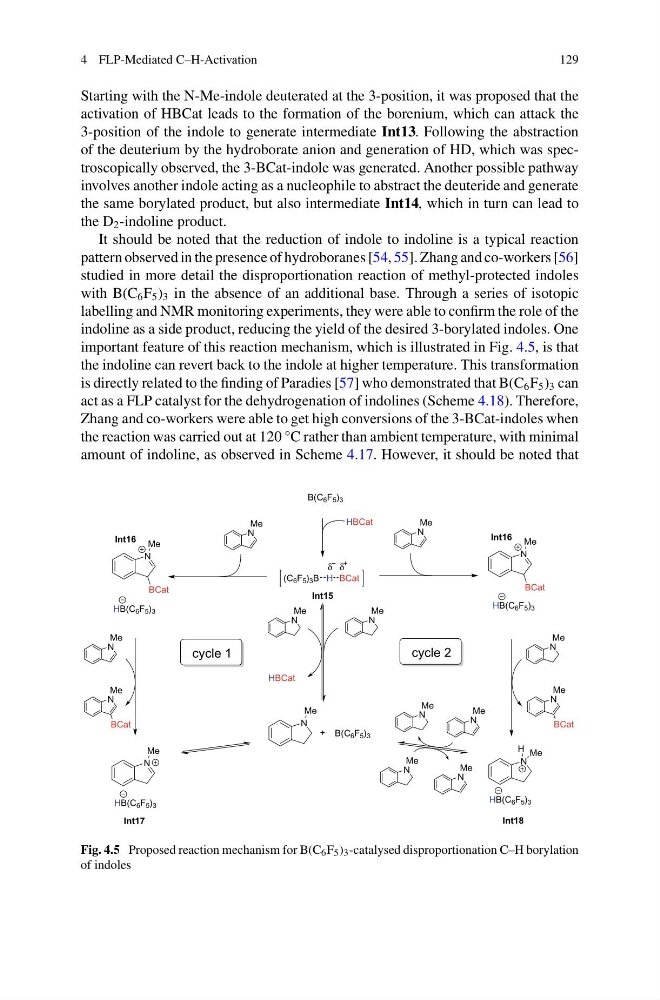
important feature of this reaction mechanism, which is illustrated in Fig. 4.5, is that
the indoline can revert back to the indole at higher temperature. This transformation
is directly related to the finding of Paradies [57] who demonstrated that B(C 6 F 5 ) 3 can
act as a FLP catalyst for the dehydrogenation of indolines (Scheme 4.18). Therefore,
Zhang and co-workers were able to get high conversions of the 3-BCat-indoles when
the reaction was carried out at 120 °C rather than ambient temperature, with minimal
amount of indoline, as observed in Scheme 4.17. However, it should be noted that
B(C 6 F 5 ) 3
HBCat
H BCat
(C 6 F 5 ) 3 B
N
Me
N
Me
BCat
HB(C 6 F 5 ) 3
N
Me
N
Me
BCat
N
Me
HB(C 6 F 5 ) 3
N
Me
BCat
HB(C 6 F 5 ) 3
N
Me
HB(C 6 F 5 ) 3
H
B(C 6 F 5 ) 3
N
Me
+
N
Me
N
Me
BCat
N
Me
N
Me
HBCat
cycle 1
Int17
Int18
Int16
Int16
Int15
N
Me
N
Me
N
Me
N
Me
N
Me
cycle 2
δ δ
Fig. 4.5 Proposed reaction mechanism for B(C 6 F 5 ) 3 -catalysed disproportionation C–H borylation
of indoles
129
Starting with the N-Me-indole deuterated at the 3-position, it was proposed that the
activation of HBCat leads to the formation of the borenium, which can attack the
3-position of the indole to generate intermediate Int13. Following the abstraction
of the deuterium by the hydroborate anion and generation of HD, which was spectroscopically observed, the 3-BCat-indole was generated. Another possible pathway
involves another indole acting as a nucleophile to abstract the deuteride and generate
the same borylated product, but also intermediate Int14, which in turn can lead to
the D 2 -indoline product.
It should be noted that the reduction of indole to indoline is a typical reaction
pattern observed in the presence of hydroboranes [54, 55]. Zhang and co-workers [56]
studied in more detail the disproportionation reaction of methyl-protected indoles
with B(C 6 F 5 ) 3 in the absence of an additional base. Through a series of isotopic
labelling and NMR monitoring experiments, they were able to confirm the role of the
indoline as a side product, reducing the yield of the desired 3-borylated indoles. One
important feature of this reaction mechanism, which is illustrated in Fig. 4.5, is that
the indoline can revert back to the indole at higher temperature. This transformation
is directly related to the finding of Paradies [57] who demonstrated that B(C 6 F 5 ) 3 can
act as a FLP catalyst for the dehydrogenation of indolines (Scheme 4.18). Therefore,
Zhang and co-workers were able to get high conversions of the 3-BCat-indoles when
the reaction was carried out at 120 °C rather than ambient temperature, with minimal
amount of indoline, as observed in Scheme 4.17. However, it should be noted that
B(C 6 F 5 ) 3
HBCat
H BCat
(C 6 F 5 ) 3 B
N
Me
N
Me
BCat
HB(C 6 F 5 ) 3
N
Me
N
Me
BCat
N
Me
HB(C 6 F 5 ) 3
N
Me
BCat
HB(C 6 F 5 ) 3
N
Me
HB(C 6 F 5 ) 3
H
B(C 6 F 5 ) 3
N
Me
+
N
Me
N
Me
BCat
N
Me
N
Me
HBCat
cycle 1
Int17
Int18
Int16
Int16
Int15
N
Me
N
Me
N
Me
N
Me
N
Me
cycle 2
δ δ
Fig. 4.5 Proposed reaction mechanism for B(C 6 F 5 ) 3 -catalysed disproportionation C–H borylation
of indoles