

128
Y. Soltani and F.-G. Fontaine
Me 2 N
BCat
Me 2 N
B(C 6 F 5 ) 3 (5 mol%)
HBCat (1.5 equiv.)
alkene additive (1 equiv.)
rt, 48 h
toluene
tBu
Ph
39%
69%
61%
85%
88%
77% (0.2 equiv.)
96%
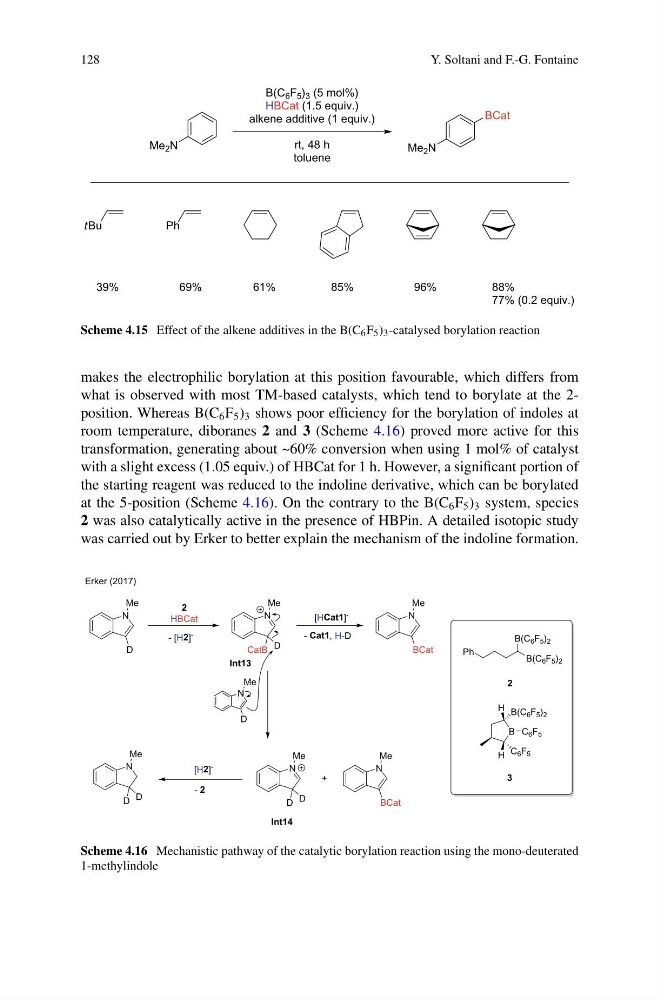
Scheme 4.15 Effect of the alkene additives in the B(C 6 F 5 ) 3 -catalysed borylation reaction
makes the electrophilic borylation at this position favourable, which differs from
what is observed with most TM-based catalysts, which tend to borylate at the 2position. Whereas B(C 6 F 5 ) 3 shows poor efficiency for the borylation of indoles at
room temperature, diboranes 2 and 3 (Scheme 4.16) proved more active for this
transformation, generating about ~60% conversion when using 1 mol% of catalyst
with a slight excess (1.05 equiv.) of HBCat for 1 h. However, a significant portion of
the starting reagent was reduced to the indoline derivative, which can be borylated
at the 5-position (Scheme 4.16). On the contrary to the B(C 6 F 5 ) 3 system, species
2 was also catalytically active in the presence of HBPin. A detailed isotopic study
was carried out by Erker to better explain the mechanism of the indoline formation.
N
Me
D
2
HBCat
N
Me
CatB D
- [H2]
-
- Cat1, H-D
N
Me
BCat
N
Me
D
N
Me
BCat
N
Me
D D
+
- 2
N
Me
D D
Erker (2017)
Ph
B(C 6 F 5 ) 2
B(C 6 F 5 ) 2
2
Int14
Int13
[HCat1]
-
[H2]
-
B C 6 F 5
H B(C 6 F 5 ) 2
H C 6 F 5
3
Scheme 4.16 Mechanistic pathway of the catalytic borylation reaction using the mono-deuterated
1-methylindole
Y. Soltani and F.-G. Fontaine
Me 2 N
BCat
Me 2 N
B(C 6 F 5 ) 3 (5 mol%)
HBCat (1.5 equiv.)
alkene additive (1 equiv.)
rt, 48 h
toluene
tBu
Ph
39%
69%
61%
85%
88%
77% (0.2 equiv.)
96%
Scheme 4.15 Effect of the alkene additives in the B(C 6 F 5 ) 3 -catalysed borylation reaction
makes the electrophilic borylation at this position favourable, which differs from
what is observed with most TM-based catalysts, which tend to borylate at the 2position. Whereas B(C 6 F 5 ) 3 shows poor efficiency for the borylation of indoles at
room temperature, diboranes 2 and 3 (Scheme 4.16) proved more active for this
transformation, generating about ~60% conversion when using 1 mol% of catalyst
with a slight excess (1.05 equiv.) of HBCat for 1 h. However, a significant portion of
the starting reagent was reduced to the indoline derivative, which can be borylated
at the 5-position (Scheme 4.16). On the contrary to the B(C 6 F 5 ) 3 system, species
2 was also catalytically active in the presence of HBPin. A detailed isotopic study
was carried out by Erker to better explain the mechanism of the indoline formation.
N
Me
D
2
HBCat
N
Me
CatB D
- [H2]
-
- Cat1, H-D
N
Me
BCat
N
Me
D
N
Me
BCat
N
Me
D D
+
- 2
N
Me
D D
Erker (2017)
Ph
B(C 6 F 5 ) 2
B(C 6 F 5 ) 2
2
Int14
Int13
[HCat1]
-
[H2]
-
B C 6 F 5
H B(C 6 F 5 ) 2
H C 6 F 5
3
Scheme 4.16 Mechanistic pathway of the catalytic borylation reaction using the mono-deuterated
1-methylindole