

4 FLP-Mediated C–H-Activation
125
NMe 2
BH 3
1) [Ph 3 C][B(C 6 F 5 ) 4 ]
2) NBu 4 BH 4
R
B
H 2
NMe 2
R
n
n
14 examples
N
Et
H 3 B
N
Et
B
H 2
N
Et
BH 2
a) or b)
+
a+b) <5%
a) 52%, b) 69%
N
H 3 B
a) or b)
N
H 2 B
N
B
H 2
Ph
N H
B
+
+
a) 30%, b) 29%
a) 48%, b) 38%
a) 0%, b) 25%
Vedejs (2009)
Vedejs (2013)
Me
D
H
BH 2
NMe 2
1 D
k H /k D =2.8
1
n=1,2,3
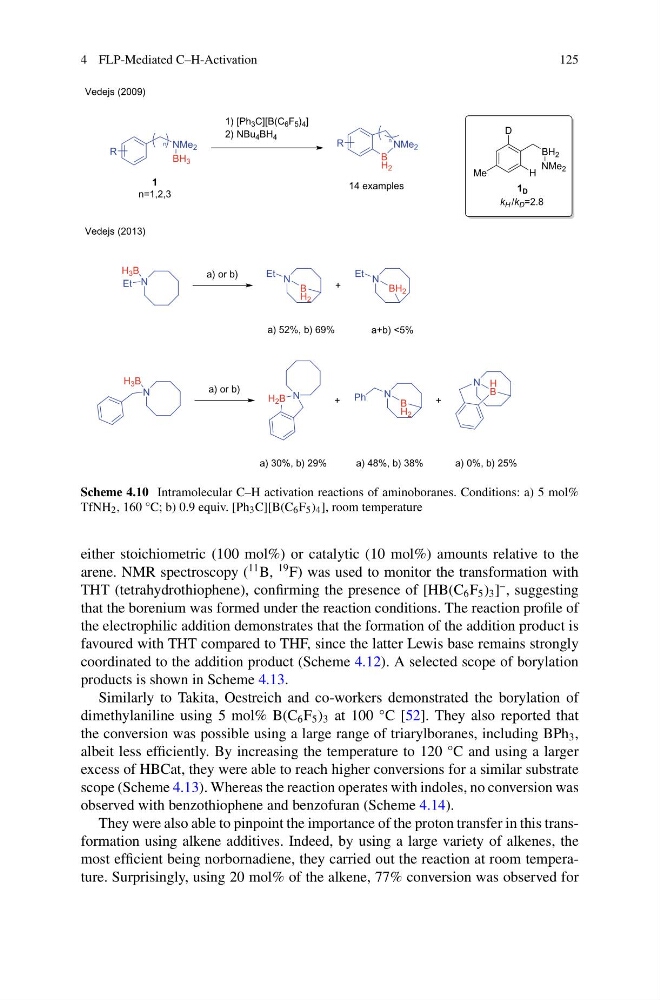
Scheme 4.10 Intramolecular C–H activation reactions of aminoboranes. Conditions: a) 5 mol%
TfNH 2 , 160 °C; b) 0.9 equiv. [Ph 3 C][B(C 6 F 5 ) 4 ], room temperature
either stoichiometric (100 mol%) or catalytic (10 mol%) amounts relative to the
arene. NMR spectroscopy (
11 B,
19 F) was used to monitor the transformation with
THT (tetrahydrothiophene), confirming the presence of [HB(C 6 F 5 ) 3 ]
– , suggesting
that the borenium was formed under the reaction conditions. The reaction profile of
the electrophilic addition demonstrates that the formation of the addition product is
favoured with THT compared to THF, since the latter Lewis base remains strongly
coordinated to the addition product (Scheme 4.12). A selected scope of borylation
products is shown in Scheme 4.13.
Similarly to Takita, Oestreich and co-workers demonstrated the borylation of
dimethylaniline using 5 mol% B(C 6 F 5 ) 3 at 100 °C [52]. They also reported that
the conversion was possible using a large range of triarylboranes, including BPh 3 ,
albeit less efficiently. By increasing the temperature to 120 °C and using a larger
excess of HBCat, they were able to reach higher conversions for a similar substrate
scope (Scheme 4.13). Whereas the reaction operates with indoles, no conversion was
observed with benzothiophene and benzofuran (Scheme 4.14).
They were also able to pinpoint the importance of the proton transfer in this transformation using alkene additives. Indeed, by using a large variety of alkenes, the
most efficient being norbornadiene, they carried out the reaction at room temperature. Surprisingly, using 20 mol% of the alkene, 77% conversion was observed for
125
NMe 2
BH 3
1) [Ph 3 C][B(C 6 F 5 ) 4 ]
2) NBu 4 BH 4
R
B
H 2
NMe 2
R
n
n
14 examples
N
Et
H 3 B
N
Et
B
H 2
N
Et
BH 2
a) or b)
+
a+b) <5%
a) 52%, b) 69%
N
H 3 B
a) or b)
N
H 2 B
N
B
H 2
Ph
N H
B
+
+
a) 30%, b) 29%
a) 48%, b) 38%
a) 0%, b) 25%
Vedejs (2009)
Vedejs (2013)
Me
D
H
BH 2
NMe 2
1 D
k H /k D =2.8
1
n=1,2,3
Scheme 4.10 Intramolecular C–H activation reactions of aminoboranes. Conditions: a) 5 mol%
TfNH 2 , 160 °C; b) 0.9 equiv. [Ph 3 C][B(C 6 F 5 ) 4 ], room temperature
either stoichiometric (100 mol%) or catalytic (10 mol%) amounts relative to the
arene. NMR spectroscopy (
11 B,
19 F) was used to monitor the transformation with
THT (tetrahydrothiophene), confirming the presence of [HB(C 6 F 5 ) 3 ]
– , suggesting
that the borenium was formed under the reaction conditions. The reaction profile of
the electrophilic addition demonstrates that the formation of the addition product is
favoured with THT compared to THF, since the latter Lewis base remains strongly
coordinated to the addition product (Scheme 4.12). A selected scope of borylation
products is shown in Scheme 4.13.
Similarly to Takita, Oestreich and co-workers demonstrated the borylation of
dimethylaniline using 5 mol% B(C 6 F 5 ) 3 at 100 °C [52]. They also reported that
the conversion was possible using a large range of triarylboranes, including BPh 3 ,
albeit less efficiently. By increasing the temperature to 120 °C and using a larger
excess of HBCat, they were able to reach higher conversions for a similar substrate
scope (Scheme 4.13). Whereas the reaction operates with indoles, no conversion was
observed with benzothiophene and benzofuran (Scheme 4.14).
They were also able to pinpoint the importance of the proton transfer in this transformation using alkene additives. Indeed, by using a large variety of alkenes, the
most efficient being norbornadiene, they carried out the reaction at room temperature. Surprisingly, using 20 mol% of the alkene, 77% conversion was observed for