

124
Y. Soltani and F.-G. Fontaine
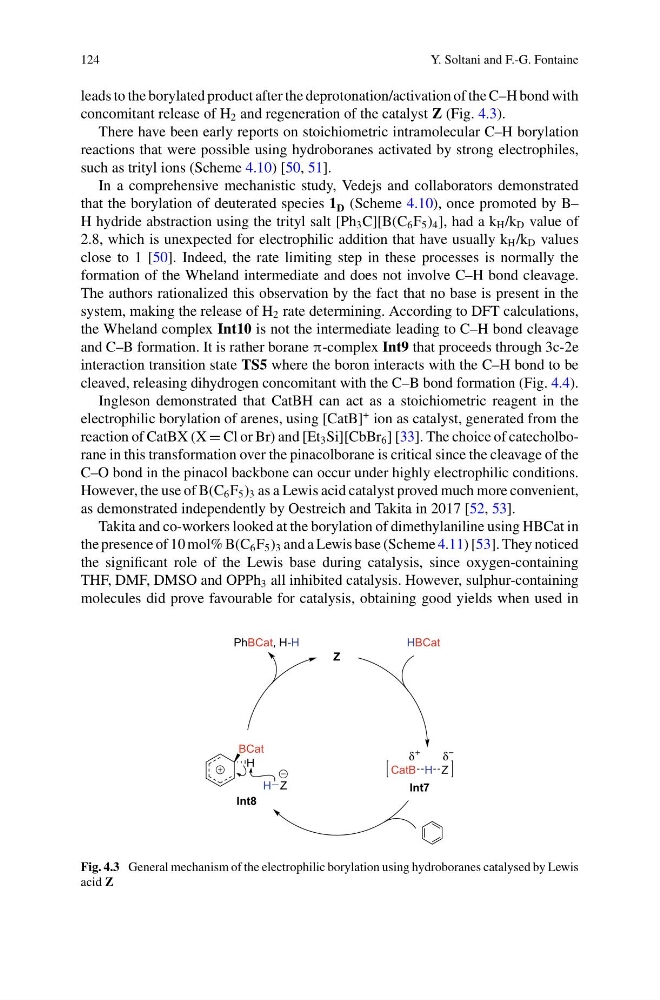
leads to the borylated product after the deprotonation/activation of the C–H bond with
concomitant release of H 2 and regeneration of the catalyst Z (Fig. 4.3).
There have been early reports on stoichiometric intramolecular C–H borylation
reactions that were possible using hydroboranes activated by strong electrophiles,
such as trityl ions (Scheme 4.10) [50, 51].
In a comprehensive mechanistic study, Vedejs and collaborators demonstrated
that the borylation of deuterated species 1 D (Scheme 4.10), once promoted by B–
H hydride abstraction using the trityl salt [Ph 3 C][B(C 6 F 5 ) 4 ], had a k H /k D value of
2.8, which is unexpected for electrophilic addition that have usually k H /k D values
close to 1 [50]. Indeed, the rate limiting step in these processes is normally the
formation of the Wheland intermediate and does not involve C–H bond cleavage.
The authors rationalized this observation by the fact that no base is present in the
system, making the release of H 2 rate determining. According to DFT calculations,
the Wheland complex Int10 is not the intermediate leading to C–H bond cleavage
and C–B formation. It is rather borane π-complex Int9 that proceeds through 3c-2e
interaction transition state TS5 where the boron interacts with the C–H bond to be
cleaved, releasing dihydrogen concomitant with the C–B bond formation (Fig. 4.4).
Ingleson demonstrated that CatBH can act as a stoichiometric reagent in the
electrophilic borylation of arenes, using [CatB]
+ ion as catalyst, generated from the
reaction of CatBX (X = Cl or Br) and [Et 3 Si][CbBr 6 ] [33]. The choice of catecholborane in this transformation over the pinacolborane is critical since the cleavage of the
C–O bond in the pinacol backbone can occur under highly electrophilic conditions.
However, the use of B(C 6 F 5 ) 3 as a Lewis acid catalyst proved much more convenient,
as demonstrated independently by Oestreich and Takita in 2017 [52, 53].
Takita and co-workers looked at the borylation of dimethylaniline using HBCat in
the presence of 10 mol% B(C 6 F 5 ) 3 and a Lewis base (Scheme 4.11) [53]. They noticed
the significant role of the Lewis base during catalysis, since oxygen-containing
THF, DMF, DMSO and OPPh 3 all inhibited catalysis. However, sulphur-containing
molecules did prove favourable for catalysis, obtaining good yields when used in
Z
HBCat
CatB H Z
H
BCat
H Z
PhBCat, H-H
Int7
Int8
δ
δ
Fig. 4.3 General mechanism of the electrophilic borylation using hydroboranes catalysed by Lewis
acid Z
Y. Soltani and F.-G. Fontaine
leads to the borylated product after the deprotonation/activation of the C–H bond with
concomitant release of H 2 and regeneration of the catalyst Z (Fig. 4.3).
There have been early reports on stoichiometric intramolecular C–H borylation
reactions that were possible using hydroboranes activated by strong electrophiles,
such as trityl ions (Scheme 4.10) [50, 51].
In a comprehensive mechanistic study, Vedejs and collaborators demonstrated
that the borylation of deuterated species 1 D (Scheme 4.10), once promoted by B–
H hydride abstraction using the trityl salt [Ph 3 C][B(C 6 F 5 ) 4 ], had a k H /k D value of
2.8, which is unexpected for electrophilic addition that have usually k H /k D values
close to 1 [50]. Indeed, the rate limiting step in these processes is normally the
formation of the Wheland intermediate and does not involve C–H bond cleavage.
The authors rationalized this observation by the fact that no base is present in the
system, making the release of H 2 rate determining. According to DFT calculations,
the Wheland complex Int10 is not the intermediate leading to C–H bond cleavage
and C–B formation. It is rather borane π-complex Int9 that proceeds through 3c-2e
interaction transition state TS5 where the boron interacts with the C–H bond to be
cleaved, releasing dihydrogen concomitant with the C–B bond formation (Fig. 4.4).
Ingleson demonstrated that CatBH can act as a stoichiometric reagent in the
electrophilic borylation of arenes, using [CatB]
+ ion as catalyst, generated from the
reaction of CatBX (X = Cl or Br) and [Et 3 Si][CbBr 6 ] [33]. The choice of catecholborane in this transformation over the pinacolborane is critical since the cleavage of the
C–O bond in the pinacol backbone can occur under highly electrophilic conditions.
However, the use of B(C 6 F 5 ) 3 as a Lewis acid catalyst proved much more convenient,
as demonstrated independently by Oestreich and Takita in 2017 [52, 53].
Takita and co-workers looked at the borylation of dimethylaniline using HBCat in
the presence of 10 mol% B(C 6 F 5 ) 3 and a Lewis base (Scheme 4.11) [53]. They noticed
the significant role of the Lewis base during catalysis, since oxygen-containing
THF, DMF, DMSO and OPPh 3 all inhibited catalysis. However, sulphur-containing
molecules did prove favourable for catalysis, obtaining good yields when used in
Z
HBCat
CatB H Z
H
BCat
H Z
PhBCat, H-H
Int7
Int8
δ
δ
Fig. 4.3 General mechanism of the electrophilic borylation using hydroboranes catalysed by Lewis
acid Z