

4 FLP-Mediated C–H-Activation
123
[B]Cl (1 equiv.)
amine (1 equiv.)
AlCl 3 (1 equiv.)
>100 °C
H
[B]
[B]
[B]
BCl 2
BCl 2
BCat
amine
Me2NTol 2
tTBP 2
dTBP
T (°C)
120 2
120 2
100
1:2 ratio
1 : 1 2
6 : 1 2
12 : 1
1
2
Ingleson (2013)
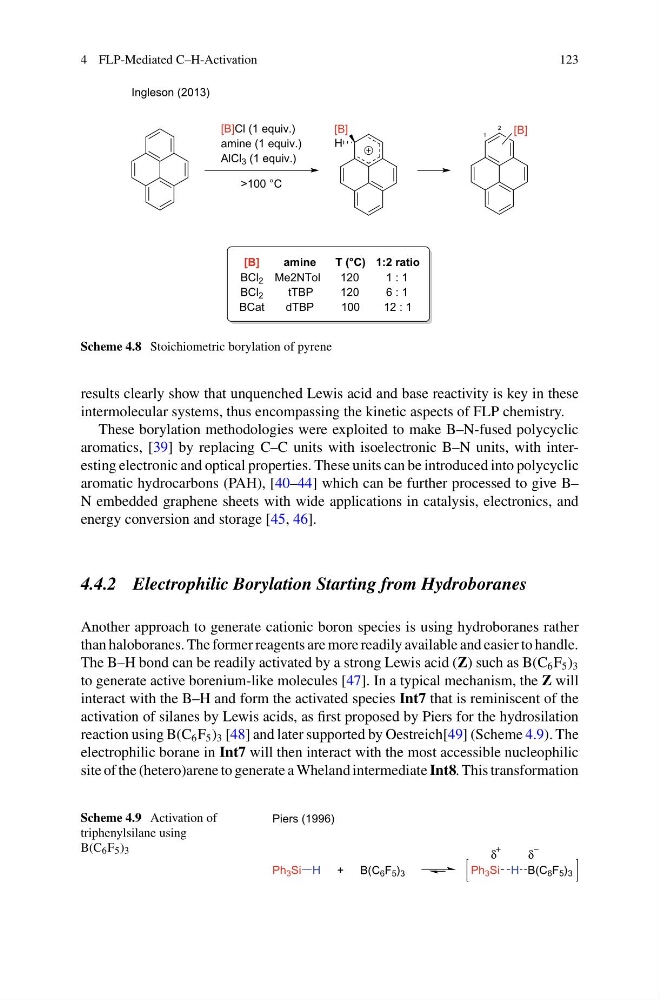
Scheme 4.8 Stoichiometric borylation of pyrene
results clearly show that unquenched Lewis acid and base reactivity is key in these
intermolecular systems, thus encompassing the kinetic aspects of FLP chemistry.
These borylation methodologies were exploited to make B–N-fused polycyclic
aromatics, [39] by replacing C–C units with isoelectronic B–N units, with interesting electronic and optical properties. These units can be introduced into polycyclic
aromatic hydrocarbons (PAH), [40–44] which can be further processed to give B–
N embedded graphene sheets with wide applications in catalysis, electronics, and
energy conversion and storage [45, 46].
4.4.2 Electrophilic Borylation Starting from Hydroboranes
Another approach to generate cationic boron species is using hydroboranes rather
than haloboranes. The former reagents are more readily available and easier to handle.
The B–H bond can be readily activated by a strong Lewis acid (Z) such as B(C 6 F 5 ) 3
to generate active borenium-like molecules [47]. In a typical mechanism, the Z will
interact with the B–H and form the activated species Int7 that is reminiscent of the
activation of silanes by Lewis acids, as first proposed by Piers for the hydrosilation
reaction using B(C 6 F 5 ) 3 [48] and later supported by Oestreich[49] (Scheme 4.9). The
electrophilic borane in Int7 will then interact with the most accessible nucleophilic
site of the (hetero)arene to generate a Wheland intermediate Int8. This transformation
Scheme 4.9 Activation of
triphenylsilane using
B(C 6 F 5 ) 3
Ph 3 Si H
B(C 6 F 5 ) 3
Ph 3 Si H B(C 6 F 5 ) 3
+
Piers (1996)
δ
δ
123
[B]Cl (1 equiv.)
amine (1 equiv.)
AlCl 3 (1 equiv.)
>100 °C
H
[B]
[B]
[B]
BCl 2
BCl 2
BCat
amine
Me2NTol 2
tTBP 2
dTBP
T (°C)
120 2
120 2
100
1:2 ratio
1 : 1 2
6 : 1 2
12 : 1
1
2
Ingleson (2013)
Scheme 4.8 Stoichiometric borylation of pyrene
results clearly show that unquenched Lewis acid and base reactivity is key in these
intermolecular systems, thus encompassing the kinetic aspects of FLP chemistry.
These borylation methodologies were exploited to make B–N-fused polycyclic
aromatics, [39] by replacing C–C units with isoelectronic B–N units, with interesting electronic and optical properties. These units can be introduced into polycyclic
aromatic hydrocarbons (PAH), [40–44] which can be further processed to give B–
N embedded graphene sheets with wide applications in catalysis, electronics, and
energy conversion and storage [45, 46].
4.4.2 Electrophilic Borylation Starting from Hydroboranes
Another approach to generate cationic boron species is using hydroboranes rather
than haloboranes. The former reagents are more readily available and easier to handle.
The B–H bond can be readily activated by a strong Lewis acid (Z) such as B(C 6 F 5 ) 3
to generate active borenium-like molecules [47]. In a typical mechanism, the Z will
interact with the B–H and form the activated species Int7 that is reminiscent of the
activation of silanes by Lewis acids, as first proposed by Piers for the hydrosilation
reaction using B(C 6 F 5 ) 3 [48] and later supported by Oestreich[49] (Scheme 4.9). The
electrophilic borane in Int7 will then interact with the most accessible nucleophilic
site of the (hetero)arene to generate a Wheland intermediate Int8. This transformation
Scheme 4.9 Activation of
triphenylsilane using
B(C 6 F 5 ) 3
Ph 3 Si H
B(C 6 F 5 ) 3
Ph 3 Si H B(C 6 F 5 ) 3
+
Piers (1996)
δ
δ