

122
Y. Soltani and F.-G. Fontaine
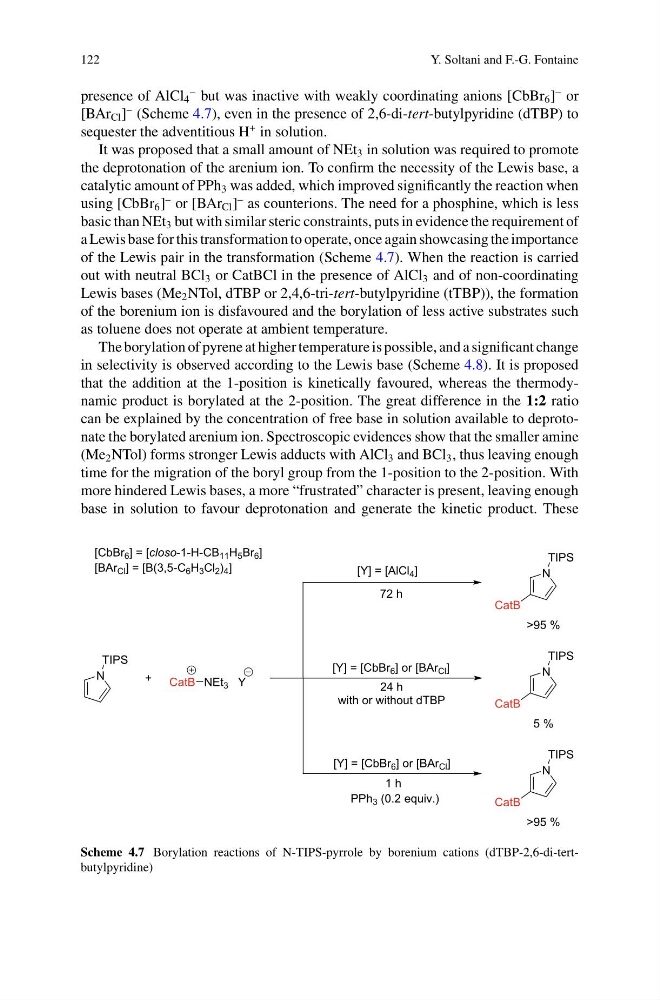
presence of AlCl 4
– but was inactive with weakly coordinating anions [CbBr 6 ]
– or
[BAr Cl ]
– (Scheme 4.7), even in the presence of 2,6-di-tert-butylpyridine (dTBP) to
sequester the adventitious H
+ in solution.
It was proposed that a small amount of NEt 3 in solution was required to promote
the deprotonation of the arenium ion. To confirm the necessity of the Lewis base, a
catalytic amount of PPh 3 was added, which improved significantly the reaction when
using [CbBr 6 ]
– or [BAr Cl ]
– as counterions. The need for a phosphine, which is less
basic than NEt 3 but with similar steric constraints, puts in evidence the requirement of
a Lewis base for this transformation to operate, once again showcasing the importance
of the Lewis pair in the transformation (Scheme 4.7). When the reaction is carried
out with neutral BCl 3 or CatBCl in the presence of AlCl 3 and of non-coordinating
Lewis bases (Me 2 NTol, dTBP or 2,4,6-tri-tert-butylpyridine (tTBP)), the formation
of the borenium ion is disfavoured and the borylation of less active substrates such
as toluene does not operate at ambient temperature.
The borylation of pyrene at higher temperature is possible, and a significant change
in selectivity is observed according to the Lewis base (Scheme 4.8). It is proposed
that the addition at the 1-position is kinetically favoured, whereas the thermodynamic product is borylated at the 2-position. The great difference in the 1:2 ratio
can be explained by the concentration of free base in solution available to deprotonate the borylated arenium ion. Spectroscopic evidences show that the smaller amine
(Me 2 NTol) forms stronger Lewis adducts with AlCl 3 and BCl 3 , thus leaving enough
time for the migration of the boryl group from the 1-position to the 2-position. With
more hindered Lewis bases, a more “frustrated” character is present, leaving enough
base in solution to favour deprotonation and generate the kinetic product. These
N
TIPS
CatB NEt 3 Y
+
[Y] = [AlCl 4 ]
72 h
[Y] = [CbBr 6 ] or [BAr Cl ]
24 h
with or without dTBP
[Y] = [CbBr 6 ] or [BAr Cl ]
1 h
PPh 3 (0.2 equiv.)
N
TIPS
CatB
N
TIPS
CatB
N
TIPS
CatB
>95 %
5 %
>95 %
[CbBr 6 ] = [closo-1-H-CB 11 H 5 Br 6 ]
[BAr Cl ] = [B(3,5-C 6 H 3 Cl 2 ) 4 ]
Scheme 4.7 Borylation reactions of N-TIPS-pyrrole by borenium cations (dTBP-2,6-di-tertbutylpyridine)
Y. Soltani and F.-G. Fontaine
presence of AlCl 4
– but was inactive with weakly coordinating anions [CbBr 6 ]
– or
[BAr Cl ]
– (Scheme 4.7), even in the presence of 2,6-di-tert-butylpyridine (dTBP) to
sequester the adventitious H
+ in solution.
It was proposed that a small amount of NEt 3 in solution was required to promote
the deprotonation of the arenium ion. To confirm the necessity of the Lewis base, a
catalytic amount of PPh 3 was added, which improved significantly the reaction when
using [CbBr 6 ]
– or [BAr Cl ]
– as counterions. The need for a phosphine, which is less
basic than NEt 3 but with similar steric constraints, puts in evidence the requirement of
a Lewis base for this transformation to operate, once again showcasing the importance
of the Lewis pair in the transformation (Scheme 4.7). When the reaction is carried
out with neutral BCl 3 or CatBCl in the presence of AlCl 3 and of non-coordinating
Lewis bases (Me 2 NTol, dTBP or 2,4,6-tri-tert-butylpyridine (tTBP)), the formation
of the borenium ion is disfavoured and the borylation of less active substrates such
as toluene does not operate at ambient temperature.
The borylation of pyrene at higher temperature is possible, and a significant change
in selectivity is observed according to the Lewis base (Scheme 4.8). It is proposed
that the addition at the 1-position is kinetically favoured, whereas the thermodynamic product is borylated at the 2-position. The great difference in the 1:2 ratio
can be explained by the concentration of free base in solution available to deprotonate the borylated arenium ion. Spectroscopic evidences show that the smaller amine
(Me 2 NTol) forms stronger Lewis adducts with AlCl 3 and BCl 3 , thus leaving enough
time for the migration of the boryl group from the 1-position to the 2-position. With
more hindered Lewis bases, a more “frustrated” character is present, leaving enough
base in solution to favour deprotonation and generate the kinetic product. These
N
TIPS
CatB NEt 3 Y
+
[Y] = [AlCl 4 ]
72 h
[Y] = [CbBr 6 ] or [BAr Cl ]
24 h
with or without dTBP
[Y] = [CbBr 6 ] or [BAr Cl ]
1 h
PPh 3 (0.2 equiv.)
N
TIPS
CatB
N
TIPS
CatB
N
TIPS
CatB
>95 %
5 %
>95 %
[CbBr 6 ] = [closo-1-H-CB 11 H 5 Br 6 ]
[BAr Cl ] = [B(3,5-C 6 H 3 Cl 2 ) 4 ]
Scheme 4.7 Borylation reactions of N-TIPS-pyrrole by borenium cations (dTBP-2,6-di-tertbutylpyridine)