

126
Y. Soltani and F.-G. Fontaine
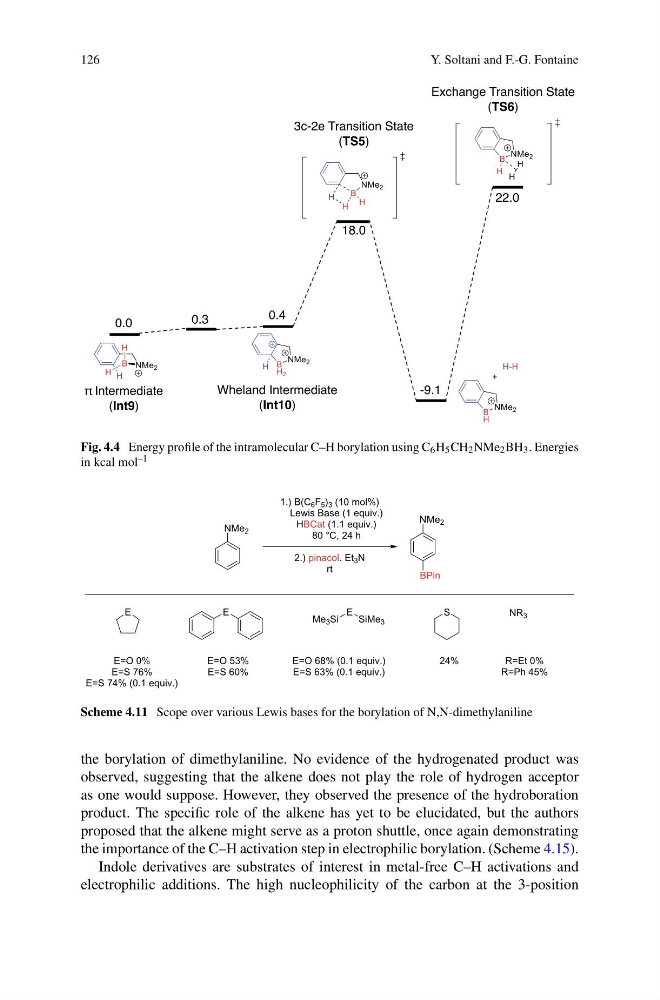
Fig. 4.4 Energy profile of the intramolecular C–H borylation using C 6 H 5 CH 2 NMe 2 BH 3 . Energies
in kcal mol –1
NMe 2
1.) B(C 6 F 5 ) 3 (10 mol%)
Lewis Base (1 equiv.)
HBCat (1.1 equiv.)
80 °C, 24 h
2.) pinacol. Et 3 N
rt
NMe 2
BPin
E
E
E=O 68% (0.1 equiv.)
E=S 63% (0.1 equiv.)
Me 3 Si
E SiMe 3
E=O 0%
E=S 76%
E=S 74% (0.1 equiv.)
E=O 53%
E=S 60%
NR 3
R=Et 0%
R=Ph 45%
S
24%
Scheme 4.11 Scope over various Lewis bases for the borylation of N,N-dimethylaniline
the borylation of dimethylaniline. No evidence of the hydrogenated product was
observed, suggesting that the alkene does not play the role of hydrogen acceptor
as one would suppose. However, they observed the presence of the hydroboration
product. The specific role of the alkene has yet to be elucidated, but the authors
proposed that the alkene might serve as a proton shuttle, once again demonstrating
the importance of the C–H activation step in electrophilic borylation. (Scheme 4.15).
Indole derivatives are substrates of interest in metal-free C–H activations and
electrophilic additions. The high nucleophilicity of the carbon at the 3-position
Y. Soltani and F.-G. Fontaine
Fig. 4.4 Energy profile of the intramolecular C–H borylation using C 6 H 5 CH 2 NMe 2 BH 3 . Energies
in kcal mol –1
NMe 2
1.) B(C 6 F 5 ) 3 (10 mol%)
Lewis Base (1 equiv.)
HBCat (1.1 equiv.)
80 °C, 24 h
2.) pinacol. Et 3 N
rt
NMe 2
BPin
E
E
E=O 68% (0.1 equiv.)
E=S 63% (0.1 equiv.)
Me 3 Si
E SiMe 3
E=O 0%
E=S 76%
E=S 74% (0.1 equiv.)
E=O 53%
E=S 60%
NR 3
R=Et 0%
R=Ph 45%
S
24%
Scheme 4.11 Scope over various Lewis bases for the borylation of N,N-dimethylaniline
the borylation of dimethylaniline. No evidence of the hydrogenated product was
observed, suggesting that the alkene does not play the role of hydrogen acceptor
as one would suppose. However, they observed the presence of the hydroboration
product. The specific role of the alkene has yet to be elucidated, but the authors
proposed that the alkene might serve as a proton shuttle, once again demonstrating
the importance of the C–H activation step in electrophilic borylation. (Scheme 4.15).
Indole derivatives are substrates of interest in metal-free C–H activations and
electrophilic additions. The high nucleophilicity of the carbon at the 3-position