

4
D. W. Stephan
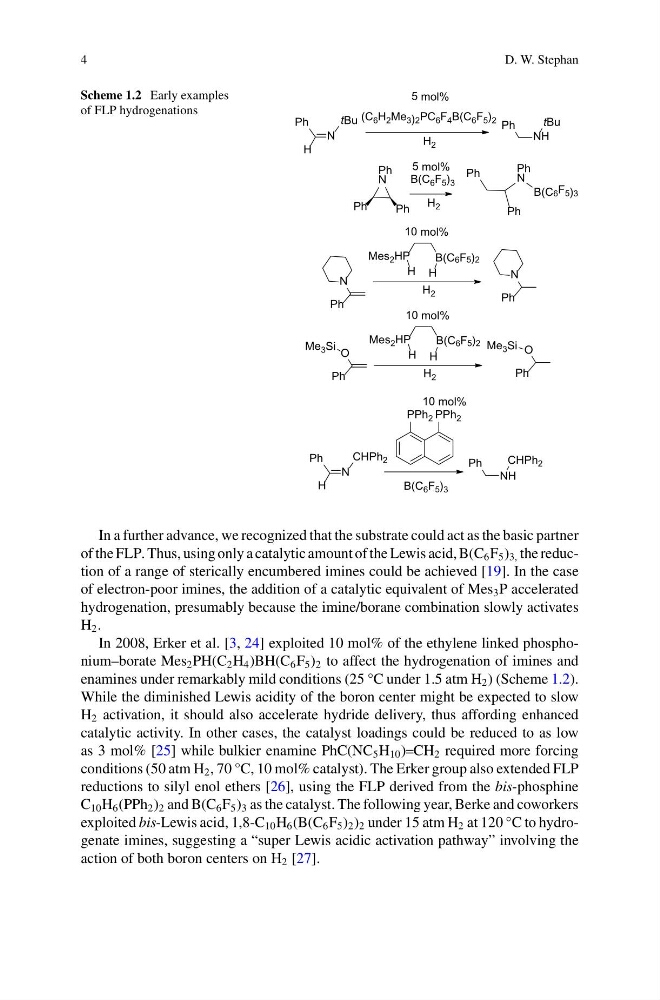
Scheme 1.2 Early examples
of FLP hydrogenations
H 2
Mes 2 HP
B(C6F5)2
H 2
(C 6 H 2 Me 3)2 PC 6 F 4 B(C 6 F 5 ) 2
5 mol%
10 mol%
PPh 2 PPh 2
B(C 6 F 5 ) 3
10 mol%
H 2
5 mol%
B(C 6 F 5 ) 3
H H
Mes 2 HP
B(C 6 F 5 ) 2
H 2
10 mol%
H H
Ph
H
N
tBu
Ph
NH
tBu
Ph
Ph
N
B(C6 F 5)3
Ph
N
Ph
Ph
N
Ph
N
Ph
O
Ph
Me 3 Si
O
Ph
Me 3 Si
Ph
H
N
CHPh 2
Ph
NH
CHPh 2
Ph
In a further advance, we recognized that the substrate could act as the basic partner
of the FLP. Thus, using only a catalytic amount of the Lewis acid, B(C 6 F 5 ) 3, the reduction of a range of sterically encumbered imines could be achieved [19]. In the case
of electron-poor imines, the addition of a catalytic equivalent of Mes 3 P accelerated
hydrogenation, presumably because the imine/borane combination slowly activates
H 2 .
In 2008, Erker et al. [3, 24] exploited 10 mol% of the ethylene linked phosphonium–borate Mes 2 PH(C 2 H 4 )BH(C 6 F 5 ) 2 to affect the hydrogenation of imines and
enamines under remarkably mild conditions (25 °C under 1.5 atm H 2 ) (Scheme 1.2).
While the diminished Lewis acidity of the boron center might be expected to slow
H 2 activation, it should also accelerate hydride delivery, thus affording enhanced
catalytic activity. In other cases, the catalyst loadings could be reduced to as low
as 3 mol% [25] while bulkier enamine PhC(NC 5 H 10 ) CH 2 required more forcing
conditions (50 atm H 2 , 70 °C, 10 mol% catalyst). The Erker group also extended FLP
reductions to silyl enol ethers [26], using the FLP derived from the bis-phosphine
C 10 H 6 (PPh 2 ) 2 and B(C 6 F 5 ) 3 as the catalyst. The following year, Berke and coworkers
exploited bis-Lewis acid, 1,8-C 10 H 6 (B(C 6 F 5 ) 2 ) 2 under 15 atm H 2 at 120 °C to hydrogenate imines, suggesting a “super Lewis acidic activation pathway” involving the
action of both boron centers on H 2 [27].
D. W. Stephan
Scheme 1.2 Early examples
of FLP hydrogenations
H 2
Mes 2 HP
B(C6F5)2
H 2
(C 6 H 2 Me 3)2 PC 6 F 4 B(C 6 F 5 ) 2
5 mol%
10 mol%
PPh 2 PPh 2
B(C 6 F 5 ) 3
10 mol%
H 2
5 mol%
B(C 6 F 5 ) 3
H H
Mes 2 HP
B(C 6 F 5 ) 2
H 2
10 mol%
H H
Ph
H
N
tBu
Ph
NH
tBu
Ph
Ph
N
B(C6 F 5)3
Ph
N
Ph
Ph
N
Ph
N
Ph
O
Ph
Me 3 Si
O
Ph
Me 3 Si
Ph
H
N
CHPh 2
Ph
NH
CHPh 2
Ph
In a further advance, we recognized that the substrate could act as the basic partner
of the FLP. Thus, using only a catalytic amount of the Lewis acid, B(C 6 F 5 ) 3, the reduction of a range of sterically encumbered imines could be achieved [19]. In the case
of electron-poor imines, the addition of a catalytic equivalent of Mes 3 P accelerated
hydrogenation, presumably because the imine/borane combination slowly activates
H 2 .
In 2008, Erker et al. [3, 24] exploited 10 mol% of the ethylene linked phosphonium–borate Mes 2 PH(C 2 H 4 )BH(C 6 F 5 ) 2 to affect the hydrogenation of imines and
enamines under remarkably mild conditions (25 °C under 1.5 atm H 2 ) (Scheme 1.2).
While the diminished Lewis acidity of the boron center might be expected to slow
H 2 activation, it should also accelerate hydride delivery, thus affording enhanced
catalytic activity. In other cases, the catalyst loadings could be reduced to as low
as 3 mol% [25] while bulkier enamine PhC(NC 5 H 10 ) CH 2 required more forcing
conditions (50 atm H 2 , 70 °C, 10 mol% catalyst). The Erker group also extended FLP
reductions to silyl enol ethers [26], using the FLP derived from the bis-phosphine
C 10 H 6 (PPh 2 ) 2 and B(C 6 F 5 ) 3 as the catalyst. The following year, Berke and coworkers
exploited bis-Lewis acid, 1,8-C 10 H 6 (B(C 6 F 5 ) 2 ) 2 under 15 atm H 2 at 120 °C to hydrogenate imines, suggesting a “super Lewis acidic activation pathway” involving the
action of both boron centers on H 2 [27].