

1 Frustrated Lewis Pair Catalysis: An Introduction
3
B(C 6 F 5 ) 2
(Me 3 C 6 H 2 ) 2 P
F
F
F
F
B(C 6 F 5 ) 2
(Me 3 C 6 H 2 ) 2 P
F
F
F
F
H
H
H 2
heat
R 3 P / B(C 6 F 5 ) 3
(R=
t Bu, Mes)
[R 3 PH] [HB(C6F5)3]
Mes 2 P
B(C 6 F 5 ) 2
Mes 2 P
B(C 6 F 5 ) 2
H 2
R 3 P / B(C 6 F 5 ) 3
R 3 P
B(C 6 F 5 ) 3
R'
R'
H 2
H
H
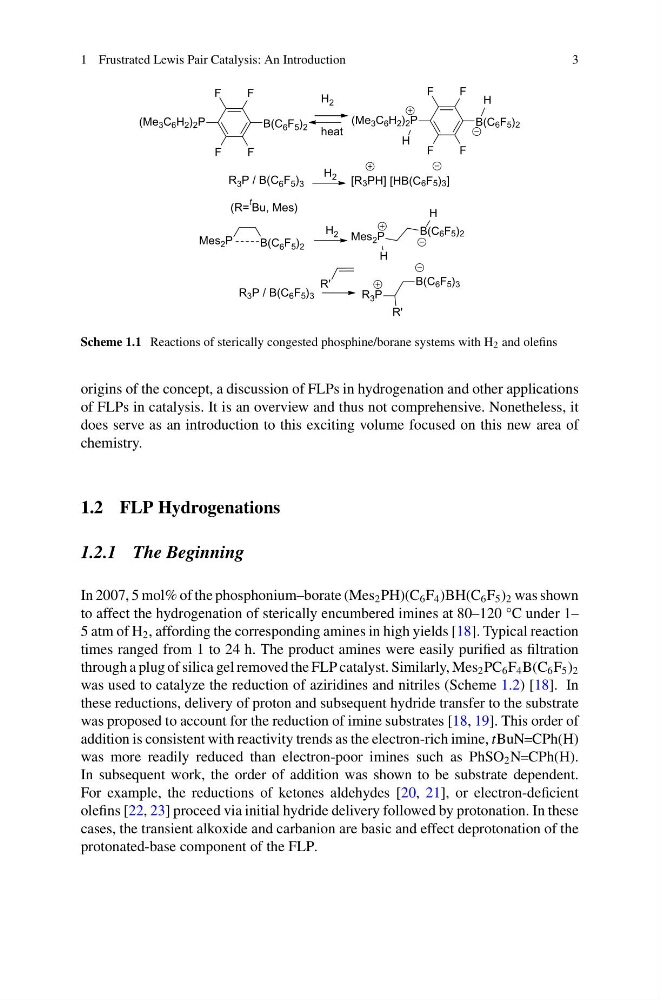
Scheme 1.1 Reactions of sterically congested phosphine/borane systems with H 2 and olefins
origins of the concept, a discussion of FLPs in hydrogenation and other applications
of FLPs in catalysis. It is an overview and thus not comprehensive. Nonetheless, it
does serve as an introduction to this exciting volume focused on this new area of
chemistry.
1.2 FLP Hydrogenations
1.2.1 The Beginning
In 2007, 5 mol% of the phosphonium–borate (Mes 2 PH)(C 6 F 4 )BH(C 6 F 5 ) 2 was shown
to affect the hydrogenation of sterically encumbered imines at 80–120 °C under 1–
5 atm of H 2 , affording the corresponding amines in high yields [18]. Typical reaction
times ranged from 1 to 24 h. The product amines were easily purified as filtration
through a plug of silica gel removed the FLP catalyst. Similarly, Mes 2 PC 6 F 4 B(C 6 F 5 ) 2
was used to catalyze the reduction of aziridines and nitriles (Scheme 1.2) [18]. In
these reductions, delivery of proton and subsequent hydride transfer to the substrate
was proposed to account for the reduction of imine substrates [18, 19]. This order of
addition is consistent with reactivity trends as the electron-rich imine, tBuN CPh(H)
was more readily reduced than electron-poor imines such as PhSO 2 N CPh(H).
In subsequent work, the order of addition was shown to be substrate dependent.
For example, the reductions of ketones aldehydes [20, 21], or electron-deficient
olefins [22, 23] proceed via initial hydride delivery followed by protonation. In these
cases, the transient alkoxide and carbanion are basic and effect deprotonation of the
protonated-base component of the FLP.
3
B(C 6 F 5 ) 2
(Me 3 C 6 H 2 ) 2 P
F
F
F
F
B(C 6 F 5 ) 2
(Me 3 C 6 H 2 ) 2 P
F
F
F
F
H
H
H 2
heat
R 3 P / B(C 6 F 5 ) 3
(R=
t Bu, Mes)
[R 3 PH] [HB(C6F5)3]
Mes 2 P
B(C 6 F 5 ) 2
Mes 2 P
B(C 6 F 5 ) 2
H 2
R 3 P / B(C 6 F 5 ) 3
R 3 P
B(C 6 F 5 ) 3
R'
R'
H 2
H
H
Scheme 1.1 Reactions of sterically congested phosphine/borane systems with H 2 and olefins
origins of the concept, a discussion of FLPs in hydrogenation and other applications
of FLPs in catalysis. It is an overview and thus not comprehensive. Nonetheless, it
does serve as an introduction to this exciting volume focused on this new area of
chemistry.
1.2 FLP Hydrogenations
1.2.1 The Beginning
In 2007, 5 mol% of the phosphonium–borate (Mes 2 PH)(C 6 F 4 )BH(C 6 F 5 ) 2 was shown
to affect the hydrogenation of sterically encumbered imines at 80–120 °C under 1–
5 atm of H 2 , affording the corresponding amines in high yields [18]. Typical reaction
times ranged from 1 to 24 h. The product amines were easily purified as filtration
through a plug of silica gel removed the FLP catalyst. Similarly, Mes 2 PC 6 F 4 B(C 6 F 5 ) 2
was used to catalyze the reduction of aziridines and nitriles (Scheme 1.2) [18]. In
these reductions, delivery of proton and subsequent hydride transfer to the substrate
was proposed to account for the reduction of imine substrates [18, 19]. This order of
addition is consistent with reactivity trends as the electron-rich imine, tBuN CPh(H)
was more readily reduced than electron-poor imines such as PhSO 2 N CPh(H).
In subsequent work, the order of addition was shown to be substrate dependent.
For example, the reductions of ketones aldehydes [20, 21], or electron-deficient
olefins [22, 23] proceed via initial hydride delivery followed by protonation. In these
cases, the transient alkoxide and carbanion are basic and effect deprotonation of the
protonated-base component of the FLP.