

1 Frustrated Lewis Pair Catalysis: An Introduction
5
Following these early studies, there was a great deal of activity that focused
on the development of a variety of aspects of FLP catalysis. The substrate scope
has broadened, a variety of catalysts were developed, and functional-group tolerant
catalysts were uncovered. Each of these key advancements has played a key role in
the technology for metal-free hydrogenations that has emerged in the last decade.
Some of the highlights of these aspects are discussed below.
1.2.2 Broadening the Substrate Scope
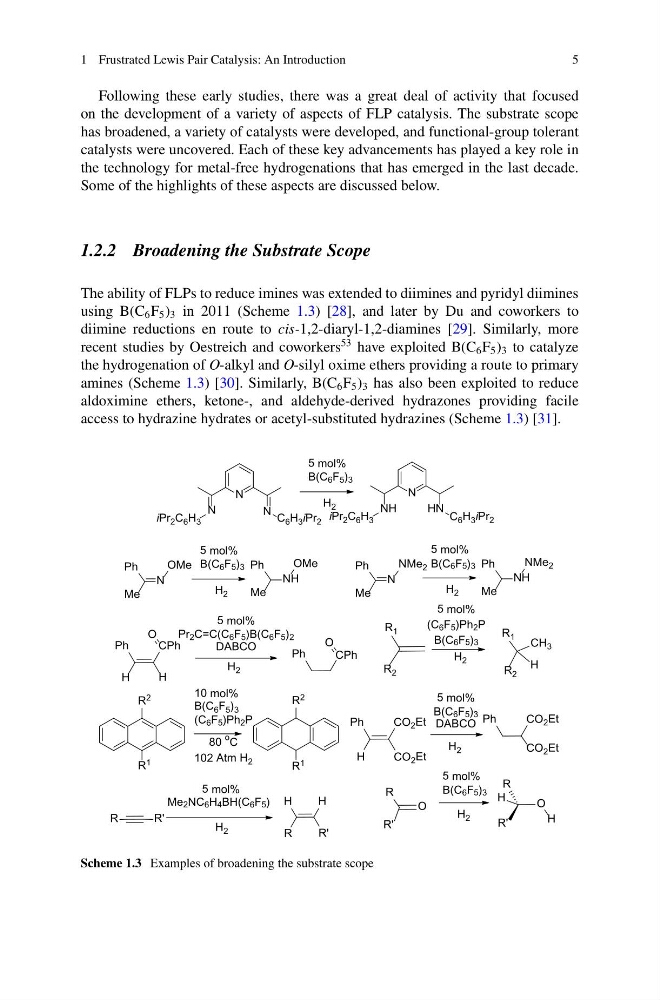
The ability of FLPs to reduce imines was extended to diimines and pyridyl diimines
using B(C 6 F 5 ) 3 in 2011 (Scheme 1.3) [28], and later by Du and coworkers to
diimine reductions en route to cis-1,2-diaryl-1,2-diamines [29]. Similarly, more
recent studies by Oestreich and coworkers
53 have exploited B(C 6 F 5 ) 3 to catalyze
the hydrogenation of O-alkyl and O-silyl oxime ethers providing a route to primary
amines (Scheme 1.3) [30]. Similarly, B(C 6 F 5 ) 3 has also been exploited to reduce
aldoximine ethers, ketone-, and aldehyde-derived hydrazones providing facile
access to hydrazine hydrates or acetyl-substituted hydrazines (Scheme 1.3) [31].
10 mol%
B(C 6 F 5 ) 3
(C 6 F 5 )Ph 2 P
80
o C
102 Atm H 2
R 1
R 2
R 1
R 2
H 2
5 mol%
(C 6 F 5 )Ph 2 P
B(C6F5)3
R 1
R 2
R 1
R 2
CH 3
H
N
N
N
iPr 2 C 6 H 3
C 6 H 3 iPr 2
5 mol%
B(C 6 F 5 ) 3
N
NH
HN
iPr 2 C 6 H 3
C 6 H 3 iPr 2
H 2
Ph
Me
N
OMe
5 mol%
B(C 6 F 5 ) 3
H 2
Ph
Me
NH
OMe
Ph
Me
N
NMe 2
5 mol%
B(C6F5)3
H 2
Ph
Me
NH
NMe 2
H
Ph
CPh
H
O
5 mol%
Pr 2 C=C(C 6 F 5 )B(C 6 F 5 ) 2
DABCO
H 2
Ph
CPh
O
H
Ph
CO 2 Et
CO 2 Et
5 mol%
B(C 6 F 5 ) 3
DABCO
H 2
Ph
CO 2 Et
CO 2 Et
R
R
H
H
R'
H 2
R'
5 mol%
O
R'
R
H
H
O
R'
R
H 2
5 mol%
B(C 6 F 5 ) 3
Me 2 NC 6 H 4 BH(C 6 F 5 )
Scheme 1.3 Examples of broadening the substrate scope
5
Following these early studies, there was a great deal of activity that focused
on the development of a variety of aspects of FLP catalysis. The substrate scope
has broadened, a variety of catalysts were developed, and functional-group tolerant
catalysts were uncovered. Each of these key advancements has played a key role in
the technology for metal-free hydrogenations that has emerged in the last decade.
Some of the highlights of these aspects are discussed below.
1.2.2 Broadening the Substrate Scope
The ability of FLPs to reduce imines was extended to diimines and pyridyl diimines
using B(C 6 F 5 ) 3 in 2011 (Scheme 1.3) [28], and later by Du and coworkers to
diimine reductions en route to cis-1,2-diaryl-1,2-diamines [29]. Similarly, more
recent studies by Oestreich and coworkers
53 have exploited B(C 6 F 5 ) 3 to catalyze
the hydrogenation of O-alkyl and O-silyl oxime ethers providing a route to primary
amines (Scheme 1.3) [30]. Similarly, B(C 6 F 5 ) 3 has also been exploited to reduce
aldoximine ethers, ketone-, and aldehyde-derived hydrazones providing facile
access to hydrazine hydrates or acetyl-substituted hydrazines (Scheme 1.3) [31].
10 mol%
B(C 6 F 5 ) 3
(C 6 F 5 )Ph 2 P
80
o C
102 Atm H 2
R 1
R 2
R 1
R 2
H 2
5 mol%
(C 6 F 5 )Ph 2 P
B(C6F5)3
R 1
R 2
R 1
R 2
CH 3
H
N
N
N
iPr 2 C 6 H 3
C 6 H 3 iPr 2
5 mol%
B(C 6 F 5 ) 3
N
NH
HN
iPr 2 C 6 H 3
C 6 H 3 iPr 2
H 2
Ph
Me
N
OMe
5 mol%
B(C 6 F 5 ) 3
H 2
Ph
Me
NH
OMe
Ph
Me
N
NMe 2
5 mol%
B(C6F5)3
H 2
Ph
Me
NH
NMe 2
H
Ph
CPh
H
O
5 mol%
Pr 2 C=C(C 6 F 5 )B(C 6 F 5 ) 2
DABCO
H 2
Ph
CPh
O
H
Ph
CO 2 Et
CO 2 Et
5 mol%
B(C 6 F 5 ) 3
DABCO
H 2
Ph
CO 2 Et
CO 2 Et
R
R
H
H
R'
H 2
R'
5 mol%
O
R'
R
H
H
O
R'
R
H 2
5 mol%
B(C 6 F 5 ) 3
Me 2 NC 6 H 4 BH(C 6 F 5 )
Scheme 1.3 Examples of broadening the substrate scope