

4 FLP-Mediated C–H-Activation
117
4.2 C–H Functionalization by Transition Metal Complexes
One of the most powerful methodologies to functionalize aromatic molecules is the
C–H borylation using iridium-based catalysts. The first observation of such a process
was reported by Marder and co-workers in 1993 [5], but was only optimized few years
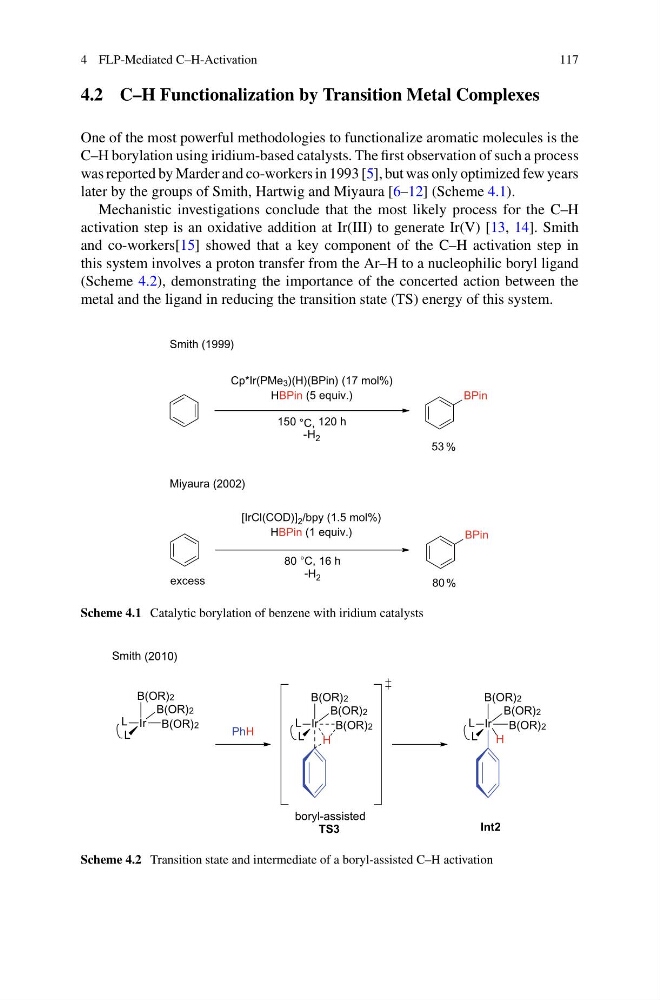
later by the groups of Smith, Hartwig and Miyaura [6–12] (Scheme 4.1).
Mechanistic investigations conclude that the most likely process for the C–H
activation step is an oxidative addition at Ir(III) to generate Ir(V) [13, 14]. Smith
and co-workers[15] showed that a key component of the C–H activation step in
this system involves a proton transfer from the Ar–H to a nucleophilic boryl ligand
(Scheme 4.2), demonstrating the importance of the concerted action between the
metal and the ligand in reducing the transition state (TS) energy of this system.
Cp*Ir(PMe 3 )(H)(BPin) (17 mol%)
HBPin (5 equiv.)
150 °C, 120 h
-H 2
BPin
Smith (1999)
53 %
[IrCl(COD)] 2 /bpy (1.5 mol%)
HBPin (1 equiv.)
excess
BPin
80 %
80 °C, 16 h
-H 2
Miyaura (2002)
Scheme 4.1 Catalytic borylation of benzene with iridium catalysts
Ir
L
L
B(OR)2
B(OR)2
B(OR)2
H
Ir
L
L
B(OR)2
B(OR)2
B(OR)2
PhH
boryl-assisted
TS3
Ir
L
L
B(OR)2
B(OR)2
B(OR)2
H
Int2
Smith (2010)
Scheme 4.2 Transition state and intermediate of a boryl-assisted C–H activation
117
4.2 C–H Functionalization by Transition Metal Complexes
One of the most powerful methodologies to functionalize aromatic molecules is the
C–H borylation using iridium-based catalysts. The first observation of such a process
was reported by Marder and co-workers in 1993 [5], but was only optimized few years
later by the groups of Smith, Hartwig and Miyaura [6–12] (Scheme 4.1).
Mechanistic investigations conclude that the most likely process for the C–H
activation step is an oxidative addition at Ir(III) to generate Ir(V) [13, 14]. Smith
and co-workers[15] showed that a key component of the C–H activation step in
this system involves a proton transfer from the Ar–H to a nucleophilic boryl ligand
(Scheme 4.2), demonstrating the importance of the concerted action between the
metal and the ligand in reducing the transition state (TS) energy of this system.
Cp*Ir(PMe 3 )(H)(BPin) (17 mol%)
HBPin (5 equiv.)
150 °C, 120 h
-H 2
BPin
Smith (1999)
53 %
[IrCl(COD)] 2 /bpy (1.5 mol%)
HBPin (1 equiv.)
excess
BPin
80 %
80 °C, 16 h
-H 2
Miyaura (2002)
Scheme 4.1 Catalytic borylation of benzene with iridium catalysts
Ir
L
L
B(OR)2
B(OR)2
B(OR)2
H
Ir
L
L
B(OR)2
B(OR)2
B(OR)2
PhH
boryl-assisted
TS3
Ir
L
L
B(OR)2
B(OR)2
B(OR)2
H
Int2
Smith (2010)
Scheme 4.2 Transition state and intermediate of a boryl-assisted C–H activation