

116
Y. Soltani and F.-G. Fontaine
the C–H bond is cleaved at the same time as the M–C and R–H bonds are formed.
The R group can be part of the coordination sphere or an outside Lewis base and
this transformation does not involve a change in oxidation state. Although similar in
concept, the electrophilic activation reaction is a two-step mechanism. A Wheland
intermediate is first formed after the initial electrophilic attack of a Lewis acid to
an unsaturated organic compound [4]. The now positively charged arenium cation
is deprotonated by a base to rearomatize the system and generate the final product.
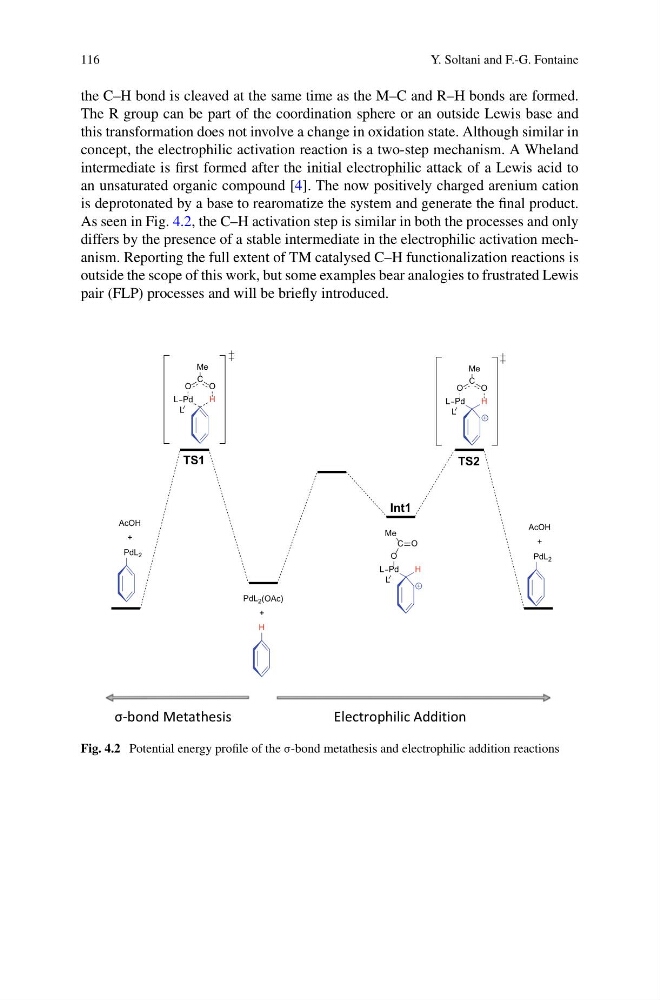
As seen in Fig. 4.2, the C–H activation step is similar in both the processes and only
differs by the presence of a stable intermediate in the electrophilic activation mechanism. Reporting the full extent of TM catalysed C–H functionalization reactions is
outside the scope of this work, but some examples bear analogies to frustrated Lewis
pair (FLP) processes and will be briefly introduced.
TS2
TS1
Int1
Electrophilic Addition
σ-bond Metathesis
H
PdL 2 (OAc)
+
H
O
C
O
Pd
Me
L
L
PdL 2
AcOH
+
PdL 2
AcOH
+
H
O
C
O
Pd
Me
L
L
H
O
C
O
Pd
Me
L
L
Fig. 4.2 Potential energy profile of the σ-bond metathesis and electrophilic addition reactions
Y. Soltani and F.-G. Fontaine
the C–H bond is cleaved at the same time as the M–C and R–H bonds are formed.
The R group can be part of the coordination sphere or an outside Lewis base and
this transformation does not involve a change in oxidation state. Although similar in
concept, the electrophilic activation reaction is a two-step mechanism. A Wheland
intermediate is first formed after the initial electrophilic attack of a Lewis acid to
an unsaturated organic compound [4]. The now positively charged arenium cation
is deprotonated by a base to rearomatize the system and generate the final product.
As seen in Fig. 4.2, the C–H activation step is similar in both the processes and only
differs by the presence of a stable intermediate in the electrophilic activation mechanism. Reporting the full extent of TM catalysed C–H functionalization reactions is
outside the scope of this work, but some examples bear analogies to frustrated Lewis
pair (FLP) processes and will be briefly introduced.
TS2
TS1
Int1
Electrophilic Addition
σ-bond Metathesis
H
PdL 2 (OAc)
+
H
O
C
O
Pd
Me
L
L
PdL 2
AcOH
+
PdL 2
AcOH
+
H
O
C
O
Pd
Me
L
L
H
O
C
O
Pd
Me
L
L
Fig. 4.2 Potential energy profile of the σ-bond metathesis and electrophilic addition reactions