

4 FLP-Mediated C–H-Activation
115
4.1 Introduction
Following many important discoveries since the beginning of the century, C–H functionalization has become a cornerstone in green chemistry. The ability to cleave
selectively C–H bonds in inactivated molecules to install active functional groups
and create complex architectures can prove both atomically and economically efficient. It is indeed a great tool for late-stage functionalization, an attractive property
in pharmaceutical and medicinal chemistry [1, 2]. It also limits the amount of waste
since it does not require the presence of functional groups on the starting materials.
One key component of the C–H functionalization reaction by transition metals (TM)
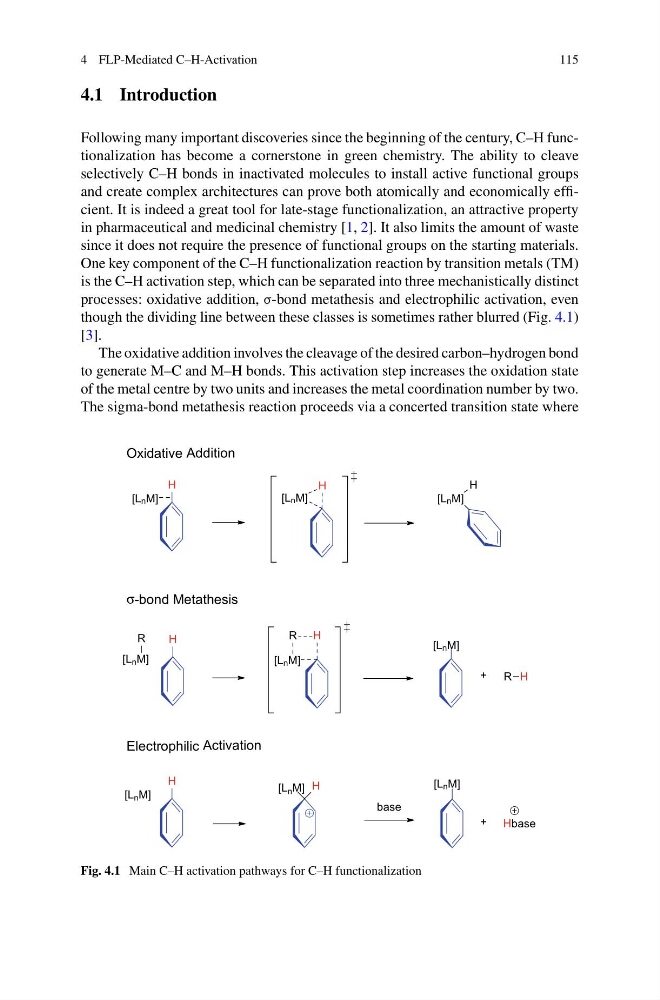
is the C–H activation step, which can be separated into three mechanistically distinct
processes: oxidative addition, σ-bond metathesis and electrophilic activation, even
though the dividing line between these classes is sometimes rather blurred (Fig. 4.1)
[3].
The oxidative addition involves the cleavage of the desired carbon–hydrogen bond
to generate M–C and M–H bonds. This activation step increases the oxidation state
of the metal centre by two units and increases the metal coordination number by two.
The sigma-bond metathesis reaction proceeds via a concerted transition state where
Oxidative Addition
σ-bond Metathesis
[L n M]
H
H
[LnM]
[LnM]
[LnM]
H
R
[L n M]
H
R
[L n M]
H
[L n M]
R H
H
[L n M]
H
[L n M]
base
Hbase
+
Electrophilic Activation
+
Fig. 4.1 Main C–H activation pathways for C–H functionalization
115
4.1 Introduction
Following many important discoveries since the beginning of the century, C–H functionalization has become a cornerstone in green chemistry. The ability to cleave
selectively C–H bonds in inactivated molecules to install active functional groups
and create complex architectures can prove both atomically and economically efficient. It is indeed a great tool for late-stage functionalization, an attractive property
in pharmaceutical and medicinal chemistry [1, 2]. It also limits the amount of waste
since it does not require the presence of functional groups on the starting materials.
One key component of the C–H functionalization reaction by transition metals (TM)
is the C–H activation step, which can be separated into three mechanistically distinct
processes: oxidative addition, σ-bond metathesis and electrophilic activation, even
though the dividing line between these classes is sometimes rather blurred (Fig. 4.1)
[3].
The oxidative addition involves the cleavage of the desired carbon–hydrogen bond
to generate M–C and M–H bonds. This activation step increases the oxidation state
of the metal centre by two units and increases the metal coordination number by two.
The sigma-bond metathesis reaction proceeds via a concerted transition state where
Oxidative Addition
σ-bond Metathesis
[L n M]
H
H
[LnM]
[LnM]
[LnM]
H
R
[L n M]
H
R
[L n M]
H
[L n M]
R H
H
[L n M]
H
[L n M]
base
Hbase
+
Electrophilic Activation
+
Fig. 4.1 Main C–H activation pathways for C–H functionalization