

118
Y. Soltani and F.-G. Fontaine
R 1
R 2
N
Me
Me
Pd(OAc) 2
CHCl 3
Ryabov (1985)
(falsely suspected arenium species)
N
Pd
OAc
O
H
O
Me
TS4
R 1
R 2
NMe 2
Pd
OAc
2
1/2
AcOH
+
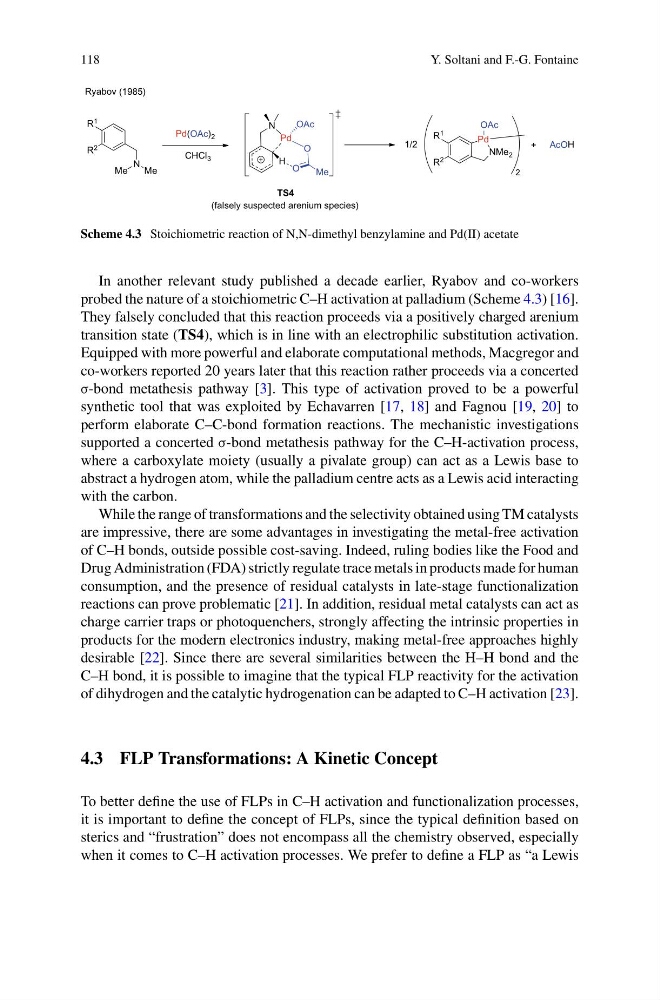
Scheme 4.3 Stoichiometric reaction of N,N-dimethyl benzylamine and Pd(II) acetate
In another relevant study published a decade earlier, Ryabov and co-workers
probed the nature of a stoichiometric C–H activation at palladium (Scheme 4.3) [16].
They falsely concluded that this reaction proceeds via a positively charged arenium
transition state (TS4), which is in line with an electrophilic substitution activation.
Equipped with more powerful and elaborate computational methods, Macgregor and
co-workers reported 20 years later that this reaction rather proceeds via a concerted
σ-bond metathesis pathway [3]. This type of activation proved to be a powerful
synthetic tool that was exploited by Echavarren [17, 18] and Fagnou [19, 20] to
perform elaborate C–C-bond formation reactions. The mechanistic investigations
supported a concerted σ-bond metathesis pathway for the C–H-activation process,
where a carboxylate moiety (usually a pivalate group) can act as a Lewis base to
abstract a hydrogen atom, while the palladium centre acts as a Lewis acid interacting
with the carbon.
While the range of transformations and the selectivity obtained using TM catalysts
are impressive, there are some advantages in investigating the metal-free activation
of C–H bonds, outside possible cost-saving. Indeed, ruling bodies like the Food and
Drug Administration (FDA) strictly regulate trace metals in products made for human
consumption, and the presence of residual catalysts in late-stage functionalization
reactions can prove problematic [21]. In addition, residual metal catalysts can act as
charge carrier traps or photoquenchers, strongly affecting the intrinsic properties in
products for the modern electronics industry, making metal-free approaches highly
desirable [22]. Since there are several similarities between the H–H bond and the
C–H bond, it is possible to imagine that the typical FLP reactivity for the activation
of dihydrogen and the catalytic hydrogenation can be adapted to C–H activation [23].
4.3 FLP Transformations: A Kinetic Concept
To better define the use of FLPs in C–H activation and functionalization processes,
it is important to define the concept of FLPs, since the typical definition based on
sterics and “frustration” does not encompass all the chemistry observed, especially
when it comes to C–H activation processes. We prefer to define a FLP as “a Lewis
Y. Soltani and F.-G. Fontaine
R 1
R 2
N
Me
Me
Pd(OAc) 2
CHCl 3
Ryabov (1985)
(falsely suspected arenium species)
N
Pd
OAc
O
H
O
Me
TS4
R 1
R 2
NMe 2
Pd
OAc
2
1/2
AcOH
+
Scheme 4.3 Stoichiometric reaction of N,N-dimethyl benzylamine and Pd(II) acetate
In another relevant study published a decade earlier, Ryabov and co-workers
probed the nature of a stoichiometric C–H activation at palladium (Scheme 4.3) [16].
They falsely concluded that this reaction proceeds via a positively charged arenium
transition state (TS4), which is in line with an electrophilic substitution activation.
Equipped with more powerful and elaborate computational methods, Macgregor and
co-workers reported 20 years later that this reaction rather proceeds via a concerted
σ-bond metathesis pathway [3]. This type of activation proved to be a powerful
synthetic tool that was exploited by Echavarren [17, 18] and Fagnou [19, 20] to
perform elaborate C–C-bond formation reactions. The mechanistic investigations
supported a concerted σ-bond metathesis pathway for the C–H-activation process,
where a carboxylate moiety (usually a pivalate group) can act as a Lewis base to
abstract a hydrogen atom, while the palladium centre acts as a Lewis acid interacting
with the carbon.
While the range of transformations and the selectivity obtained using TM catalysts
are impressive, there are some advantages in investigating the metal-free activation
of C–H bonds, outside possible cost-saving. Indeed, ruling bodies like the Food and
Drug Administration (FDA) strictly regulate trace metals in products made for human
consumption, and the presence of residual catalysts in late-stage functionalization
reactions can prove problematic [21]. In addition, residual metal catalysts can act as
charge carrier traps or photoquenchers, strongly affecting the intrinsic properties in
products for the modern electronics industry, making metal-free approaches highly
desirable [22]. Since there are several similarities between the H–H bond and the
C–H bond, it is possible to imagine that the typical FLP reactivity for the activation
of dihydrogen and the catalytic hydrogenation can be adapted to C–H activation [23].
4.3 FLP Transformations: A Kinetic Concept
To better define the use of FLPs in C–H activation and functionalization processes,
it is important to define the concept of FLPs, since the typical definition based on
sterics and “frustration” does not encompass all the chemistry observed, especially
when it comes to C–H activation processes. We prefer to define a FLP as “a Lewis