

3 FLP Reduction of Carbon Monoxide and Related Reactions
105
Cp* 2 Zr
CH 3
CH 3
108
+
N O
TEMPO
Cp* 2 Zr
CH 3
109
+
N O
CH 3
TEMPO
Cp* 2 Zr
CH 3
110
N
O
HB(C 6 F 5 ) 2
Cp* 2 Zr
H
111
N
O
B(C 6 F 5 ) 2
H 3 C
CO
Cp* 2 Zr
O
112
O
(C 6 F 5 ) 2 B
N
H
CH 3
B(C 6 F 5 ) 3
Cp* 2 Zr
113
N
O
B(C 6 F 5 ) 3
H 3 C
FLP reactions
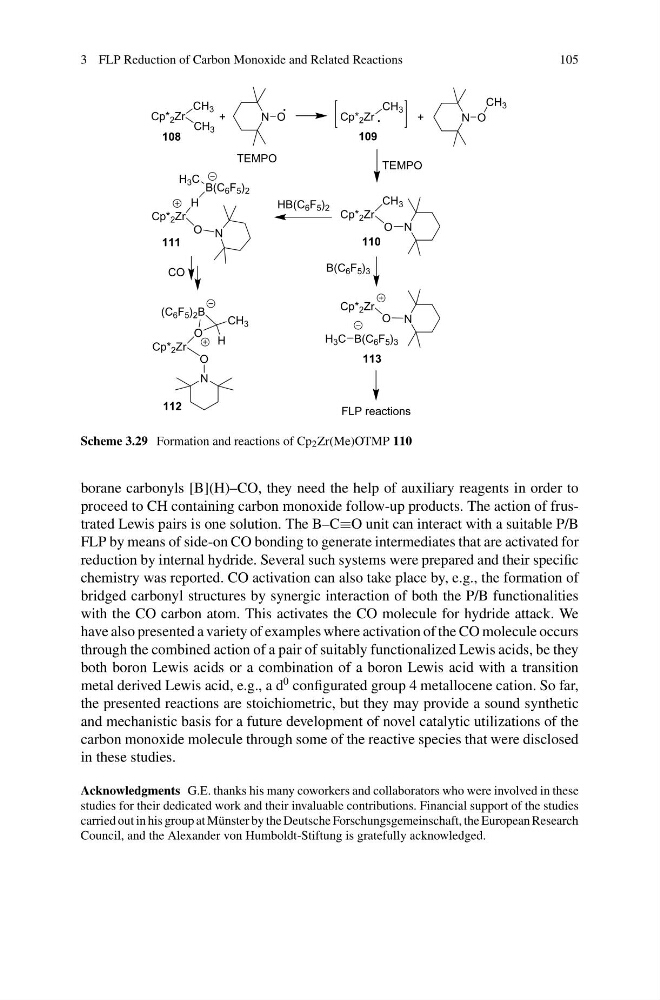
Scheme 3.29 Formation and reactions of Cp 2 Zr(Me)OTMP 110
borane carbonyls [B](H)–CO, they need the help of auxiliary reagents in order to
proceed to CH containing carbon monoxide follow-up products. The action of frustrated Lewis pairs is one solution. The B–C≡O unit can interact with a suitable P/B
FLP by means of side-on CO bonding to generate intermediates that are activated for
reduction by internal hydride. Several such systems were prepared and their specific
chemistry was reported. CO activation can also take place by, e.g., the formation of
bridged carbonyl structures by synergic interaction of both the P/B functionalities
with the CO carbon atom. This activates the CO molecule for hydride attack. We
have also presented a variety of examples where activation of the CO molecule occurs
through the combined action of a pair of suitably functionalized Lewis acids, be they
both boron Lewis acids or a combination of a boron Lewis acid with a transition
metal derived Lewis acid, e.g., a d
0 configurated group 4 metallocene cation. So far,
the presented reactions are stoichiometric, but they may provide a sound synthetic
and mechanistic basis for a future development of novel catalytic utilizations of the
carbon monoxide molecule through some of the reactive species that were disclosed
in these studies.
Acknowledgments G.E. thanks his many coworkers and collaborators who were involved in these
studies for their dedicated work and their invaluable contributions. Financial support of the studies
carried out in his group at Münster by the Deutsche Forschungsgemeinschaft, the European Research
Council, and the Alexander von Humboldt-Stiftung is gratefully acknowledged.
105
Cp* 2 Zr
CH 3
CH 3
108
+
N O
TEMPO
Cp* 2 Zr
CH 3
109
+
N O
CH 3
TEMPO
Cp* 2 Zr
CH 3
110
N
O
HB(C 6 F 5 ) 2
Cp* 2 Zr
H
111
N
O
B(C 6 F 5 ) 2
H 3 C
CO
Cp* 2 Zr
O
112
O
(C 6 F 5 ) 2 B
N
H
CH 3
B(C 6 F 5 ) 3
Cp* 2 Zr
113
N
O
B(C 6 F 5 ) 3
H 3 C
FLP reactions
Scheme 3.29 Formation and reactions of Cp 2 Zr(Me)OTMP 110
borane carbonyls [B](H)–CO, they need the help of auxiliary reagents in order to
proceed to CH containing carbon monoxide follow-up products. The action of frustrated Lewis pairs is one solution. The B–C≡O unit can interact with a suitable P/B
FLP by means of side-on CO bonding to generate intermediates that are activated for
reduction by internal hydride. Several such systems were prepared and their specific
chemistry was reported. CO activation can also take place by, e.g., the formation of
bridged carbonyl structures by synergic interaction of both the P/B functionalities
with the CO carbon atom. This activates the CO molecule for hydride attack. We
have also presented a variety of examples where activation of the CO molecule occurs
through the combined action of a pair of suitably functionalized Lewis acids, be they
both boron Lewis acids or a combination of a boron Lewis acid with a transition
metal derived Lewis acid, e.g., a d
0 configurated group 4 metallocene cation. So far,
the presented reactions are stoichiometric, but they may provide a sound synthetic
and mechanistic basis for a future development of novel catalytic utilizations of the
carbon monoxide molecule through some of the reactive species that were disclosed
in these studies.
Acknowledgments G.E. thanks his many coworkers and collaborators who were involved in these
studies for their dedicated work and their invaluable contributions. Financial support of the studies
carried out in his group at Münster by the Deutsche Forschungsgemeinschaft, the European Research
Council, and the Alexander von Humboldt-Stiftung is gratefully acknowledged.