

104
T. Wang et al.
Cp* 2 Zr
OMes
CH 3
101
Cp* 2 Zr
OMes
O
104
B(C 6 F 5 ) 2
H CH 3
Cp* 2 Zr
OMes
O
103
B(C 6 F 5 ) 2
H CH 3
+
HB(C 6 F 5 ) 2
H 3 C B(C 6 F 5 ) 2
98
Cp* 2 Zr
OMes
H
83
+
CO
102
Cp* 2 Zr
OMes
O
105
B(C 6 F 5 ) 2
H 3 C
C
H
O
Cp* 2 Zr
OMes
O
106
B(C 6 F 5 ) 2
H 3 C
C
H
Cp* 2 Zr
OMes
O
107
O
B(C 6 F 5 ) 2
CH 3
H
CO
Cp* 2 Zr
OMes
O
B(C 6 F 5 ) 2
H 3 C H
O
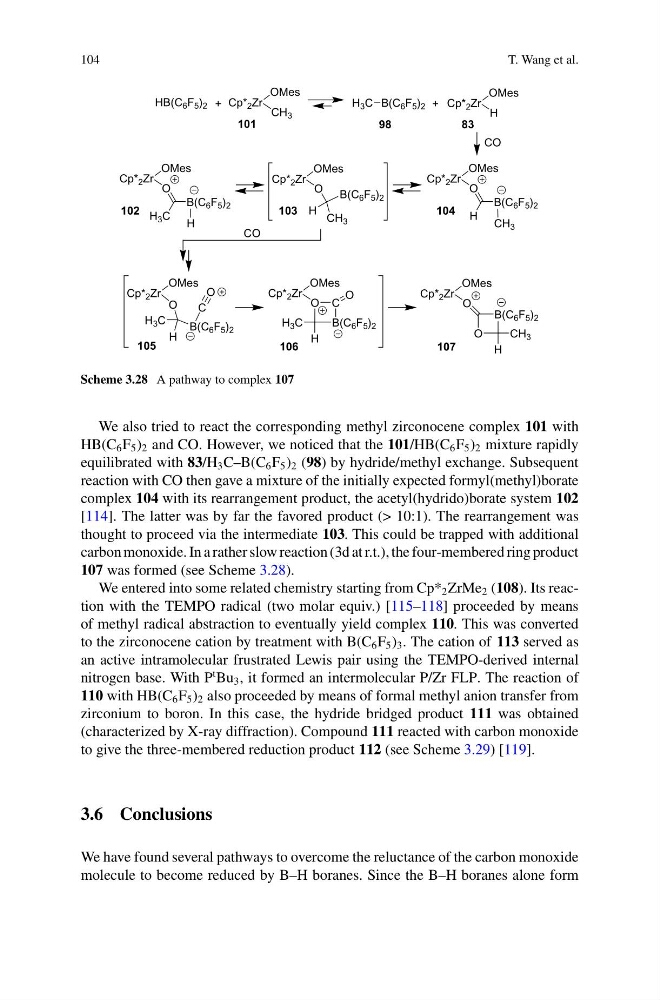
Scheme 3.28 A pathway to complex 107
We also tried to react the corresponding methyl zirconocene complex 101 with
HB(C 6 F 5 ) 2 and CO. However, we noticed that the 101/HB(C 6 F 5 ) 2 mixture rapidly
equilibrated with 83/H 3 C–B(C 6 F 5 ) 2 (98) by hydride/methyl exchange. Subsequent
reaction with CO then gave a mixture of the initially expected formyl(methyl)borate
complex 104 with its rearrangement product, the acetyl(hydrido)borate system 102
[114]. The latter was by far the favored product (> 10:1). The rearrangement was
thought to proceed via the intermediate 103. This could be trapped with additional
carbon monoxide. In a rather slow reaction (3d at r.t.), the four-membered ring product
107 was formed (see Scheme 3.28).
We entered into some related chemistry starting from Cp* 2 ZrMe 2 (108). Its reaction with the TEMPO radical (two molar equiv.) [115–118] proceeded by means
of methyl radical abstraction to eventually yield complex 110. This was converted
to the zirconocene cation by treatment with B(C 6 F 5 ) 3 . The cation of 113 served as
an active intramolecular frustrated Lewis pair using the TEMPO-derived internal
nitrogen base. With P
t Bu 3 , it formed an intermolecular P/Zr FLP. The reaction of
110 with HB(C 6 F 5 ) 2 also proceeded by means of formal methyl anion transfer from
zirconium to boron. In this case, the hydride bridged product 111 was obtained
(characterized by X-ray diffraction). Compound 111 reacted with carbon monoxide
to give the three-membered reduction product 112 (see Scheme 3.29) [119].
3.6 Conclusions
We have found several pathways to overcome the reluctance of the carbon monoxide
molecule to become reduced by B–H boranes. Since the B–H boranes alone form
T. Wang et al.
Cp* 2 Zr
OMes
CH 3
101
Cp* 2 Zr
OMes
O
104
B(C 6 F 5 ) 2
H CH 3
Cp* 2 Zr
OMes
O
103
B(C 6 F 5 ) 2
H CH 3
+
HB(C 6 F 5 ) 2
H 3 C B(C 6 F 5 ) 2
98
Cp* 2 Zr
OMes
H
83
+
CO
102
Cp* 2 Zr
OMes
O
105
B(C 6 F 5 ) 2
H 3 C
C
H
O
Cp* 2 Zr
OMes
O
106
B(C 6 F 5 ) 2
H 3 C
C
H
Cp* 2 Zr
OMes
O
107
O
B(C 6 F 5 ) 2
CH 3
H
CO
Cp* 2 Zr
OMes
O
B(C 6 F 5 ) 2
H 3 C H
O
Scheme 3.28 A pathway to complex 107
We also tried to react the corresponding methyl zirconocene complex 101 with
HB(C 6 F 5 ) 2 and CO. However, we noticed that the 101/HB(C 6 F 5 ) 2 mixture rapidly
equilibrated with 83/H 3 C–B(C 6 F 5 ) 2 (98) by hydride/methyl exchange. Subsequent
reaction with CO then gave a mixture of the initially expected formyl(methyl)borate
complex 104 with its rearrangement product, the acetyl(hydrido)borate system 102
[114]. The latter was by far the favored product (> 10:1). The rearrangement was
thought to proceed via the intermediate 103. This could be trapped with additional
carbon monoxide. In a rather slow reaction (3d at r.t.), the four-membered ring product
107 was formed (see Scheme 3.28).
We entered into some related chemistry starting from Cp* 2 ZrMe 2 (108). Its reaction with the TEMPO radical (two molar equiv.) [115–118] proceeded by means
of methyl radical abstraction to eventually yield complex 110. This was converted
to the zirconocene cation by treatment with B(C 6 F 5 ) 3 . The cation of 113 served as
an active intramolecular frustrated Lewis pair using the TEMPO-derived internal
nitrogen base. With P
t Bu 3 , it formed an intermolecular P/Zr FLP. The reaction of
110 with HB(C 6 F 5 ) 2 also proceeded by means of formal methyl anion transfer from
zirconium to boron. In this case, the hydride bridged product 111 was obtained
(characterized by X-ray diffraction). Compound 111 reacted with carbon monoxide
to give the three-membered reduction product 112 (see Scheme 3.29) [119].
3.6 Conclusions
We have found several pathways to overcome the reluctance of the carbon monoxide
molecule to become reduced by B–H boranes. Since the B–H boranes alone form