

102
T. Wang et al.
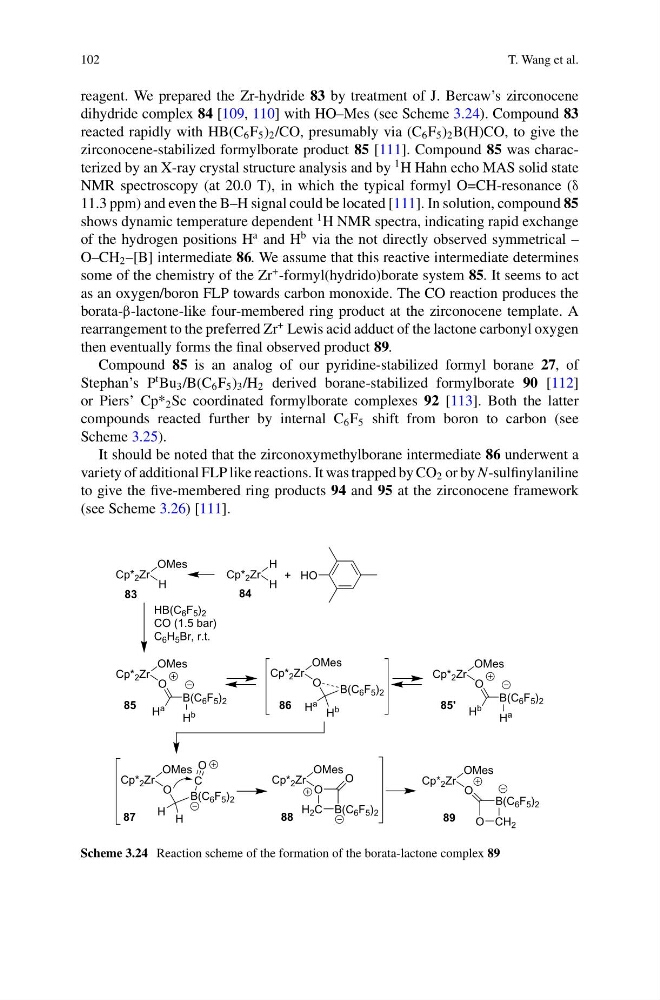
reagent. We prepared the Zr-hydride 83 by treatment of J. Bercaw’s zirconocene
dihydride complex 84 [109, 110] with HO–Mes (see Scheme 3.24). Compound 83
reacted rapidly with HB(C 6 F 5 ) 2 /CO, presumably via (C 6 F 5 ) 2 B(H)CO, to give the
zirconocene-stabilized formylborate product 85 [111]. Compound 85 was characterized by an X-ray crystal structure analysis and by
1 H Hahn echo MAS solid state
NMR spectroscopy (at 20.0 T), in which the typical formyl O=CH-resonance (δ
11.3 ppm) and even the B–H signal could be located [111]. In solution, compound 85
shows dynamic temperature dependent
1 H NMR spectra, indicating rapid exchange
of the hydrogen positions H
a and H
b via the not directly observed symmetrical –
O–CH 2 –[B] intermediate 86. We assume that this reactive intermediate determines
some of the chemistry of the Zr
+ -formyl(hydrido)borate system 85. It seems to act
as an oxygen/boron FLP towards carbon monoxide. The CO reaction produces the
borata-β-lactone-like four-membered ring product at the zirconocene template. A
rearrangement to the preferred Zr
+ Lewis acid adduct of the lactone carbonyl oxygen
then eventually forms the final observed product 89.
Compound 85 is an analog of our pyridine-stabilized formyl borane 27, of
Stephan’s P
t Bu 3 /B(C 6 F 5 ) 3 /H 2 derived borane-stabilized formylborate 90 [112]
or Piers’ Cp* 2 Sc coordinated formylborate complexes 92 [113]. Both the latter
compounds reacted further by internal C 6 F 5 shift from boron to carbon (see
Scheme 3.25).
It should be noted that the zirconoxymethylborane intermediate 86 underwent a
variety of additional FLP like reactions. It was trapped by CO 2 or by N-sulfinylaniline
to give the five-membered ring products 94 and 95 at the zirconocene framework
(see Scheme 3.26) [111].
Cp* 2 Zr
OMes
H
Cp* 2 Zr
H
H
+ HO
84
83
Cp* 2 Zr
OMes
O
85
B(C 6 F 5 ) 2
H
a
H
b
Cp* 2 Zr
OMes
O
86
B(C 6 F 5 ) 2
H
a
H
b
Cp* 2 Zr
OMes
O
87
B(C 6 F 5 ) 2
H H
C
O
Cp* 2 Zr
OMes
O
88
H 2 C B(C 6 F 5 ) 2
O
Cp* 2 Zr
OMes
O
89
O CH 2
B(C 6 F 5 ) 2
HB(C 6 F 5 ) 2
CO (1.5 bar)
C 6 H 5 Br, r.t.
Cp* 2 Zr
OMes
O
85'
B(C 6 F 5 ) 2
H
b
H
a
Scheme 3.24 Reaction scheme of the formation of the borata-lactone complex 89
T. Wang et al.
reagent. We prepared the Zr-hydride 83 by treatment of J. Bercaw’s zirconocene
dihydride complex 84 [109, 110] with HO–Mes (see Scheme 3.24). Compound 83
reacted rapidly with HB(C 6 F 5 ) 2 /CO, presumably via (C 6 F 5 ) 2 B(H)CO, to give the
zirconocene-stabilized formylborate product 85 [111]. Compound 85 was characterized by an X-ray crystal structure analysis and by
1 H Hahn echo MAS solid state
NMR spectroscopy (at 20.0 T), in which the typical formyl O=CH-resonance (δ
11.3 ppm) and even the B–H signal could be located [111]. In solution, compound 85
shows dynamic temperature dependent
1 H NMR spectra, indicating rapid exchange
of the hydrogen positions H
a and H
b via the not directly observed symmetrical –
O–CH 2 –[B] intermediate 86. We assume that this reactive intermediate determines
some of the chemistry of the Zr
+ -formyl(hydrido)borate system 85. It seems to act
as an oxygen/boron FLP towards carbon monoxide. The CO reaction produces the
borata-β-lactone-like four-membered ring product at the zirconocene template. A
rearrangement to the preferred Zr
+ Lewis acid adduct of the lactone carbonyl oxygen
then eventually forms the final observed product 89.
Compound 85 is an analog of our pyridine-stabilized formyl borane 27, of
Stephan’s P
t Bu 3 /B(C 6 F 5 ) 3 /H 2 derived borane-stabilized formylborate 90 [112]
or Piers’ Cp* 2 Sc coordinated formylborate complexes 92 [113]. Both the latter
compounds reacted further by internal C 6 F 5 shift from boron to carbon (see
Scheme 3.25).
It should be noted that the zirconoxymethylborane intermediate 86 underwent a
variety of additional FLP like reactions. It was trapped by CO 2 or by N-sulfinylaniline
to give the five-membered ring products 94 and 95 at the zirconocene framework
(see Scheme 3.26) [111].
Cp* 2 Zr
OMes
H
Cp* 2 Zr
H
H
+ HO
84
83
Cp* 2 Zr
OMes
O
85
B(C 6 F 5 ) 2
H
a
H
b
Cp* 2 Zr
OMes
O
86
B(C 6 F 5 ) 2
H
a
H
b
Cp* 2 Zr
OMes
O
87
B(C 6 F 5 ) 2
H H
C
O
Cp* 2 Zr
OMes
O
88
H 2 C B(C 6 F 5 ) 2
O
Cp* 2 Zr
OMes
O
89
O CH 2
B(C 6 F 5 ) 2
HB(C 6 F 5 ) 2
CO (1.5 bar)
C 6 H 5 Br, r.t.
Cp* 2 Zr
OMes
O
85'
B(C 6 F 5 ) 2
H
b
H
a
Scheme 3.24 Reaction scheme of the formation of the borata-lactone complex 89