

3 FLP Reduction of Carbon Monoxide and Related Reactions
101
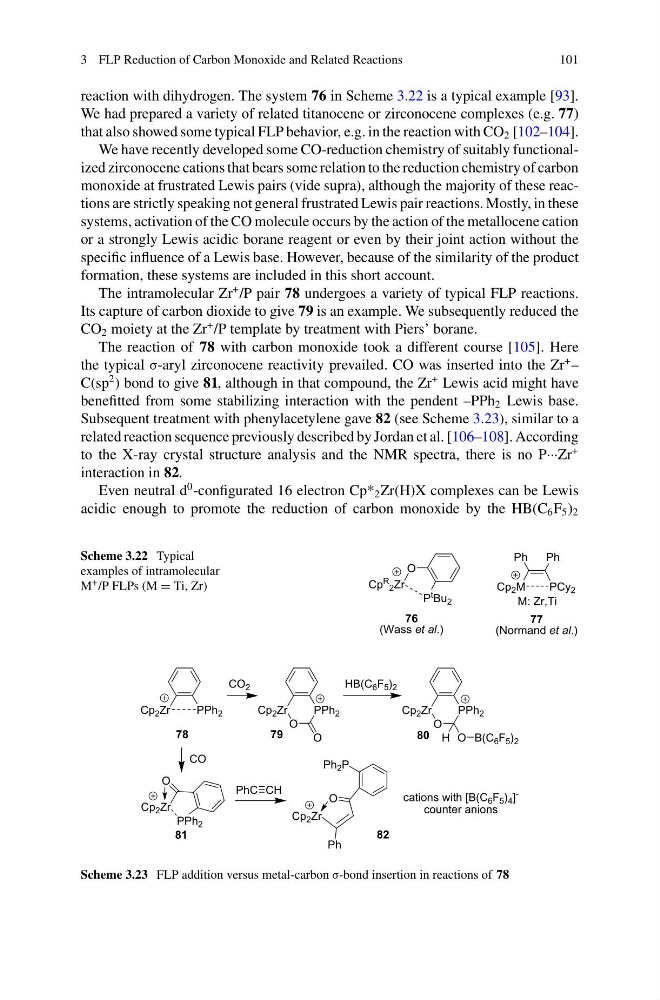
reaction with dihydrogen. The system 76 in Scheme 3.22 is a typical example [93].
We had prepared a variety of related titanocene or zirconocene complexes (e.g. 77)
that also showed some typical FLP behavior, e.g. in the reaction with CO 2 [102–104].
We have recently developed some CO-reduction chemistry of suitably functionalized zirconocene cations that bears some relation to the reduction chemistry of carbon
monoxide at frustrated Lewis pairs (vide supra), although the majority of these reactions are strictly speaking not general frustrated Lewis pair reactions. Mostly, in these
systems, activation of the CO molecule occurs by the action of the metallocene cation
or a strongly Lewis acidic borane reagent or even by their joint action without the
specific influence of a Lewis base. However, because of the similarity of the product
formation, these systems are included in this short account.
The intramolecular Zr
+ /P pair 78 undergoes a variety of typical FLP reactions.
Its capture of carbon dioxide to give 79 is an example. We subsequently reduced the
CO 2 moiety at the Zr
+ /P template by treatment with Piers’ borane.
The reaction of 78 with carbon monoxide took a different course [105]. Here
the typical σ-aryl zirconocene reactivity prevailed. CO was inserted into the Zr
+ –
C(sp
2 ) bond to give 81, although in that compound, the Zr
+ Lewis acid might have
benefitted from some stabilizing interaction with the pendent –PPh 2 Lewis base.
Subsequent treatment with phenylacetylene gave 82 (see Scheme 3.23), similar to a
related reaction sequence previously described by Jordan et al. [106–108]. According
to the X-ray crystal structure analysis and the NMR spectra, there is no P···Zr
+
interaction in 82.
Even neutral d
0 -configurated 16 electron Cp* 2 Zr(H)X complexes can be Lewis
acidic enough to promote the reduction of carbon monoxide by the HB(C 6 F 5 ) 2
Scheme 3.22 Typical
examples of intramolecular
M + /P FLPs (M = Ti, Zr)
O
P
t
Bu 2
Cp
R
2 Zr
76
(Wass et al.)
Cp 2 M
Ph
Ph
PCy 2
77
(Normand et al.)
M: Zr,Ti
Cp 2 Zr
PPh 2
78
CO 2
Cp 2 Zr
PPh 2
79
O
O
HB(C 6 F 5 ) 2
Cp 2 Zr
PPh 2
80
O
O B(C 6 F 5 ) 2
H
CO
Cp 2 Zr
PPh 2
O
81
PhC CH
O
Cp 2 Zr
82
Ph
Ph 2 P
cations with [B(C 6 F 5 ) 4 ]
-
counter anions
Scheme 3.23 FLP addition versus metal-carbon σ-bond insertion in reactions of 78
101
reaction with dihydrogen. The system 76 in Scheme 3.22 is a typical example [93].
We had prepared a variety of related titanocene or zirconocene complexes (e.g. 77)
that also showed some typical FLP behavior, e.g. in the reaction with CO 2 [102–104].
We have recently developed some CO-reduction chemistry of suitably functionalized zirconocene cations that bears some relation to the reduction chemistry of carbon
monoxide at frustrated Lewis pairs (vide supra), although the majority of these reactions are strictly speaking not general frustrated Lewis pair reactions. Mostly, in these
systems, activation of the CO molecule occurs by the action of the metallocene cation
or a strongly Lewis acidic borane reagent or even by their joint action without the
specific influence of a Lewis base. However, because of the similarity of the product
formation, these systems are included in this short account.
The intramolecular Zr
+ /P pair 78 undergoes a variety of typical FLP reactions.
Its capture of carbon dioxide to give 79 is an example. We subsequently reduced the
CO 2 moiety at the Zr
+ /P template by treatment with Piers’ borane.
The reaction of 78 with carbon monoxide took a different course [105]. Here
the typical σ-aryl zirconocene reactivity prevailed. CO was inserted into the Zr
+ –
C(sp
2 ) bond to give 81, although in that compound, the Zr
+ Lewis acid might have
benefitted from some stabilizing interaction with the pendent –PPh 2 Lewis base.
Subsequent treatment with phenylacetylene gave 82 (see Scheme 3.23), similar to a
related reaction sequence previously described by Jordan et al. [106–108]. According
to the X-ray crystal structure analysis and the NMR spectra, there is no P···Zr
+
interaction in 82.
Even neutral d
0 -configurated 16 electron Cp* 2 Zr(H)X complexes can be Lewis
acidic enough to promote the reduction of carbon monoxide by the HB(C 6 F 5 ) 2
Scheme 3.22 Typical
examples of intramolecular
M + /P FLPs (M = Ti, Zr)
O
P
t
Bu 2
Cp
R
2 Zr
76
(Wass et al.)
Cp 2 M
Ph
Ph
PCy 2
77
(Normand et al.)
M: Zr,Ti
Cp 2 Zr
PPh 2
78
CO 2
Cp 2 Zr
PPh 2
79
O
O
HB(C 6 F 5 ) 2
Cp 2 Zr
PPh 2
80
O
O B(C 6 F 5 ) 2
H
CO
Cp 2 Zr
PPh 2
O
81
PhC CH
O
Cp 2 Zr
82
Ph
Ph 2 P
cations with [B(C 6 F 5 ) 4 ]
-
counter anions
Scheme 3.23 FLP addition versus metal-carbon σ-bond insertion in reactions of 78