

100
T. Wang et al.
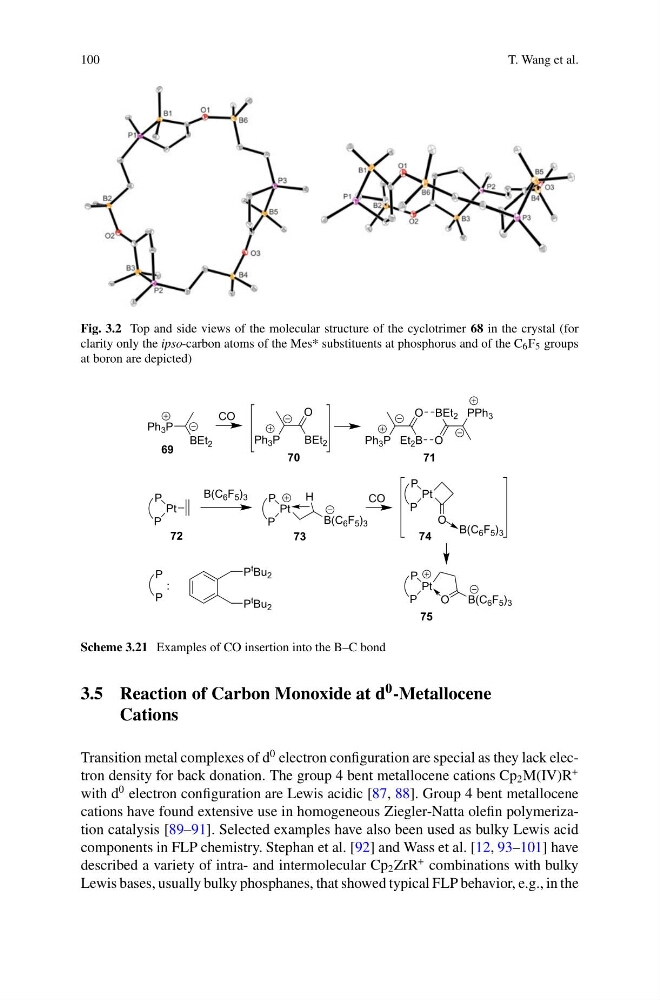
Fig. 3.2 Top and side views of the molecular structure of the cyclotrimer 68 in the crystal (for
clarity only the ipso-carbon atoms of the Mes* substituents at phosphorus and of the C 6 F 5 groups
at boron are depicted)
Ph 3 P
BEt 2
Et 2 B O
BEt 2
O
Ph 3 P
PPh 3
CO
BEt 2
O
Ph 3 P
69
70
71
P
P
Pt
B(C 6 F 5 ) 3
P
P
Pt
H
B(C 6 F 5 ) 3
P
P
Pt
O
B(C 6 F 5 ) 3
P
P
Pt
O
B(C 6 F 5 ) 3
P
P
:
P
t
Bu 2
P
t
Bu 2
72
73
74
75
CO
Scheme 3.21 Examples of CO insertion into the B–C bond
3.5 Reaction of Carbon Monoxide at d 0 -Metallocene
Cations
Transition metal complexes of d
0 electron configuration are special as they lack electron density for back donation. The group 4 bent metallocene cations Cp 2 M(IV)R
+
with d
0 electron configuration are Lewis acidic [87, 88]. Group 4 bent metallocene
cations have found extensive use in homogeneous Ziegler-Natta olefin polymerization catalysis [89–91]. Selected examples have also been used as bulky Lewis acid
components in FLP chemistry. Stephan et al. [92] and Wass et al. [12, 93–101] have
described a variety of intra- and intermolecular Cp 2 ZrR
+ combinations with bulky
Lewis bases, usually bulky phosphanes, that showed typical FLP behavior, e.g., in the
T. Wang et al.
Fig. 3.2 Top and side views of the molecular structure of the cyclotrimer 68 in the crystal (for
clarity only the ipso-carbon atoms of the Mes* substituents at phosphorus and of the C 6 F 5 groups
at boron are depicted)
Ph 3 P
BEt 2
Et 2 B O
BEt 2
O
Ph 3 P
PPh 3
CO
BEt 2
O
Ph 3 P
69
70
71
P
P
Pt
B(C 6 F 5 ) 3
P
P
Pt
H
B(C 6 F 5 ) 3
P
P
Pt
O
B(C 6 F 5 ) 3
P
P
Pt
O
B(C 6 F 5 ) 3
P
P
:
P
t
Bu 2
P
t
Bu 2
72
73
74
75
CO
Scheme 3.21 Examples of CO insertion into the B–C bond
3.5 Reaction of Carbon Monoxide at d 0 -Metallocene
Cations
Transition metal complexes of d
0 electron configuration are special as they lack electron density for back donation. The group 4 bent metallocene cations Cp 2 M(IV)R
+
with d
0 electron configuration are Lewis acidic [87, 88]. Group 4 bent metallocene
cations have found extensive use in homogeneous Ziegler-Natta olefin polymerization catalysis [89–91]. Selected examples have also been used as bulky Lewis acid
components in FLP chemistry. Stephan et al. [92] and Wass et al. [12, 93–101] have
described a variety of intra- and intermolecular Cp 2 ZrR
+ combinations with bulky
Lewis bases, usually bulky phosphanes, that showed typical FLP behavior, e.g., in the