

98
T. Wang et al.
HB(C 6 F 5 ) 2 hydroboration of the aryl(divinyl)phosphanes 60b and 60c, which
feature the bulky 2,6-dimesitylphenyl (Dmesp) or 2,4,6-tri(iso-propyl)phenyl (Tipp)
ligands at phosphorus instead of Mes*, gave the P/B/B FLP systems 61b and 61c,
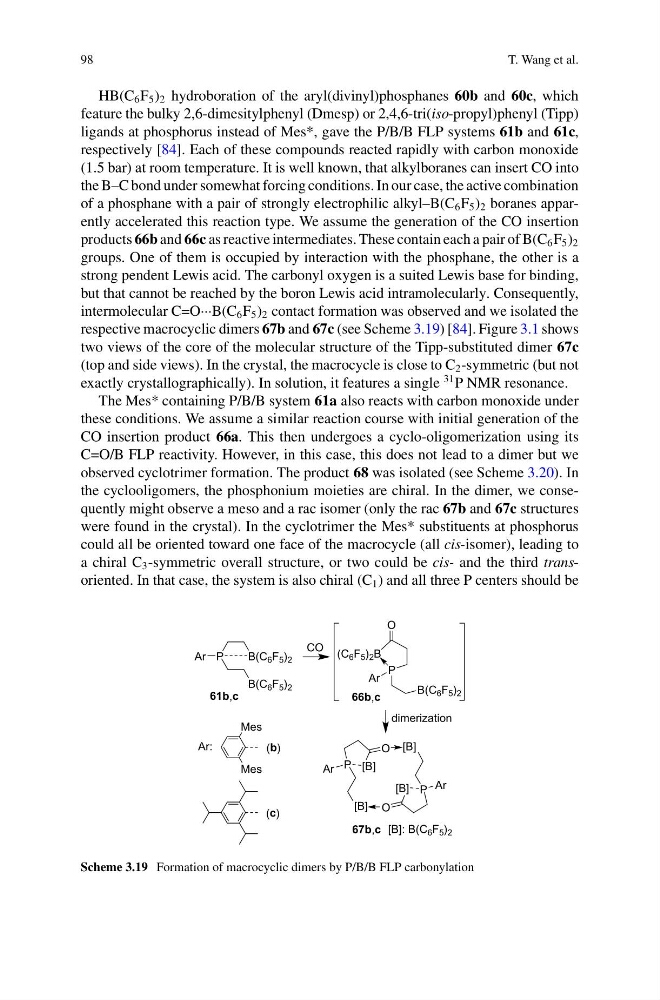
respectively [84]. Each of these compounds reacted rapidly with carbon monoxide
(1.5 bar) at room temperature. It is well known, that alkylboranes can insert CO into
the B–C bond under somewhat forcing conditions. In our case, the active combination
of a phosphane with a pair of strongly electrophilic alkyl–B(C 6 F 5 ) 2 boranes apparently accelerated this reaction type. We assume the generation of the CO insertion
products 66b and 66c as reactive intermediates. These contain each a pair of B(C 6 F 5 ) 2
groups. One of them is occupied by interaction with the phosphane, the other is a
strong pendent Lewis acid. The carbonyl oxygen is a suited Lewis base for binding,
but that cannot be reached by the boron Lewis acid intramolecularly. Consequently,
intermolecular C=O···B(C 6 F 5 ) 2 contact formation was observed and we isolated the
respective macrocyclic dimers 67b and 67c (see Scheme 3.19) [84]. Figure 3.1 shows
two views of the core of the molecular structure of the Tipp-substituted dimer 67c
(top and side views). In the crystal, the macrocycle is close to C 2 -symmetric (but not
exactly crystallographically). In solution, it features a single
31 P NMR resonance.
The Mes* containing P/B/B system 61a also reacts with carbon monoxide under
these conditions. We assume a similar reaction course with initial generation of the
CO insertion product 66a. This then undergoes a cyclo-oligomerization using its
C=O/B FLP reactivity. However, in this case, this does not lead to a dimer but we
observed cyclotrimer formation. The product 68 was isolated (see Scheme 3.20). In
the cyclooligomers, the phosphonium moieties are chiral. In the dimer, we consequently might observe a meso and a rac isomer (only the rac 67b and 67c structures
were found in the crystal). In the cyclotrimer the Mes* substituents at phosphorus
could all be oriented toward one face of the macrocycle (all cis-isomer), leading to
a chiral C 3 -symmetric overall structure, or two could be cis- and the third transoriented. In that case, the system is also chiral (C 1 ) and all three P centers should be
P
B(C 6 F 5 ) 2
B(C 6 F 5 ) 2
61b,c
Ar
CO (C 6 F 5 ) 2 B
P
B(C 6 F 5 ) 2
O
Ar
66b,c
dimerization
P [B]
O
Ar
[B]
P
[B]
O
Ar
[B]
Ar:
Mes
Mes
(b)
(c)
67b,c [B]: B(C 6 F 5 ) 2
Scheme 3.19 Formation of macrocyclic dimers by P/B/B FLP carbonylation
T. Wang et al.
HB(C 6 F 5 ) 2 hydroboration of the aryl(divinyl)phosphanes 60b and 60c, which
feature the bulky 2,6-dimesitylphenyl (Dmesp) or 2,4,6-tri(iso-propyl)phenyl (Tipp)
ligands at phosphorus instead of Mes*, gave the P/B/B FLP systems 61b and 61c,
respectively [84]. Each of these compounds reacted rapidly with carbon monoxide
(1.5 bar) at room temperature. It is well known, that alkylboranes can insert CO into
the B–C bond under somewhat forcing conditions. In our case, the active combination
of a phosphane with a pair of strongly electrophilic alkyl–B(C 6 F 5 ) 2 boranes apparently accelerated this reaction type. We assume the generation of the CO insertion
products 66b and 66c as reactive intermediates. These contain each a pair of B(C 6 F 5 ) 2
groups. One of them is occupied by interaction with the phosphane, the other is a
strong pendent Lewis acid. The carbonyl oxygen is a suited Lewis base for binding,
but that cannot be reached by the boron Lewis acid intramolecularly. Consequently,
intermolecular C=O···B(C 6 F 5 ) 2 contact formation was observed and we isolated the
respective macrocyclic dimers 67b and 67c (see Scheme 3.19) [84]. Figure 3.1 shows
two views of the core of the molecular structure of the Tipp-substituted dimer 67c
(top and side views). In the crystal, the macrocycle is close to C 2 -symmetric (but not
exactly crystallographically). In solution, it features a single
31 P NMR resonance.
The Mes* containing P/B/B system 61a also reacts with carbon monoxide under
these conditions. We assume a similar reaction course with initial generation of the
CO insertion product 66a. This then undergoes a cyclo-oligomerization using its
C=O/B FLP reactivity. However, in this case, this does not lead to a dimer but we
observed cyclotrimer formation. The product 68 was isolated (see Scheme 3.20). In
the cyclooligomers, the phosphonium moieties are chiral. In the dimer, we consequently might observe a meso and a rac isomer (only the rac 67b and 67c structures
were found in the crystal). In the cyclotrimer the Mes* substituents at phosphorus
could all be oriented toward one face of the macrocycle (all cis-isomer), leading to
a chiral C 3 -symmetric overall structure, or two could be cis- and the third transoriented. In that case, the system is also chiral (C 1 ) and all three P centers should be
P
B(C 6 F 5 ) 2
B(C 6 F 5 ) 2
61b,c
Ar
CO (C 6 F 5 ) 2 B
P
B(C 6 F 5 ) 2
O
Ar
66b,c
dimerization
P [B]
O
Ar
[B]
P
[B]
O
Ar
[B]
Ar:
Mes
Mes
(b)
(c)
67b,c [B]: B(C 6 F 5 ) 2
Scheme 3.19 Formation of macrocyclic dimers by P/B/B FLP carbonylation