

96
T. Wang et al.
Sc
Sc
Me 2 Si
PhN
B
N
N
Ar
C
O
THF
Ar
53
53'
Me 2 Si
PhN
Cl
B
Li(THF) 3
N
N
Ar
Ar
Sc
Me 2 Si
B
N N
Ar
Ar
O
C
C
O
PhN
2 CO
52
54
CO
Ar: 2,6-diisopropyl
phenyl
THF
THF
Sc
Me 2 Si
PhN
B
N
N
Ar
C
O
THF
Ar
:
CO
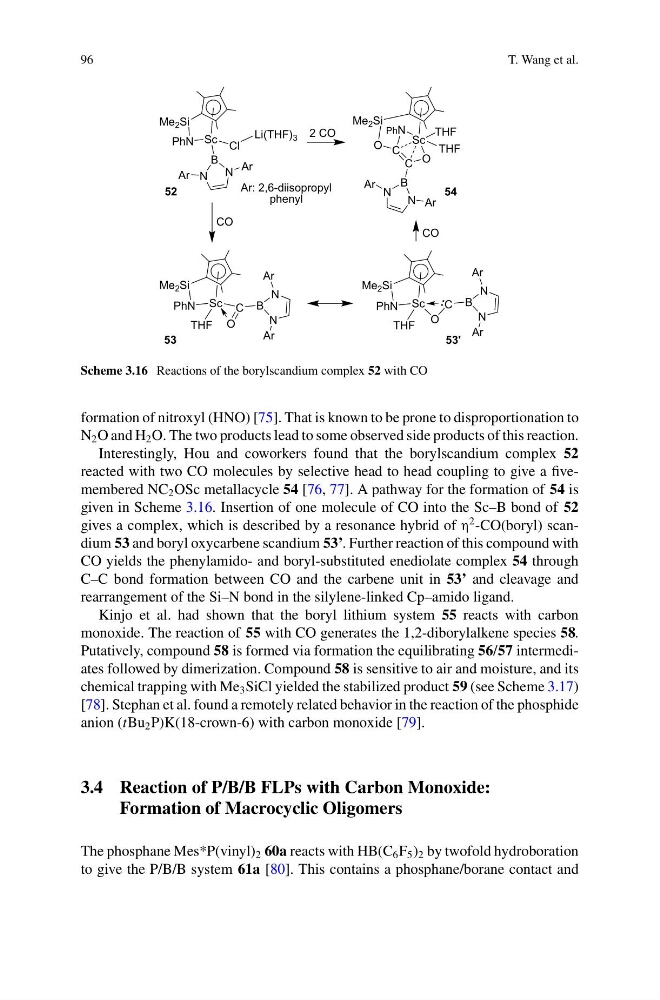
Scheme 3.16 Reactions of the borylscandium complex 52 with CO
formation of nitroxyl (HNO) [75]. That is known to be prone to disproportionation to
N 2 O and H 2 O. The two products lead to some observed side products of this reaction.
Interestingly, Hou and coworkers found that the borylscandium complex 52
reacted with two CO molecules by selective head to head coupling to give a fivemembered NC 2 OSc metallacycle 54 [76, 77]. A pathway for the formation of 54 is
given in Scheme 3.16. Insertion of one molecule of CO into the Sc–B bond of 52
gives a complex, which is described by a resonance hybrid of η
2 -CO(boryl) scandium 53 and boryl oxycarbene scandium 53’. Further reaction of this compound with
CO yields the phenylamido- and boryl-substituted enediolate complex 54 through
C–C bond formation between CO and the carbene unit in 53’ and cleavage and
rearrangement of the Si–N bond in the silylene-linked Cp–amido ligand.
Kinjo et al. had shown that the boryl lithium system 55 reacts with carbon
monoxide. The reaction of 55 with CO generates the 1,2-diborylalkene species 58.
Putatively, compound 58 is formed via formation the equilibrating 56/57 intermediates followed by dimerization. Compound 58 is sensitive to air and moisture, and its
chemical trapping with Me 3 SiCl yielded the stabilized product 59 (see Scheme 3.17)
[78]. Stephan et al. found a remotely related behavior in the reaction of the phosphide
anion (tBu 2 P)K(18-crown-6) with carbon monoxide [79].
3.4 Reaction of P/B/B FLPs with Carbon Monoxide:
Formation of Macrocyclic Oligomers
The phosphane Mes*P(vinyl) 2 60a reacts with HB(C 6 F 5 ) 2 by twofold hydroboration
to give the P/B/B system 61a [80]. This contains a phosphane/borane contact and
T. Wang et al.
Sc
Sc
Me 2 Si
PhN
B
N
N
Ar
C
O
THF
Ar
53
53'
Me 2 Si
PhN
Cl
B
Li(THF) 3
N
N
Ar
Ar
Sc
Me 2 Si
B
N N
Ar
Ar
O
C
C
O
PhN
2 CO
52
54
CO
Ar: 2,6-diisopropyl
phenyl
THF
THF
Sc
Me 2 Si
PhN
B
N
N
Ar
C
O
THF
Ar
:
CO
Scheme 3.16 Reactions of the borylscandium complex 52 with CO
formation of nitroxyl (HNO) [75]. That is known to be prone to disproportionation to
N 2 O and H 2 O. The two products lead to some observed side products of this reaction.
Interestingly, Hou and coworkers found that the borylscandium complex 52
reacted with two CO molecules by selective head to head coupling to give a fivemembered NC 2 OSc metallacycle 54 [76, 77]. A pathway for the formation of 54 is
given in Scheme 3.16. Insertion of one molecule of CO into the Sc–B bond of 52
gives a complex, which is described by a resonance hybrid of η
2 -CO(boryl) scandium 53 and boryl oxycarbene scandium 53’. Further reaction of this compound with
CO yields the phenylamido- and boryl-substituted enediolate complex 54 through
C–C bond formation between CO and the carbene unit in 53’ and cleavage and
rearrangement of the Si–N bond in the silylene-linked Cp–amido ligand.
Kinjo et al. had shown that the boryl lithium system 55 reacts with carbon
monoxide. The reaction of 55 with CO generates the 1,2-diborylalkene species 58.
Putatively, compound 58 is formed via formation the equilibrating 56/57 intermediates followed by dimerization. Compound 58 is sensitive to air and moisture, and its
chemical trapping with Me 3 SiCl yielded the stabilized product 59 (see Scheme 3.17)
[78]. Stephan et al. found a remotely related behavior in the reaction of the phosphide
anion (tBu 2 P)K(18-crown-6) with carbon monoxide [79].
3.4 Reaction of P/B/B FLPs with Carbon Monoxide:
Formation of Macrocyclic Oligomers
The phosphane Mes*P(vinyl) 2 60a reacts with HB(C 6 F 5 ) 2 by twofold hydroboration
to give the P/B/B system 61a [80]. This contains a phosphane/borane contact and