

94
T. Wang et al.
pyrimidine gave the compounds 34 and 35, respectively. Both were characterized by
X-ray diffraction [67].
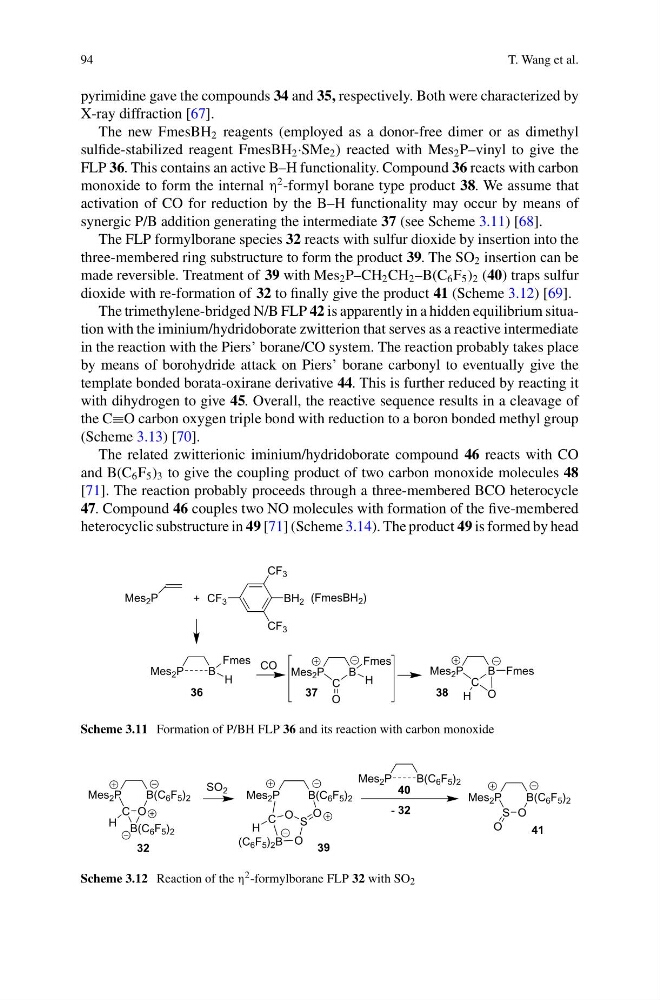
The new FmesBH 2 reagents (employed as a donor-free dimer or as dimethyl
sulfide-stabilized reagent FmesBH 2 ·SMe 2 ) reacted with Mes 2 P–vinyl to give the
FLP 36. This contains an active B–H functionality. Compound 36 reacts with carbon
monoxide to form the internal η
2 -formyl borane type product 38. We assume that
activation of CO for reduction by the B–H functionality may occur by means of
synergic P/B addition generating the intermediate 37 (see Scheme 3.11) [68].
The FLP formylborane species 32 reacts with sulfur dioxide by insertion into the
three-membered ring substructure to form the product 39. The SO 2 insertion can be
made reversible. Treatment of 39 with Mes 2 P–CH 2 CH 2 –B(C 6 F 5 ) 2 (40) traps sulfur
dioxide with re-formation of 32 to finally give the product 41 (Scheme 3.12) [69].
The trimethylene-bridged N/B FLP 42 is apparently in a hidden equilibrium situation with the iminium/hydridoborate zwitterion that serves as a reactive intermediate
in the reaction with the Piers’ borane/CO system. The reaction probably takes place
by means of borohydride attack on Piers’ borane carbonyl to eventually give the
template bonded borata-oxirane derivative 44. This is further reduced by reacting it
with dihydrogen to give 45. Overall, the reactive sequence results in a cleavage of
the C≡O carbon oxygen triple bond with reduction to a boron bonded methyl group
(Scheme 3.13) [70].
The related zwitterionic iminium/hydridoborate compound 46 reacts with CO
and B(C 6 F 5 ) 3 to give the coupling product of two carbon monoxide molecules 48
[71]. The reaction probably proceeds through a three-membered BCO heterocycle
47. Compound 46 couples two NO molecules with formation of the five-membered
heterocyclic substructure in 49 [71] (Scheme 3.14). The product 49 is formed by head
Mes 2 P
+
CF 3
CF 3
BH 2
CF 3
(FmesBH 2 )
Mes 2 P
B
H
Fmes
36
CO Mes 2 P
B
H
Fmes
37
C
O
Mes 2 P
B Fmes
38
C
O
H
Scheme 3.11 Formation of P/BH FLP 36 and its reaction with carbon monoxide
Mes 2 P
B(C 6 F 5 ) 2
C O
B(C 6 F 5 ) 2
H
32
SO 2
Mes 2 P
B(C 6 F 5 ) 2
C O
(C 6 F 5 ) 2 B
H
39
O
S
O
Mes 2 P
B(C 6 F 5 ) 2
S O
41
Mes 2 P
B(C 6 F 5 ) 2
40
O
- 32
Scheme 3.12 Reaction of the η 2 -formylborane FLP 32 with SO 2
T. Wang et al.
pyrimidine gave the compounds 34 and 35, respectively. Both were characterized by
X-ray diffraction [67].
The new FmesBH 2 reagents (employed as a donor-free dimer or as dimethyl
sulfide-stabilized reagent FmesBH 2 ·SMe 2 ) reacted with Mes 2 P–vinyl to give the
FLP 36. This contains an active B–H functionality. Compound 36 reacts with carbon
monoxide to form the internal η
2 -formyl borane type product 38. We assume that
activation of CO for reduction by the B–H functionality may occur by means of
synergic P/B addition generating the intermediate 37 (see Scheme 3.11) [68].
The FLP formylborane species 32 reacts with sulfur dioxide by insertion into the
three-membered ring substructure to form the product 39. The SO 2 insertion can be
made reversible. Treatment of 39 with Mes 2 P–CH 2 CH 2 –B(C 6 F 5 ) 2 (40) traps sulfur
dioxide with re-formation of 32 to finally give the product 41 (Scheme 3.12) [69].
The trimethylene-bridged N/B FLP 42 is apparently in a hidden equilibrium situation with the iminium/hydridoborate zwitterion that serves as a reactive intermediate
in the reaction with the Piers’ borane/CO system. The reaction probably takes place
by means of borohydride attack on Piers’ borane carbonyl to eventually give the
template bonded borata-oxirane derivative 44. This is further reduced by reacting it
with dihydrogen to give 45. Overall, the reactive sequence results in a cleavage of
the C≡O carbon oxygen triple bond with reduction to a boron bonded methyl group
(Scheme 3.13) [70].
The related zwitterionic iminium/hydridoborate compound 46 reacts with CO
and B(C 6 F 5 ) 3 to give the coupling product of two carbon monoxide molecules 48
[71]. The reaction probably proceeds through a three-membered BCO heterocycle
47. Compound 46 couples two NO molecules with formation of the five-membered
heterocyclic substructure in 49 [71] (Scheme 3.14). The product 49 is formed by head
Mes 2 P
+
CF 3
CF 3
BH 2
CF 3
(FmesBH 2 )
Mes 2 P
B
H
Fmes
36
CO Mes 2 P
B
H
Fmes
37
C
O
Mes 2 P
B Fmes
38
C
O
H
Scheme 3.11 Formation of P/BH FLP 36 and its reaction with carbon monoxide
Mes 2 P
B(C 6 F 5 ) 2
C O
B(C 6 F 5 ) 2
H
32
SO 2
Mes 2 P
B(C 6 F 5 ) 2
C O
(C 6 F 5 ) 2 B
H
39
O
S
O
Mes 2 P
B(C 6 F 5 ) 2
S O
41
Mes 2 P
B(C 6 F 5 ) 2
40
O
- 32
Scheme 3.12 Reaction of the η 2 -formylborane FLP 32 with SO 2