

92
T. Wang et al.
Scheme 3.7 A pathway to
P/B FLP 21 and its reaction
with NO
PMes 2
SiMe 3
19
80
o C
B(C 6 F 5 ) 3
PMes 2
20
SiMe 3
C 6 F 5
B(C 6 F 5 ) 2
B
SiMe 3
C 6 F 5
C 6 F 5
P
Mes
C 6 F 5
Mes
r.t.
NO
B
SiMe 3
C 6 F 5
C 6 F 5
P
Mes
Mes
21
22
C 6 F 5
N O
3.3 Metal-Free FLP Reduction and Coupling of Carbon
Monoxide
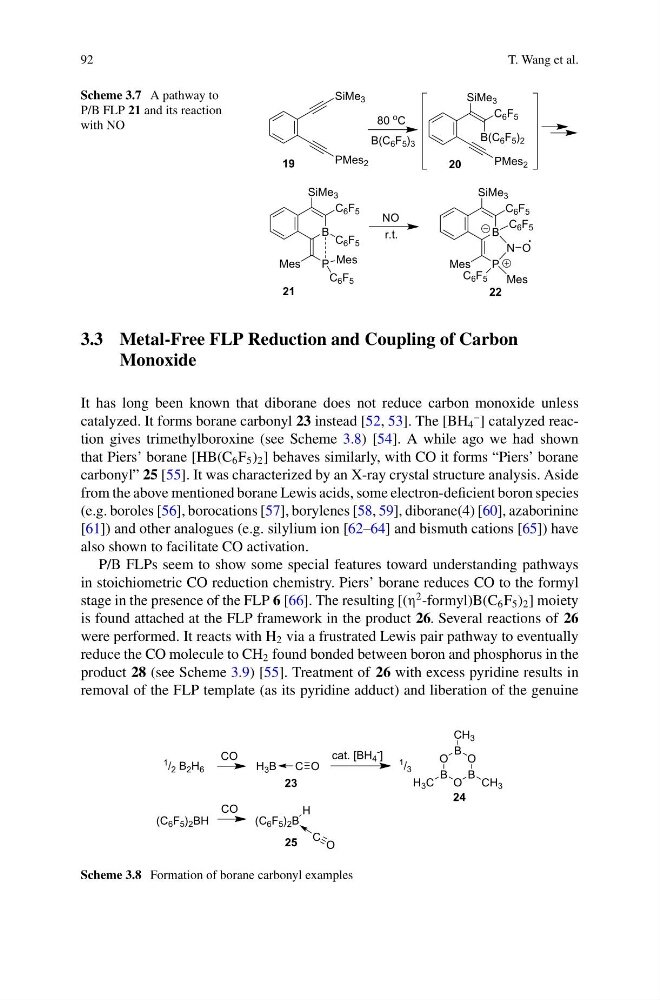
It has long been known that diborane does not reduce carbon monoxide unless
catalyzed. It forms borane carbonyl 23 instead [52, 53]. The [BH 4
– ] catalyzed reaction gives trimethylboroxine (see Scheme 3.8) [54]. A while ago we had shown
that Piers’ borane [HB(C 6 F 5 ) 2 ] behaves similarly, with CO it forms “Piers’ borane
carbonyl” 25 [55]. It was characterized by an X-ray crystal structure analysis. Aside
from the above mentioned borane Lewis acids, some electron-deficient boron species
(e.g. boroles [56], borocations [57], borylenes [58, 59], diborane(4) [60], azaborinine
[61]) and other analogues (e.g. silylium ion [62–64] and bismuth cations [65]) have
also shown to facilitate CO activation.
P/B FLPs seem to show some special features toward understanding pathways
in stoichiometric CO reduction chemistry. Piers’ borane reduces CO to the formyl
stage in the presence of the FLP 6 [66]. The resulting [(η
2 -formyl)B(C 6 F 5 ) 2 ] moiety
is found attached at the FLP framework in the product 26. Several reactions of 26
were performed. It reacts with H 2 via a frustrated Lewis pair pathway to eventually
reduce the CO molecule to CH 2 found bonded between boron and phosphorus in the
product 28 (see Scheme 3.9) [55]. Treatment of 26 with excess pyridine results in
removal of the FLP template (as its pyridine adduct) and liberation of the genuine
1 / 2 B 2 H 6
CO
H 3 B
C O
23
cat. [BH 4
- ]
O
B O
B
O
B
CH 3
H 3 C
CH 3
1 / 3
24
25
(C 6 F 5 ) 2 BH
(C 6 F 5 ) 2 B
H
C O
CO
Scheme 3.8 Formation of borane carbonyl examples
T. Wang et al.
Scheme 3.7 A pathway to
P/B FLP 21 and its reaction
with NO
PMes 2
SiMe 3
19
80
o C
B(C 6 F 5 ) 3
PMes 2
20
SiMe 3
C 6 F 5
B(C 6 F 5 ) 2
B
SiMe 3
C 6 F 5
C 6 F 5
P
Mes
C 6 F 5
Mes
r.t.
NO
B
SiMe 3
C 6 F 5
C 6 F 5
P
Mes
Mes
21
22
C 6 F 5
N O
3.3 Metal-Free FLP Reduction and Coupling of Carbon
Monoxide
It has long been known that diborane does not reduce carbon monoxide unless
catalyzed. It forms borane carbonyl 23 instead [52, 53]. The [BH 4
– ] catalyzed reaction gives trimethylboroxine (see Scheme 3.8) [54]. A while ago we had shown
that Piers’ borane [HB(C 6 F 5 ) 2 ] behaves similarly, with CO it forms “Piers’ borane
carbonyl” 25 [55]. It was characterized by an X-ray crystal structure analysis. Aside
from the above mentioned borane Lewis acids, some electron-deficient boron species
(e.g. boroles [56], borocations [57], borylenes [58, 59], diborane(4) [60], azaborinine
[61]) and other analogues (e.g. silylium ion [62–64] and bismuth cations [65]) have
also shown to facilitate CO activation.
P/B FLPs seem to show some special features toward understanding pathways
in stoichiometric CO reduction chemistry. Piers’ borane reduces CO to the formyl
stage in the presence of the FLP 6 [66]. The resulting [(η
2 -formyl)B(C 6 F 5 ) 2 ] moiety
is found attached at the FLP framework in the product 26. Several reactions of 26
were performed. It reacts with H 2 via a frustrated Lewis pair pathway to eventually
reduce the CO molecule to CH 2 found bonded between boron and phosphorus in the
product 28 (see Scheme 3.9) [55]. Treatment of 26 with excess pyridine results in
removal of the FLP template (as its pyridine adduct) and liberation of the genuine
1 / 2 B 2 H 6
CO
H 3 B
C O
23
cat. [BH 4
- ]
O
B O
B
O
B
CH 3
H 3 C
CH 3
1 / 3
24
25
(C 6 F 5 ) 2 BH
(C 6 F 5 ) 2 B
H
C O
CO
Scheme 3.8 Formation of borane carbonyl examples