

3 FLP Reduction of Carbon Monoxide and Related Reactions
91
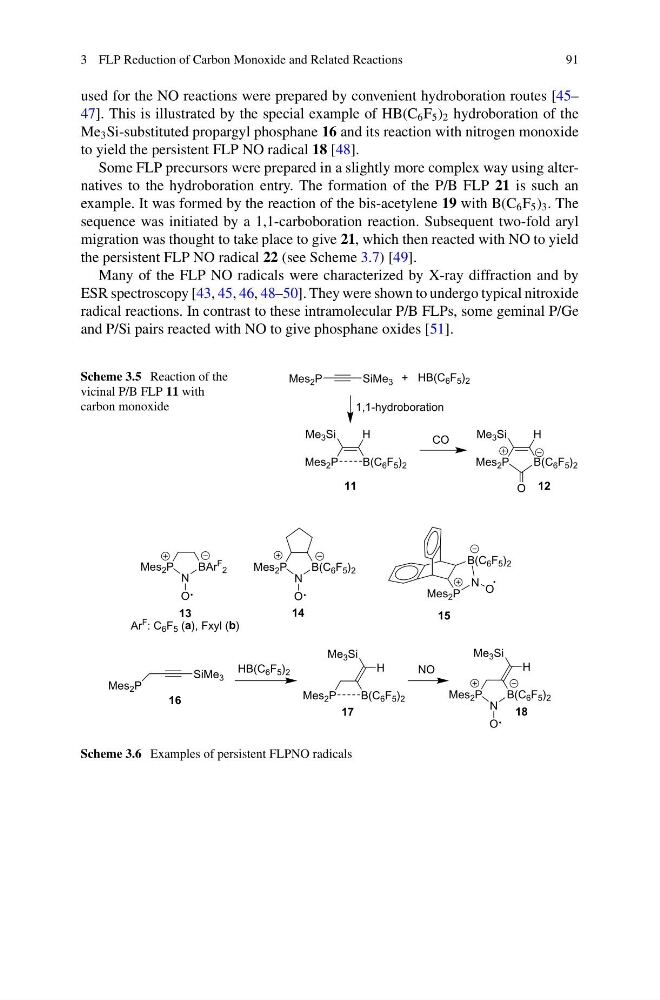
used for the NO reactions were prepared by convenient hydroboration routes [45–
47]. This is illustrated by the special example of HB(C 6 F 5 ) 2 hydroboration of the
Me 3 Si-substituted propargyl phosphane 16 and its reaction with nitrogen monoxide
to yield the persistent FLP NO radical 18 [48].
Some FLP precursors were prepared in a slightly more complex way using alternatives to the hydroboration entry. The formation of the P/B FLP 21 is such an
example. It was formed by the reaction of the bis-acetylene 19 with B(C 6 F 5 ) 3 . The
sequence was initiated by a 1,1-carboboration reaction. Subsequent two-fold aryl
migration was thought to take place to give 21, which then reacted with NO to yield
the persistent FLP NO radical 22 (see Scheme 3.7) [49].
Many of the FLP NO radicals were characterized by X-ray diffraction and by
ESR spectroscopy [43, 45, 46, 48–50]. They were shown to undergo typical nitroxide
radical reactions. In contrast to these intramolecular P/B FLPs, some geminal P/Ge
and P/Si pairs reacted with NO to give phosphane oxides [51].
Scheme 3.5 Reaction of the
vicinal P/B FLP 11 with
carbon monoxide
Mes 2 P
SiMe 3 + HB(C 6 F 5 ) 2
1,1-hydroboration
Mes 2 P
Me 3 Si
H
B(C 6 F 5 ) 2
CO
Mes 2 P
Me 3 Si
H
B(C 6 F 5 ) 2
O
11
12
Mes 2 P
BAr
F
2
N
O
13
Ar
F : C 6 F 5 (a), Fxyl (b)
Mes 2 P
B(C 6 F 5 ) 2
N
O
14
15
SiMe 3
Mes 2 P
16
HB(C 6 F 5 ) 2
Mes 2 P
B(C 6 F 5 ) 2
H
Me 3 Si
17
Mes 2 P
B(C 6 F 5 ) 2
N
O
Me 3 Si
H
18
NO
B(C 6 F 5 ) 2
Mes 2 P
N O
Scheme 3.6 Examples of persistent FLPNO radicals
91
used for the NO reactions were prepared by convenient hydroboration routes [45–
47]. This is illustrated by the special example of HB(C 6 F 5 ) 2 hydroboration of the
Me 3 Si-substituted propargyl phosphane 16 and its reaction with nitrogen monoxide
to yield the persistent FLP NO radical 18 [48].
Some FLP precursors were prepared in a slightly more complex way using alternatives to the hydroboration entry. The formation of the P/B FLP 21 is such an
example. It was formed by the reaction of the bis-acetylene 19 with B(C 6 F 5 ) 3 . The
sequence was initiated by a 1,1-carboboration reaction. Subsequent two-fold aryl
migration was thought to take place to give 21, which then reacted with NO to yield
the persistent FLP NO radical 22 (see Scheme 3.7) [49].
Many of the FLP NO radicals were characterized by X-ray diffraction and by
ESR spectroscopy [43, 45, 46, 48–50]. They were shown to undergo typical nitroxide
radical reactions. In contrast to these intramolecular P/B FLPs, some geminal P/Ge
and P/Si pairs reacted with NO to give phosphane oxides [51].
Scheme 3.5 Reaction of the
vicinal P/B FLP 11 with
carbon monoxide
Mes 2 P
SiMe 3 + HB(C 6 F 5 ) 2
1,1-hydroboration
Mes 2 P
Me 3 Si
H
B(C 6 F 5 ) 2
CO
Mes 2 P
Me 3 Si
H
B(C 6 F 5 ) 2
O
11
12
Mes 2 P
BAr
F
2
N
O
13
Ar
F : C 6 F 5 (a), Fxyl (b)
Mes 2 P
B(C 6 F 5 ) 2
N
O
14
15
SiMe 3
Mes 2 P
16
HB(C 6 F 5 ) 2
Mes 2 P
B(C 6 F 5 ) 2
H
Me 3 Si
17
Mes 2 P
B(C 6 F 5 ) 2
N
O
Me 3 Si
H
18
NO
B(C 6 F 5 ) 2
Mes 2 P
N O
Scheme 3.6 Examples of persistent FLPNO radicals