

4.7 Volume Elements
53
way, as the product of the physical distances,
dV n ≡ d . . . d n =
√ g 11 . . . g nn dx
1
. . . dx
n
=
|g|d
n x, . . .
(4.76)
where |g| denotes the determinant of the metric tensor. This last expression turns out
to be general, except that one must use the absolute value of the determinant if the
signature is negative.
To show that the expression (4.76) is the correct volume element we prove the
following theorem.
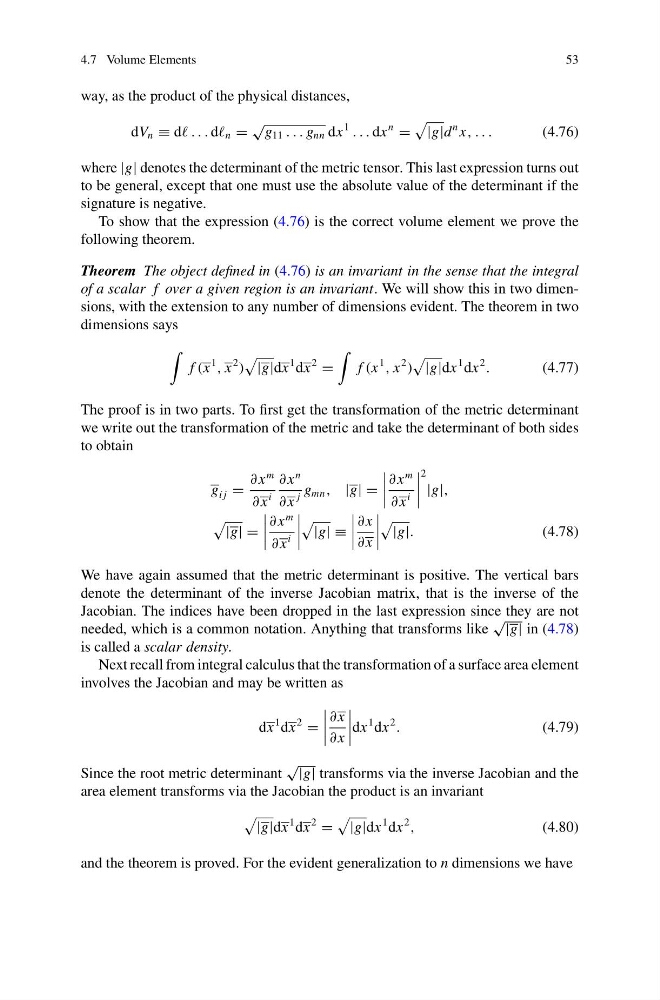
Theorem The object defined in (4.76) is an invariant in the sense that the integral
of a scalar f over a given region is an invariant. We will show this in two dimensions, with the extension to any number of dimensions evident. The theorem in two
dimensions says
f (x
1
, x
2
)
|g|dx
1 dx
2
=
f (x
1
, x
2
)
|g|dx
1 dx
2
.
(4.77)
The proof is in two parts. To first get the transformation of the metric determinant
we write out the transformation of the metric and take the determinant of both sides
to obtain
g i j =
∂ x
m
∂ x
i
∂ x
n
∂ x
j
g mn , |g| =
∂ x
m
∂ x
i
2
|g|,
|g| =
∂ x
m
∂ x
i
|g| ≡
∂ x
∂ x
|g|.
(4.78)
We have again assumed that the metric determinant is positive. The vertical bars
denote the determinant of the inverse Jacobian matrix, that is the inverse of the
Jacobian. The indices have been dropped in the last expression since they are not
needed, which is a common notation. Anything that transforms like
√ |g| in (4.78)
is called a scalar density.
Next recall from integral calculus that the transformation of a surface area element
involves the Jacobian and may be written as
dx
1 dx
2
=
∂ x
∂ x
dx
1 dx
2
.
(4.79)
Since the root metric determinant
√ |g| transforms via the inverse Jacobian and the
area element transforms via the Jacobian the product is an invariant
|g|dx
1 dx
2
=
|g|dx
1 dx
2
,
(4.80)
and the theorem is proved. For the evident generalization to n dimensions we have
53
way, as the product of the physical distances,
dV n ≡ d . . . d n =
√ g 11 . . . g nn dx
1
. . . dx
n
=
|g|d
n x, . . .
(4.76)
where |g| denotes the determinant of the metric tensor. This last expression turns out
to be general, except that one must use the absolute value of the determinant if the
signature is negative.
To show that the expression (4.76) is the correct volume element we prove the
following theorem.
Theorem The object defined in (4.76) is an invariant in the sense that the integral
of a scalar f over a given region is an invariant. We will show this in two dimensions, with the extension to any number of dimensions evident. The theorem in two
dimensions says
f (x
1
, x
2
)
|g|dx
1 dx
2
=
f (x
1
, x
2
)
|g|dx
1 dx
2
.
(4.77)
The proof is in two parts. To first get the transformation of the metric determinant
we write out the transformation of the metric and take the determinant of both sides
to obtain
g i j =
∂ x
m
∂ x
i
∂ x
n
∂ x
j
g mn , |g| =
∂ x
m
∂ x
i
2
|g|,
|g| =
∂ x
m
∂ x
i
|g| ≡
∂ x
∂ x
|g|.
(4.78)
We have again assumed that the metric determinant is positive. The vertical bars
denote the determinant of the inverse Jacobian matrix, that is the inverse of the
Jacobian. The indices have been dropped in the last expression since they are not
needed, which is a common notation. Anything that transforms like
√ |g| in (4.78)
is called a scalar density.
Next recall from integral calculus that the transformation of a surface area element
involves the Jacobian and may be written as
dx
1 dx
2
=
∂ x
∂ x
dx
1 dx
2
.
(4.79)
Since the root metric determinant
√ |g| transforms via the inverse Jacobian and the
area element transforms via the Jacobian the product is an invariant
|g|dx
1 dx
2
=
|g|dx
1 dx
2
,
(4.80)
and the theorem is proved. For the evident generalization to n dimensions we have