

52
4 Riemann Spaces and Tensors
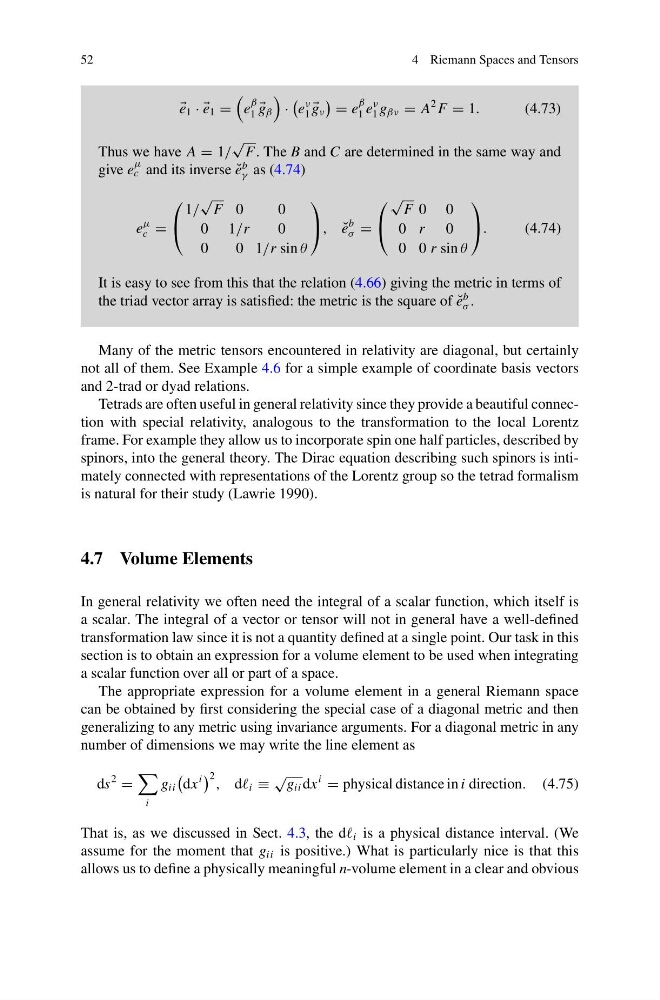
e 1 · ·
e 1 =
e
β
1
g β
·
e
ν
1
g ν
= e
β
1 e
ν
1 g βν = A
2 F = 1.
(4.73)
Thus we have A = 1/
√
F. The B and C are determined in the same way and
give e
μ
c and its inverse ˘
e
b
γ as (4.74)
e
μ
c =
⎛
⎝
1/
√
F 0
0
0 1/r
0
0
0 1/r sin θ
⎞
⎠ , ˘
e
b
σ =
⎛
⎝
√
F 0 0
0 r 0
0 0 r sin θ
⎞
⎠ .
(4.74)
It is easy to see from this that the relation (4.66) giving the metric in terms of
the triad vector array is satisfied: the metric is the square of ˘
e
b
σ .
Many of the metric tensors encountered in relativity are diagonal, but certainly
not all of them. See Example 4.6 for a simple example of coordinate basis vectors
and 2-trad or dyad relations.
Tetrads are often useful in general relativity since they provide a beautiful connection with special relativity, analogous to the transformation to the local Lorentz
frame. For example they allow us to incorporate spin one half particles, described by
spinors, into the general theory. The Dirac equation describing such spinors is intimately connected with representations of the Lorentz group so the tetrad formalism
is natural for their study (Lawrie 1990).
4.7 Volume Elements
In general relativity we often need the integral of a scalar function, which itself is
a scalar. The integral of a vector or tensor will not in general have a well-defined
transformation law since it is not a quantity defined at a single point. Our task in this
section is to obtain an expression for a volume element to be used when integrating
a scalar function over all or part of a space.
The appropriate expression for a volume element in a general Riemann space
can be obtained by first considering the special case of a diagonal metric and then
generalizing to any metric using invariance arguments. For a diagonal metric in any
number of dimensions we may write the line element as
ds
2
=
i
g ii
dx
i
2 , d i ≡
√ g ii dx
i
= physical distance in i direction. (4.75)
That is, as we discussed in Sect. 4.3, the d i is a physical distance interval. (We
assume for the moment that g ii is positive.) What is particularly nice is that this
allows us to define a physically meaningful n-volume element in a clear and obvious
4 Riemann Spaces and Tensors
e 1 · ·
e 1 =
e
β
1
g β
·
e
ν
1
g ν
= e
β
1 e
ν
1 g βν = A
2 F = 1.
(4.73)
Thus we have A = 1/
√
F. The B and C are determined in the same way and
give e
μ
c and its inverse ˘
e
b
γ as (4.74)
e
μ
c =
⎛
⎝
1/
√
F 0
0
0 1/r
0
0
0 1/r sin θ
⎞
⎠ , ˘
e
b
σ =
⎛
⎝
√
F 0 0
0 r 0
0 0 r sin θ
⎞
⎠ .
(4.74)
It is easy to see from this that the relation (4.66) giving the metric in terms of
the triad vector array is satisfied: the metric is the square of ˘
e
b
σ .
Many of the metric tensors encountered in relativity are diagonal, but certainly
not all of them. See Example 4.6 for a simple example of coordinate basis vectors
and 2-trad or dyad relations.
Tetrads are often useful in general relativity since they provide a beautiful connection with special relativity, analogous to the transformation to the local Lorentz
frame. For example they allow us to incorporate spin one half particles, described by
spinors, into the general theory. The Dirac equation describing such spinors is intimately connected with representations of the Lorentz group so the tetrad formalism
is natural for their study (Lawrie 1990).
4.7 Volume Elements
In general relativity we often need the integral of a scalar function, which itself is
a scalar. The integral of a vector or tensor will not in general have a well-defined
transformation law since it is not a quantity defined at a single point. Our task in this
section is to obtain an expression for a volume element to be used when integrating
a scalar function over all or part of a space.
The appropriate expression for a volume element in a general Riemann space
can be obtained by first considering the special case of a diagonal metric and then
generalizing to any metric using invariance arguments. For a diagonal metric in any
number of dimensions we may write the line element as
ds
2
=
i
g ii
dx
i
2 , d i ≡
√ g ii dx
i
= physical distance in i direction. (4.75)
That is, as we discussed in Sect. 4.3, the d i is a physical distance interval. (We
assume for the moment that g ii is positive.) What is particularly nice is that this
allows us to define a physically meaningful n-volume element in a clear and obvious