

4.6 Tetrads and n-Trads
51
Both the coordinate basis
g β and the n-trad
e b can serve as bases in which to
expand a given vector. Thus we may write
V = V
β
g β = V
c
e c ,
(4.67)
where as before we have denoted the vector components by Greek indices and the
n-trad components by Latin indices. It is useful to relate the two types of components.
We can express the n-trads in terms of the coordinate basis using (4.63) and obtain
V
β
g β = V
c e
β
c
g β so V
β
= V
c e
β
c .
(4.68)
Thus the components in the two systems are simply related by the tetrad component
matrix. The last relation above is easily inverted to give
V
b
= V
γ
˘
e
b
γ
(4.69)
There are many simple algebraic relations like this that can be obtained by straightforward algebra. For example it is easy to see that n-trad indices are raised and
lowered with the tetrad matrix, squares of vectors are n-trad squares and so forth.
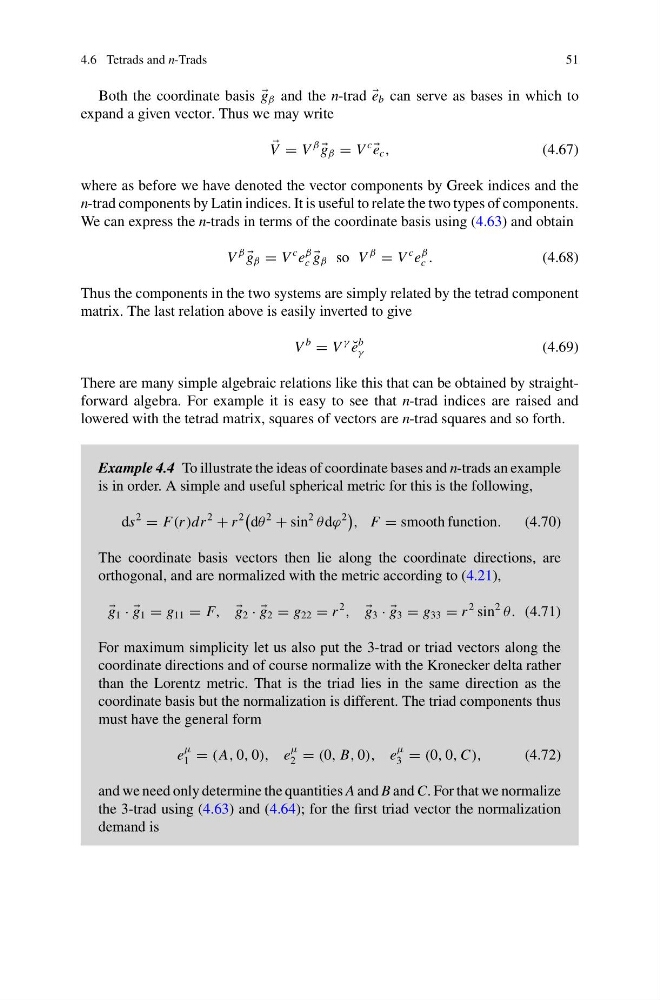
Example 4.4 To illustrate the ideas of coordinate bases and n-trads an example
is in order. A simple and useful spherical metric for this is the following,
ds
2
= F(r )dr
2
+ r
2
dθ
2
+ sin
2
θ dϕ
2
, F = smooth function.
(4.70)
The coordinate basis vectors then lie along the coordinate directions, are
orthogonal, and are normalized with the metric according to (4.21),
g 1 · ·
g 1 = g 11 = F,
g 2 · ·
g 2 = g 22 = r
2
,
g 3 · ·
g 3 = g 33 = r
2 sin
2
θ. (4.71)
For maximum simplicity let us also put the 3-trad or triad vectors along the
coordinate directions and of course normalize with the Kronecker delta rather
than the Lorentz metric. That is the triad lies in the same direction as the
coordinate basis but the normalization is different. The triad components thus
must have the general form
e
μ
1 = (A, 0, 0), e
μ
2 = (0, B, 0), e
μ
3 = (0, 0, C),
(4.72)
and we need only determine the quantities A and B and C. For that we normalize
the 3-trad using (4.63) and (4.64); for the first triad vector the normalization
demand is
51
Both the coordinate basis
g β and the n-trad
e b can serve as bases in which to
expand a given vector. Thus we may write
V = V
β
g β = V
c
e c ,
(4.67)
where as before we have denoted the vector components by Greek indices and the
n-trad components by Latin indices. It is useful to relate the two types of components.
We can express the n-trads in terms of the coordinate basis using (4.63) and obtain
V
β
g β = V
c e
β
c
g β so V
β
= V
c e
β
c .
(4.68)
Thus the components in the two systems are simply related by the tetrad component
matrix. The last relation above is easily inverted to give
V
b
= V
γ
˘
e
b
γ
(4.69)
There are many simple algebraic relations like this that can be obtained by straightforward algebra. For example it is easy to see that n-trad indices are raised and
lowered with the tetrad matrix, squares of vectors are n-trad squares and so forth.
Example 4.4 To illustrate the ideas of coordinate bases and n-trads an example
is in order. A simple and useful spherical metric for this is the following,
ds
2
= F(r )dr
2
+ r
2
dθ
2
+ sin
2
θ dϕ
2
, F = smooth function.
(4.70)
The coordinate basis vectors then lie along the coordinate directions, are
orthogonal, and are normalized with the metric according to (4.21),
g 1 · ·
g 1 = g 11 = F,
g 2 · ·
g 2 = g 22 = r
2
,
g 3 · ·
g 3 = g 33 = r
2 sin
2
θ. (4.71)
For maximum simplicity let us also put the 3-trad or triad vectors along the
coordinate directions and of course normalize with the Kronecker delta rather
than the Lorentz metric. That is the triad lies in the same direction as the
coordinate basis but the normalization is different. The triad components thus
must have the general form
e
μ
1 = (A, 0, 0), e
μ
2 = (0, B, 0), e
μ
3 = (0, 0, C),
(4.72)
and we need only determine the quantities A and B and C. For that we normalize
the 3-trad using (4.63) and (4.64); for the first triad vector the normalization
demand is