

50
4 Riemann Spaces and Tensors
differs from the set of coordinate basis vectors in that it is normalized and need not
align with the coordinate axes. More generally, in n dimensions we define an n-trad,
a set of n basis vectors
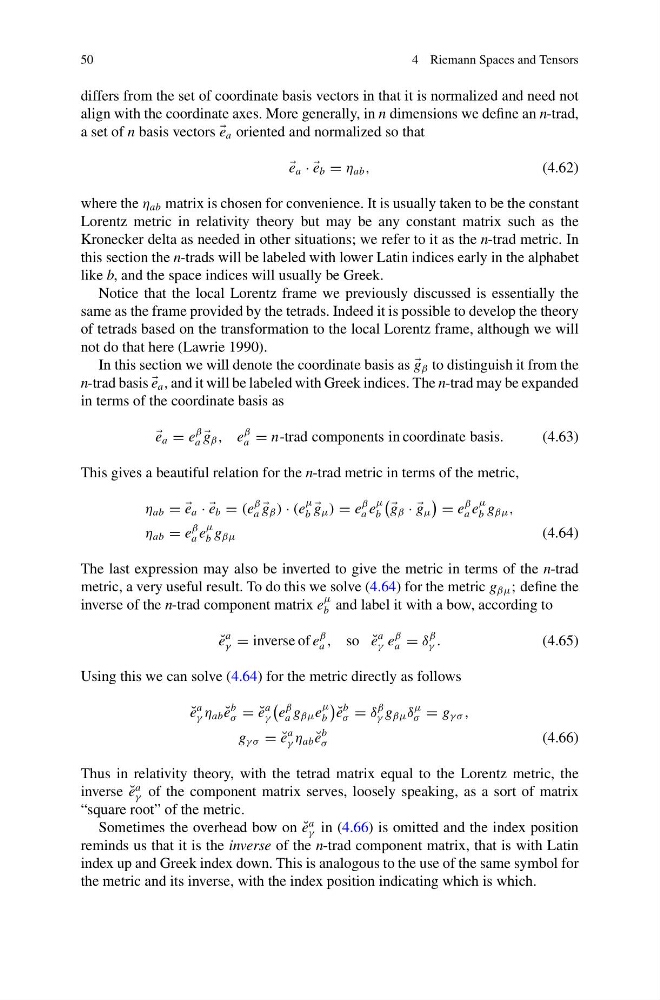
e a oriented and normalized so that
e a · ·
e b = η ab ,
(4.62)
where the η ab matrix is chosen for convenience. It is usually taken to be the constant
Lorentz metric in relativity theory but may be any constant matrix such as the
Kronecker delta as needed in other situations; we refer to it as the n-trad metric. In
this section the n-trads will be labeled with lower Latin indices early in the alphabet
like b, and the space indices will usually be Greek.
Notice that the local Lorentz frame we previously discussed is essentially the
same as the frame provided by the tetrads. Indeed it is possible to develop the theory
of tetrads based on the transformation to the local Lorentz frame, although we will
not do that here (Lawrie 1990).
In this section we will denote the coordinate basis as
g β to distinguish it from the
n-trad basis
e a , and it will be labeled with Greek indices. The n-trad may be expanded
in terms of the coordinate basis as
e a = e
β
a
g β , e
β
a = n-trad components in coordinate basis.
(4.63)
This gives a beautiful relation for the n-trad metric in terms of the metric,
η ab = =
e a · ·
e b = (e
β
a
g β ) · (e
μ
b
g μ ) = e
β
a e
μ
b
g β · ·
g μ
= e
β
a e
μ
b g βμ ,
η ab = e
β
a e
μ
b g βμ
(4.64)
The last expression may also be inverted to give the metric in terms of the n-trad
metric, a very useful result. To do this we solve (4.64) for the metric g βμ ; define the
inverse of the n-trad component matrix e
μ
b and label it with a bow, according to
˘
e
a
γ = inverse of e
β
a , so ˘
e
a
γ e
β
a = δ
β
γ .
(4.65)
Using this we can solve (4.64) for the metric directly as follows
˘
e
a
γ η ab ˘
e
b
σ = ˘
e
a
γ
e
β
a g βμ e
μ
b
˘
e
b
σ = δ
β
γ g βμ δ
μ
σ = g γ σ ,
g γ σ = ˘
e
a
γ η ab ˘
e
b
σ
(4.66)
Thus in relativity theory, with the tetrad matrix equal to the Lorentz metric, the
inverse ˘
e
a
γ of the component matrix serves, loosely speaking, as a sort of matrix
“square root” of the metric.
Sometimes the overhead bow on ˘
e
a
γ in (4.66) is omitted and the index position
reminds us that it is the inverse of the n-trad component matrix, that is with Latin
index up and Greek index down. This is analogous to the use of the same symbol for
the metric and its inverse, with the index position indicating which is which.
4 Riemann Spaces and Tensors
differs from the set of coordinate basis vectors in that it is normalized and need not
align with the coordinate axes. More generally, in n dimensions we define an n-trad,
a set of n basis vectors
e a oriented and normalized so that
e a · ·
e b = η ab ,
(4.62)
where the η ab matrix is chosen for convenience. It is usually taken to be the constant
Lorentz metric in relativity theory but may be any constant matrix such as the
Kronecker delta as needed in other situations; we refer to it as the n-trad metric. In
this section the n-trads will be labeled with lower Latin indices early in the alphabet
like b, and the space indices will usually be Greek.
Notice that the local Lorentz frame we previously discussed is essentially the
same as the frame provided by the tetrads. Indeed it is possible to develop the theory
of tetrads based on the transformation to the local Lorentz frame, although we will
not do that here (Lawrie 1990).
In this section we will denote the coordinate basis as
g β to distinguish it from the
n-trad basis
e a , and it will be labeled with Greek indices. The n-trad may be expanded
in terms of the coordinate basis as
e a = e
β
a
g β , e
β
a = n-trad components in coordinate basis.
(4.63)
This gives a beautiful relation for the n-trad metric in terms of the metric,
η ab = =
e a · ·
e b = (e
β
a
g β ) · (e
μ
b
g μ ) = e
β
a e
μ
b
g β · ·
g μ
= e
β
a e
μ
b g βμ ,
η ab = e
β
a e
μ
b g βμ
(4.64)
The last expression may also be inverted to give the metric in terms of the n-trad
metric, a very useful result. To do this we solve (4.64) for the metric g βμ ; define the
inverse of the n-trad component matrix e
μ
b and label it with a bow, according to
˘
e
a
γ = inverse of e
β
a , so ˘
e
a
γ e
β
a = δ
β
γ .
(4.65)
Using this we can solve (4.64) for the metric directly as follows
˘
e
a
γ η ab ˘
e
b
σ = ˘
e
a
γ
e
β
a g βμ e
μ
b
˘
e
b
σ = δ
β
γ g βμ δ
μ
σ = g γ σ ,
g γ σ = ˘
e
a
γ η ab ˘
e
b
σ
(4.66)
Thus in relativity theory, with the tetrad matrix equal to the Lorentz metric, the
inverse ˘
e
a
γ of the component matrix serves, loosely speaking, as a sort of matrix
“square root” of the metric.
Sometimes the overhead bow on ˘
e
a
γ in (4.66) is omitted and the index position
reminds us that it is the inverse of the n-trad component matrix, that is with Latin
index up and Greek index down. This is analogous to the use of the same symbol for
the metric and its inverse, with the index position indicating which is which.