

54
4 Riemann Spaces and Tensors
dV n =
|g|dx
1
. . . dx
n invariant n-volume element.
(4.81)
The only caveat needed is that for the general case the metric determinant in (4.81)
can be negative, as it generally is in relativity, and we must then use the absolute
value for |g|. Note also that the scalar in (4.81) reduces to the obviously correct
expression in the local frame where the metric is the Cayley-Sylvester canonical
form with diagonal elements equal to 1 or −1.
Example 4.5 Volume elements are often fairly easy to calculate. Here are some
examples with diagonal metrics. For the curved 2-space with polar coordinates
in Example 4.2 the volume element is
dV 2 =
1 + f
2 ρdρdϕ, polar.
(4.82)
For cylindrical coordinates in flat 3-space the volume element is
dV 3 = ρdρdϕdz cylindrical.
(4.83)
For spherical coordinates in 3-space, the volume element in Example 4.4 is
dV 3 =
√
Fr
2 sin θ dr dθ dϕ spherical.
(4.84)
For Minkowski spacetime in Cartesian or spherical coordinates,
dV 4 = cdtdxdydz = r
2 sin
2
θ cdtdr dθ dϕ flat spacetime.
(4.85)
Non-diagonal metrics are also straight forward to analyze but somewhat more
subtle, as we show in the following example.
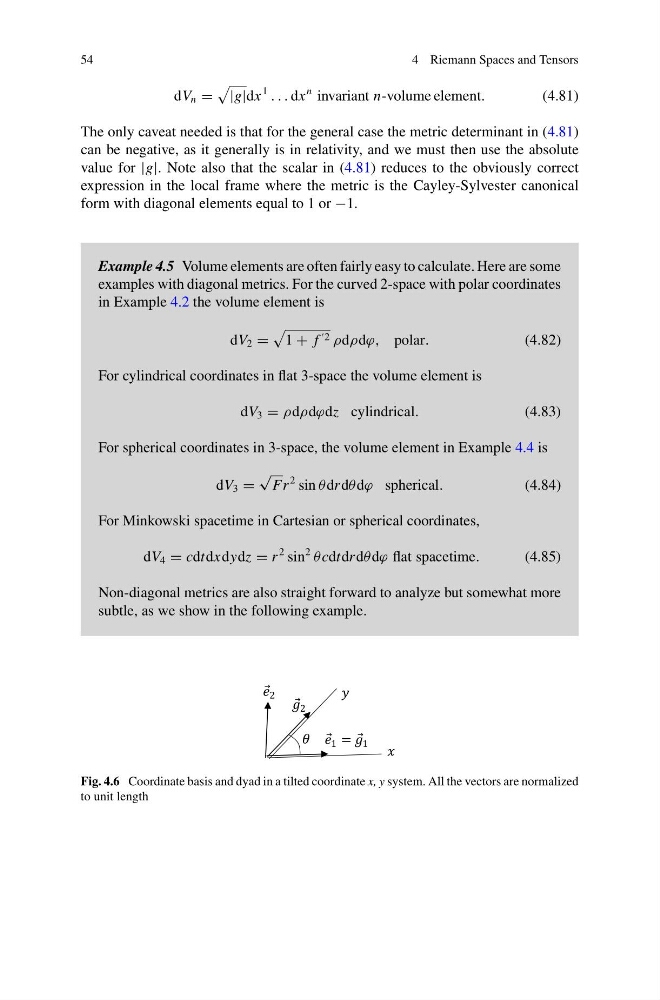
Fig. 4.6 Coordinate basis and dyad in a tilted coordinate x, y system. All the vectors are normalized
to unit length
4 Riemann Spaces and Tensors
dV n =
|g|dx
1
. . . dx
n invariant n-volume element.
(4.81)
The only caveat needed is that for the general case the metric determinant in (4.81)
can be negative, as it generally is in relativity, and we must then use the absolute
value for |g|. Note also that the scalar in (4.81) reduces to the obviously correct
expression in the local frame where the metric is the Cayley-Sylvester canonical
form with diagonal elements equal to 1 or −1.
Example 4.5 Volume elements are often fairly easy to calculate. Here are some
examples with diagonal metrics. For the curved 2-space with polar coordinates
in Example 4.2 the volume element is
dV 2 =
1 + f
2 ρdρdϕ, polar.
(4.82)
For cylindrical coordinates in flat 3-space the volume element is
dV 3 = ρdρdϕdz cylindrical.
(4.83)
For spherical coordinates in 3-space, the volume element in Example 4.4 is
dV 3 =
√
Fr
2 sin θ dr dθ dϕ spherical.
(4.84)
For Minkowski spacetime in Cartesian or spherical coordinates,
dV 4 = cdtdxdydz = r
2 sin
2
θ cdtdr dθ dϕ flat spacetime.
(4.85)
Non-diagonal metrics are also straight forward to analyze but somewhat more
subtle, as we show in the following example.
Fig. 4.6 Coordinate basis and dyad in a tilted coordinate x, y system. All the vectors are normalized
to unit length