

4.1 Riemann Spaces
37
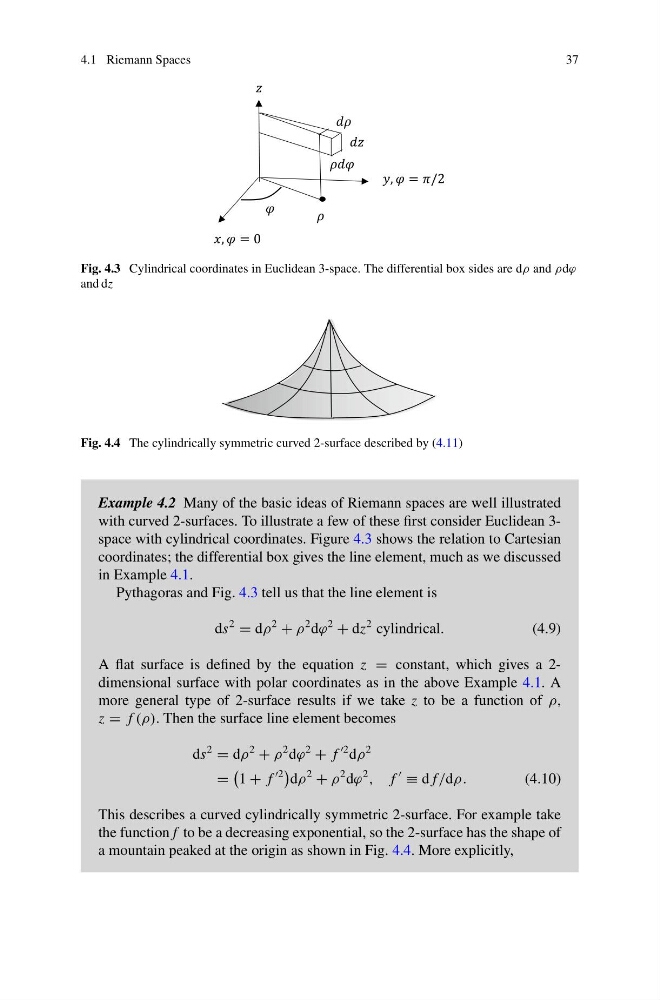
Fig. 4.3 Cylindrical coordinates in Euclidean 3-space. The differential box sides are dρ and ρdϕ
and dz
Fig. 4.4 The cylindrically symmetric curved 2-surface described by (4.11)
Example 4.2 Many of the basic ideas of Riemann spaces are well illustrated
with curved 2-surfaces. To illustrate a few of these first consider Euclidean 3space with cylindrical coordinates. Figure 4.3 shows the relation to Cartesian
coordinates; the differential box gives the line element, much as we discussed
in Example 4.1.
Pythagoras and Fig. 4.3 tell us that the line element is
ds
2
= dρ
2
+ ρ
2 dϕ
2
+ dz
2 cylindrical.
(4.9)
A flat surface is defined by the equation z = constant, which gives a 2dimensional surface with polar coordinates as in the above Example 4.1. A
more general type of 2-surface results if we take z to be a function of ρ,
z = f (ρ). Then the surface line element becomes
ds
2
= dρ
2
+ ρ
2 dϕ
2
+ f
dρ
2
=
1 + f
dρ
2
+ ρ
2 dϕ
2
, f
≡ d f /dρ.
(4.10)
This describes a curved cylindrically symmetric 2-surface. For example take
the function f to be a decreasing exponential, so the 2-surface has the shape of
a mountain peaked at the origin as shown in Fig. 4.4. More explicitly,
37
Fig. 4.3 Cylindrical coordinates in Euclidean 3-space. The differential box sides are dρ and ρdϕ
and dz
Fig. 4.4 The cylindrically symmetric curved 2-surface described by (4.11)
Example 4.2 Many of the basic ideas of Riemann spaces are well illustrated
with curved 2-surfaces. To illustrate a few of these first consider Euclidean 3space with cylindrical coordinates. Figure 4.3 shows the relation to Cartesian
coordinates; the differential box gives the line element, much as we discussed
in Example 4.1.
Pythagoras and Fig. 4.3 tell us that the line element is
ds
2
= dρ
2
+ ρ
2 dϕ
2
+ dz
2 cylindrical.
(4.9)
A flat surface is defined by the equation z = constant, which gives a 2dimensional surface with polar coordinates as in the above Example 4.1. A
more general type of 2-surface results if we take z to be a function of ρ,
z = f (ρ). Then the surface line element becomes
ds
2
= dρ
2
+ ρ
2 dϕ
2
+ f
dρ
2
=
1 + f
dρ
2
+ ρ
2 dϕ
2
, f
≡ d f /dρ.
(4.10)
This describes a curved cylindrically symmetric 2-surface. For example take
the function f to be a decreasing exponential, so the 2-surface has the shape of
a mountain peaked at the origin as shown in Fig. 4.4. More explicitly,