

36
4 Riemann Spaces and Tensors
ds
2
= dx
2
+ dy
2 Cartesian, ds
2
= dρ
2
+ ρ
2 dϕ
2 polar.
(4.7)
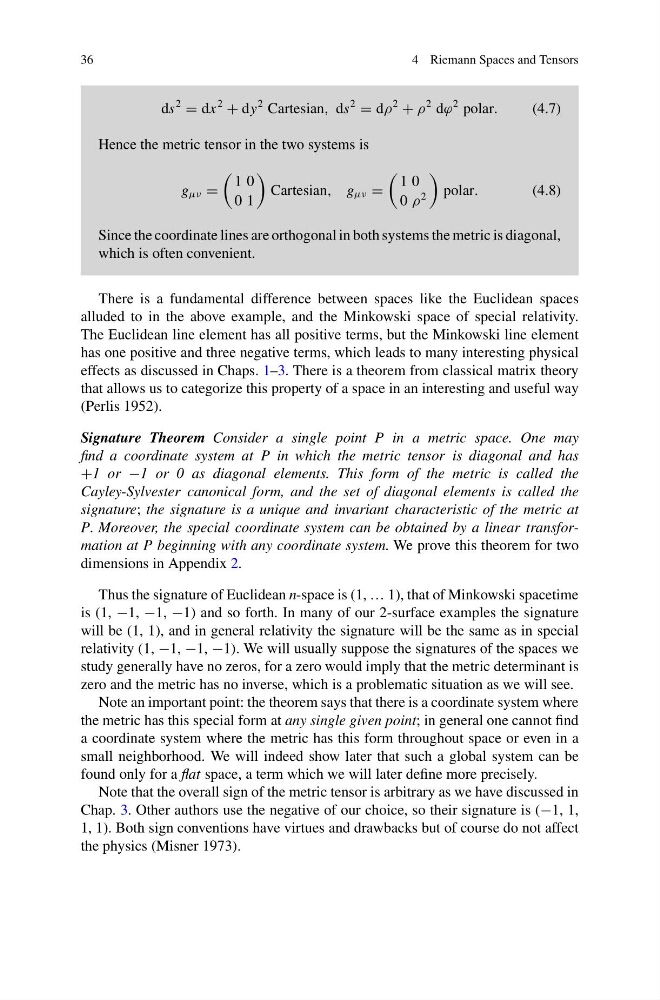
Hence the metric tensor in the two systems is
g μν =
1 0
0 1
Cartesian, g μν =
1 0
0 ρ
2
polar.
(4.8)
Since the coordinate lines are orthogonal in both systems the metric is diagonal,
which is often convenient.
There is a fundamental difference between spaces like the Euclidean spaces
alluded to in the above example, and the Minkowski space of special relativity.
The Euclidean line element has all positive terms, but the Minkowski line element
has one positive and three negative terms, which leads to many interesting physical
effects as discussed in Chaps. 1–3. There is a theorem from classical matrix theory
that allows us to categorize this property of a space in an interesting and useful way
(Perlis 1952).
Signature Theorem Consider a single point P in a metric space. One may
find a coordinate system at P in which the metric tensor is diagonal and has
+1 or −1 or 0 as diagonal elements. This form of the metric is called the
Cayley-Sylvester canonical form, and the set of diagonal elements is called the
signature; the signature is a unique and invariant characteristic of the metric at
P. Moreover, the special coordinate system can be obtained by a linear transformation at P beginning with any coordinate system. We prove this theorem for two
dimensions in Appendix 2.
Thus the signature of Euclidean n-space is (1, … 1), that of Minkowski spacetime
is (1, −1, −1, −1) and so forth. In many of our 2-surface examples the signature
will be (1, 1), and in general relativity the signature will be the same as in special
relativity (1, −1, −1, −1). We will usually suppose the signatures of the spaces we
study generally have no zeros, for a zero would imply that the metric determinant is
zero and the metric has no inverse, which is a problematic situation as we will see.
Note an important point: the theorem says that there is a coordinate system where
the metric has this special form at any single given point; in general one cannot find
a coordinate system where the metric has this form throughout space or even in a
small neighborhood. We will indeed show later that such a global system can be
found only for a flat space, a term which we will later define more precisely.
Note that the overall sign of the metric tensor is arbitrary as we have discussed in
Chap. 3. Other authors use the negative of our choice, so their signature is (−1, 1,
1, 1). Both sign conventions have virtues and drawbacks but of course do not affect
the physics (Misner 1973).
4 Riemann Spaces and Tensors
ds
2
= dx
2
+ dy
2 Cartesian, ds
2
= dρ
2
+ ρ
2 dϕ
2 polar.
(4.7)
Hence the metric tensor in the two systems is
g μν =
1 0
0 1
Cartesian, g μν =
1 0
0 ρ
2
polar.
(4.8)
Since the coordinate lines are orthogonal in both systems the metric is diagonal,
which is often convenient.
There is a fundamental difference between spaces like the Euclidean spaces
alluded to in the above example, and the Minkowski space of special relativity.
The Euclidean line element has all positive terms, but the Minkowski line element
has one positive and three negative terms, which leads to many interesting physical
effects as discussed in Chaps. 1–3. There is a theorem from classical matrix theory
that allows us to categorize this property of a space in an interesting and useful way
(Perlis 1952).
Signature Theorem Consider a single point P in a metric space. One may
find a coordinate system at P in which the metric tensor is diagonal and has
+1 or −1 or 0 as diagonal elements. This form of the metric is called the
Cayley-Sylvester canonical form, and the set of diagonal elements is called the
signature; the signature is a unique and invariant characteristic of the metric at
P. Moreover, the special coordinate system can be obtained by a linear transformation at P beginning with any coordinate system. We prove this theorem for two
dimensions in Appendix 2.
Thus the signature of Euclidean n-space is (1, … 1), that of Minkowski spacetime
is (1, −1, −1, −1) and so forth. In many of our 2-surface examples the signature
will be (1, 1), and in general relativity the signature will be the same as in special
relativity (1, −1, −1, −1). We will usually suppose the signatures of the spaces we
study generally have no zeros, for a zero would imply that the metric determinant is
zero and the metric has no inverse, which is a problematic situation as we will see.
Note an important point: the theorem says that there is a coordinate system where
the metric has this special form at any single given point; in general one cannot find
a coordinate system where the metric has this form throughout space or even in a
small neighborhood. We will indeed show later that such a global system can be
found only for a flat space, a term which we will later define more precisely.
Note that the overall sign of the metric tensor is arbitrary as we have discussed in
Chap. 3. Other authors use the negative of our choice, so their signature is (−1, 1,
1, 1). Both sign conventions have virtues and drawbacks but of course do not affect
the physics (Misner 1973).