

4.1 Riemann Spaces
35
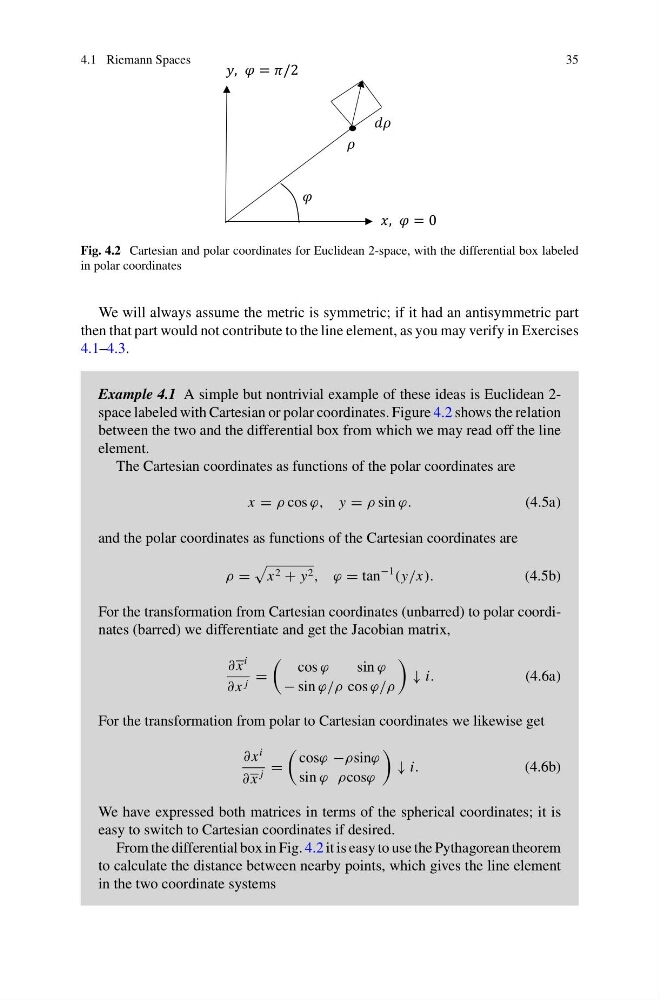
Fig. 4.2 Cartesian and polar coordinates for Euclidean 2-space, with the differential box labeled
in polar coordinates
We will always assume the metric is symmetric; if it had an antisymmetric part
then that part would not contribute to the line element, as you may verify in Exercises
4.1–4.3.
Example 4.1 A simple but nontrivial example of these ideas is Euclidean 2space labeled with Cartesian or polar coordinates. Figure 4.2 shows the relation
between the two and the differential box from which we may read off the line
element.
The Cartesian coordinates as functions of the polar coordinates are
x = ρ cos ϕ, y = ρ sin ϕ.
(4.5a)
and the polar coordinates as functions of the Cartesian coordinates are
ρ =
x 2 + y 2 , ϕ = tan
−1
(y/x).
(4.5b)
For the transformation from Cartesian coordinates (unbarred) to polar coordinates (barred) we differentiate and get the Jacobian matrix,
∂ x
i
∂ x j =
cos ϕ
sin ϕ
− sin ϕ/ρ cos ϕ/ρ
↓ i.
(4.6a)
For the transformation from polar to Cartesian coordinates we likewise get
∂ x
i
∂ x
j
=
cosϕ −ρsinϕ
sin ϕ ρcosϕ
↓ i.
(4.6b)
We have expressed both matrices in terms of the spherical coordinates; it is
easy to switch to Cartesian coordinates if desired.
From the differential box in Fig. 4.2 it is easy to use the Pythagorean theorem
to calculate the distance between nearby points, which gives the line element
in the two coordinate systems
35
Fig. 4.2 Cartesian and polar coordinates for Euclidean 2-space, with the differential box labeled
in polar coordinates
We will always assume the metric is symmetric; if it had an antisymmetric part
then that part would not contribute to the line element, as you may verify in Exercises
4.1–4.3.
Example 4.1 A simple but nontrivial example of these ideas is Euclidean 2space labeled with Cartesian or polar coordinates. Figure 4.2 shows the relation
between the two and the differential box from which we may read off the line
element.
The Cartesian coordinates as functions of the polar coordinates are
x = ρ cos ϕ, y = ρ sin ϕ.
(4.5a)
and the polar coordinates as functions of the Cartesian coordinates are
ρ =
x 2 + y 2 , ϕ = tan
−1
(y/x).
(4.5b)
For the transformation from Cartesian coordinates (unbarred) to polar coordinates (barred) we differentiate and get the Jacobian matrix,
∂ x
i
∂ x j =
cos ϕ
sin ϕ
− sin ϕ/ρ cos ϕ/ρ
↓ i.
(4.6a)
For the transformation from polar to Cartesian coordinates we likewise get
∂ x
i
∂ x
j
=
cosϕ −ρsinϕ
sin ϕ ρcosϕ
↓ i.
(4.6b)
We have expressed both matrices in terms of the spherical coordinates; it is
easy to switch to Cartesian coordinates if desired.
From the differential box in Fig. 4.2 it is easy to use the Pythagorean theorem
to calculate the distance between nearby points, which gives the line element
in the two coordinate systems