

298
19 Inflation and Some Questions
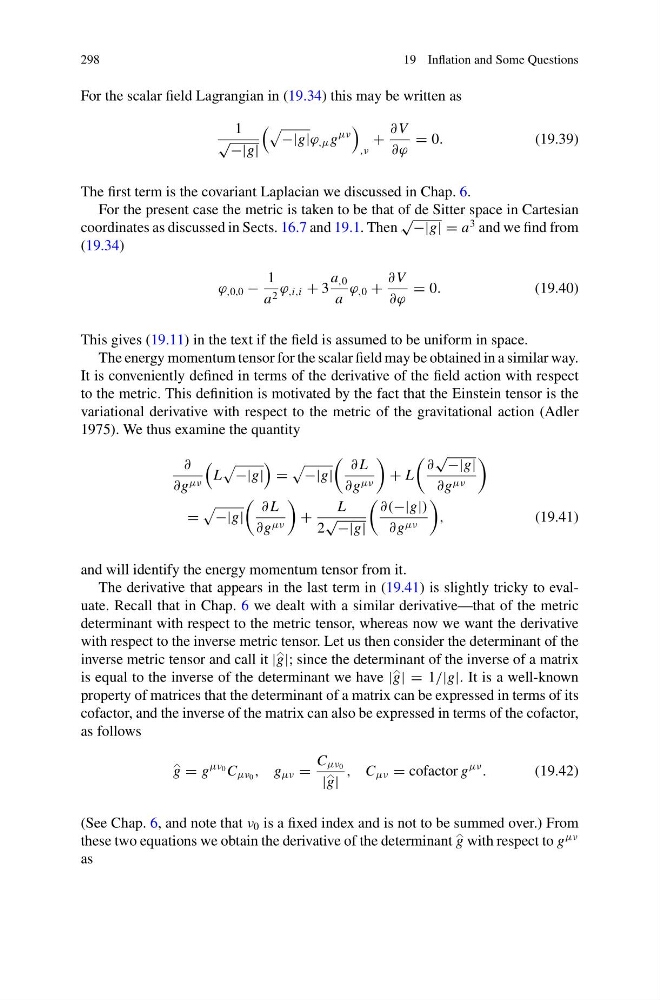
For the scalar field Lagrangian in (19.34) this may be written as
1
√ −|g|
−|g|ϕ ,μ g
μν
,ν
+
∂ V
∂ϕ
= 0.
(19.39)
The first term is the covariant Laplacian we discussed in Chap. 6.
For the present case the metric is taken to be that of de Sitter space in Cartesian
coordinates as discussed in Sects. 16.7 and 19.1. Then
√ −|g| = a
3 and we find from
(19.34)
ϕ ,0,0 −
1
a 2 ϕ ,i,i + 3
a ,0
a
ϕ ,0 +
∂ V
∂ϕ
= 0.
(19.40)
This gives (19.11) in the text if the field is assumed to be uniform in space.
The energy momentum tensor for the scalar field may be obtained in a similar way.
It is conveniently defined in terms of the derivative of the field action with respect
to the metric. This definition is motivated by the fact that the Einstein tensor is the
variational derivative with respect to the metric of the gravitational action (Adler
1975). We thus examine the quantity
∂
∂g μν
L
−|g|
=
−|g|
∂ L
∂g μν
+ L
∂
√
−|g|
∂g μν
=
−|g|
∂ L
∂g μν
+
L
2
√ −|g|
∂(−|g|)
∂g μν
,
(19.41)
and will identify the energy momentum tensor from it.
The derivative that appears in the last term in (19.41) is slightly tricky to evaluate. Recall that in Chap. 6 we dealt with a similar derivative—that of the metric
determinant with respect to the metric tensor, whereas now we want the derivative
with respect to the inverse metric tensor. Let us then consider the determinant of the
inverse metric tensor and call it |g
|; since the determinant of the inverse of a matrix
is equal to the inverse of the determinant we have |g
| = 1/|g|. It is a well-known
property of matrices that the determinant of a matrix can be expressed in terms of its
cofactor, and the inverse of the matrix can also be expressed in terms of the cofactor,
as follows
g
= g
μν 0 C μν 0 , g μν =
C μν 0
|g
|
, C μν = cofactor g
μν
.
(19.42)
(See Chap. 6, and note that ν 0 is a fixed index and is not to be summed over.) From
these two equations we obtain the derivative of the determinant g
with respect to g
μν
as
19 Inflation and Some Questions
For the scalar field Lagrangian in (19.34) this may be written as
1
√ −|g|
−|g|ϕ ,μ g
μν
,ν
+
∂ V
∂ϕ
= 0.
(19.39)
The first term is the covariant Laplacian we discussed in Chap. 6.
For the present case the metric is taken to be that of de Sitter space in Cartesian
coordinates as discussed in Sects. 16.7 and 19.1. Then
√ −|g| = a
3 and we find from
(19.34)
ϕ ,0,0 −
1
a 2 ϕ ,i,i + 3
a ,0
a
ϕ ,0 +
∂ V
∂ϕ
= 0.
(19.40)
This gives (19.11) in the text if the field is assumed to be uniform in space.
The energy momentum tensor for the scalar field may be obtained in a similar way.
It is conveniently defined in terms of the derivative of the field action with respect
to the metric. This definition is motivated by the fact that the Einstein tensor is the
variational derivative with respect to the metric of the gravitational action (Adler
1975). We thus examine the quantity
∂
∂g μν
L
−|g|
=
−|g|
∂ L
∂g μν
+ L
∂
√
−|g|
∂g μν
=
−|g|
∂ L
∂g μν
+
L
2
√ −|g|
∂(−|g|)
∂g μν
,
(19.41)
and will identify the energy momentum tensor from it.
The derivative that appears in the last term in (19.41) is slightly tricky to evaluate. Recall that in Chap. 6 we dealt with a similar derivative—that of the metric
determinant with respect to the metric tensor, whereas now we want the derivative
with respect to the inverse metric tensor. Let us then consider the determinant of the
inverse metric tensor and call it |g
|; since the determinant of the inverse of a matrix
is equal to the inverse of the determinant we have |g
| = 1/|g|. It is a well-known
property of matrices that the determinant of a matrix can be expressed in terms of its
cofactor, and the inverse of the matrix can also be expressed in terms of the cofactor,
as follows
g
= g
μν 0 C μν 0 , g μν =
C μν 0
|g
|
, C μν = cofactor g
μν
.
(19.42)
(See Chap. 6, and note that ν 0 is a fixed index and is not to be summed over.) From
these two equations we obtain the derivative of the determinant g
with respect to g
μν
as