

Appendix 2: Scalar Field Theory
297
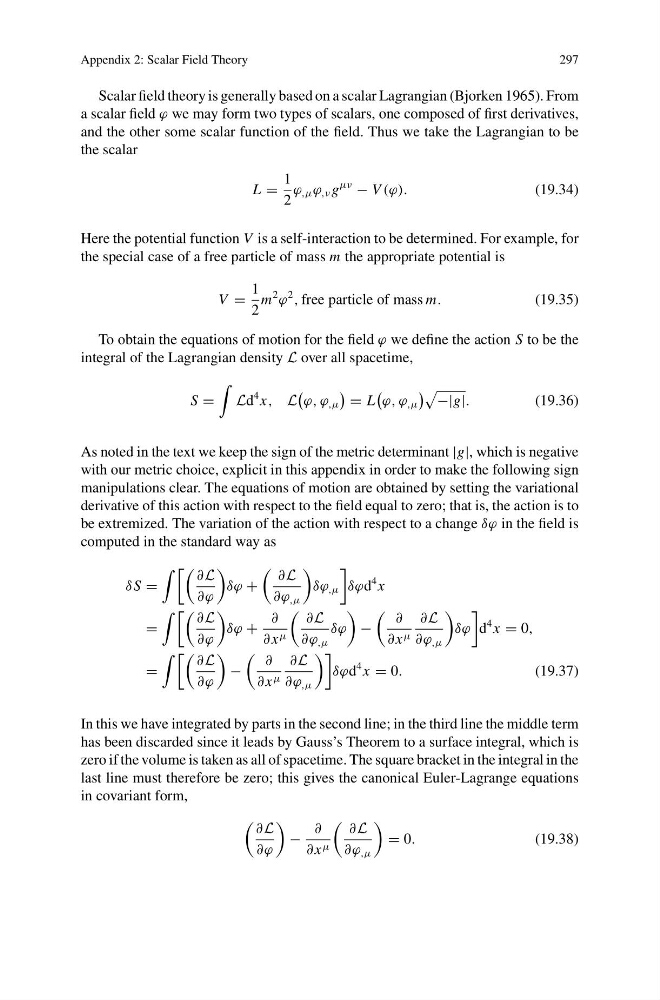
Scalar field theory is generally based on a scalar Lagrangian (Bjorken 1965). From
a scalar field ϕ we may form two types of scalars, one composed of first derivatives,
and the other some scalar function of the field. Thus we take the Lagrangian to be
the scalar
L =
1
2
ϕ ,μ ϕ ,ν g
μν
− V (ϕ).
(19.34)
Here the potential function V is a self-interaction to be determined. For example, for
the special case of a free particle of mass m the appropriate potential is
V =
1
2
m
2
ϕ
2
, free particle of mass m.
(19.35)
To obtain the equations of motion for the field ϕ we define the action S to be the
integral of the Lagrangian density L over all spacetime,
S =
Ld
4 x, L
ϕ, ϕ ,μ
= L
ϕ, ϕ ,μ
−|g|.
(19.36)
As noted in the text we keep the sign of the metric determinant |g|, which is negative
with our metric choice, explicit in this appendix in order to make the following sign
manipulations clear. The equations of motion are obtained by setting the variational
derivative of this action with respect to the field equal to zero; that is, the action is to
be extremized. The variation of the action with respect to a change δϕ in the field is
computed in the standard way as
δS =
∂L
∂ϕ
δϕ +
∂L
∂ϕ ,μ
δϕ ,μ
δϕd
4 x
=
∂L
∂ϕ
δϕ +
∂
∂ x μ
∂L
∂ϕ ,μ
δϕ
−
∂
∂ x μ
∂L
∂ϕ ,μ
δϕ
d
4 x = 0,
=
∂L
∂ϕ
−
∂
∂ x μ
∂L
∂ϕ ,μ
δϕd
4 x = 0.
(19.37)
In this we have integrated by parts in the second line; in the third line the middle term
has been discarded since it leads by Gauss’s Theorem to a surface integral, which is
zero if the volume is taken as all of spacetime. The square bracket in the integral in the
last line must therefore be zero; this gives the canonical Euler-Lagrange equations
in covariant form,
∂L
∂ϕ
−
∂
∂ x μ
∂L
∂ϕ ,μ
= 0.
(19.38)
297
Scalar field theory is generally based on a scalar Lagrangian (Bjorken 1965). From
a scalar field ϕ we may form two types of scalars, one composed of first derivatives,
and the other some scalar function of the field. Thus we take the Lagrangian to be
the scalar
L =
1
2
ϕ ,μ ϕ ,ν g
μν
− V (ϕ).
(19.34)
Here the potential function V is a self-interaction to be determined. For example, for
the special case of a free particle of mass m the appropriate potential is
V =
1
2
m
2
ϕ
2
, free particle of mass m.
(19.35)
To obtain the equations of motion for the field ϕ we define the action S to be the
integral of the Lagrangian density L over all spacetime,
S =
Ld
4 x, L
ϕ, ϕ ,μ
= L
ϕ, ϕ ,μ
−|g|.
(19.36)
As noted in the text we keep the sign of the metric determinant |g|, which is negative
with our metric choice, explicit in this appendix in order to make the following sign
manipulations clear. The equations of motion are obtained by setting the variational
derivative of this action with respect to the field equal to zero; that is, the action is to
be extremized. The variation of the action with respect to a change δϕ in the field is
computed in the standard way as
δS =
∂L
∂ϕ
δϕ +
∂L
∂ϕ ,μ
δϕ ,μ
δϕd
4 x
=
∂L
∂ϕ
δϕ +
∂
∂ x μ
∂L
∂ϕ ,μ
δϕ
−
∂
∂ x μ
∂L
∂ϕ ,μ
δϕ
d
4 x = 0,
=
∂L
∂ϕ
−
∂
∂ x μ
∂L
∂ϕ ,μ
δϕd
4 x = 0.
(19.37)
In this we have integrated by parts in the second line; in the third line the middle term
has been discarded since it leads by Gauss’s Theorem to a surface integral, which is
zero if the volume is taken as all of spacetime. The square bracket in the integral in the
last line must therefore be zero; this gives the canonical Euler-Lagrange equations
in covariant form,
∂L
∂ϕ
−
∂
∂ x μ
∂L
∂ϕ ,μ
= 0.
(19.38)