

Appendix 2: Scalar Field Theory
299
∂|g
|
∂g μν = C μν = g μν
g
.
(19.43)
But we know that |g
| = 1/|g|, so by substituting this in the last equation we finally
obtain the desired derivative
∂
∂g μν
1
|g|
= g μν
1
|g|
,
∂|g|
∂g μν = −|g|g μν .
(19.44)
Substituting this into (19.41) we obtain
∂
∂g μν
L
−|g|
=
−|g|
∂ L
∂g μν
−
L
2
g μν
.
(19.45)
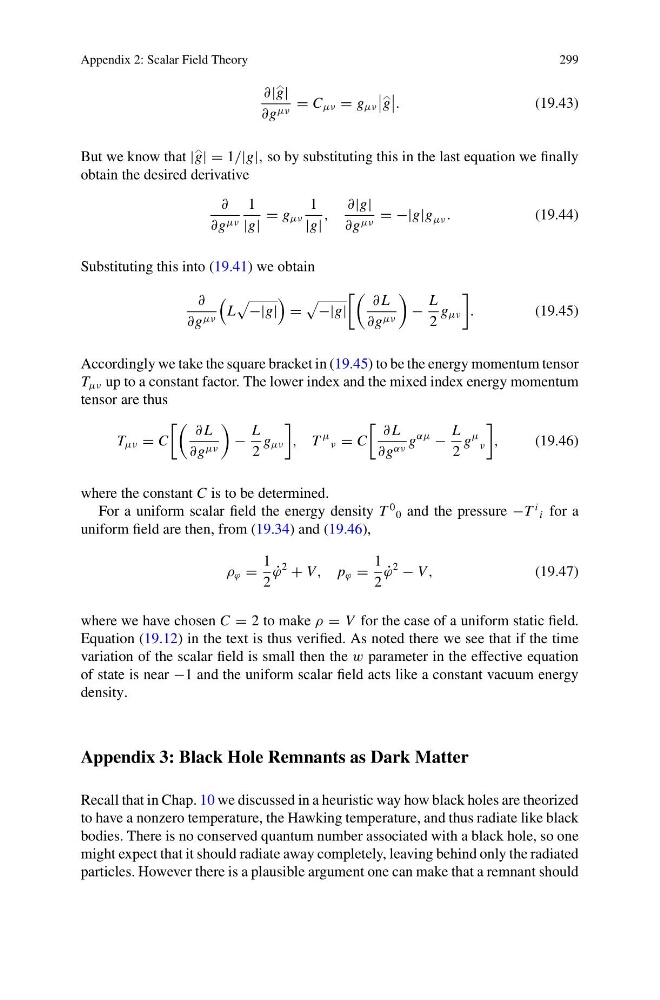
Accordingly we take the square bracket in (19.45) to be the energy momentum tensor
T μν up to a constant factor. The lower index and the mixed index energy momentum
tensor are thus
T μν = C
∂ L
∂g μν
−
L
2
g μν
, T
μ ν = C
∂ L
∂g αν g
αμ
−
L
2
g
μ ν
,
(19.46)
where the constant C is to be determined.
For a uniform scalar field the energy density T
0
0 and the pressure −T
i
i for a
uniform field are then, from (19.34) and (19.46),
ρ ϕ =
1
2
˙
ϕ
2
+ V, p ϕ =
1
2
˙
ϕ
2
− V,
(19.47)
where we have chosen C = 2 to make ρ = V for the case of a uniform static field.
Equation (19.12) in the text is thus verified. As noted there we see that if the time
variation of the scalar field is small then the w parameter in the effective equation
of state is near −1 and the uniform scalar field acts like a constant vacuum energy
density.
Appendix 3: Black Hole Remnants as Dark Matter
Recall that in Chap. 10 we discussed in a heuristic way how black holes are theorized
to have a nonzero temperature, the Hawking temperature, and thus radiate like black
bodies. There is no conserved quantum number associated with a black hole, so one
might expect that it should radiate away completely, leaving behind only the radiated
particles. However there is a plausible argument one can make that a remnant should
299
∂|g
|
∂g μν = C μν = g μν
g
.
(19.43)
But we know that |g
| = 1/|g|, so by substituting this in the last equation we finally
obtain the desired derivative
∂
∂g μν
1
|g|
= g μν
1
|g|
,
∂|g|
∂g μν = −|g|g μν .
(19.44)
Substituting this into (19.41) we obtain
∂
∂g μν
L
−|g|
=
−|g|
∂ L
∂g μν
−
L
2
g μν
.
(19.45)
Accordingly we take the square bracket in (19.45) to be the energy momentum tensor
T μν up to a constant factor. The lower index and the mixed index energy momentum
tensor are thus
T μν = C
∂ L
∂g μν
−
L
2
g μν
, T
μ ν = C
∂ L
∂g αν g
αμ
−
L
2
g
μ ν
,
(19.46)
where the constant C is to be determined.
For a uniform scalar field the energy density T
0
0 and the pressure −T
i
i for a
uniform field are then, from (19.34) and (19.46),
ρ ϕ =
1
2
˙
ϕ
2
+ V, p ϕ =
1
2
˙
ϕ
2
− V,
(19.47)
where we have chosen C = 2 to make ρ = V for the case of a uniform static field.
Equation (19.12) in the text is thus verified. As noted there we see that if the time
variation of the scalar field is small then the w parameter in the effective equation
of state is near −1 and the uniform scalar field acts like a constant vacuum energy
density.
Appendix 3: Black Hole Remnants as Dark Matter
Recall that in Chap. 10 we discussed in a heuristic way how black holes are theorized
to have a nonzero temperature, the Hawking temperature, and thus radiate like black
bodies. There is no conserved quantum number associated with a black hole, so one
might expect that it should radiate away completely, leaving behind only the radiated
particles. However there is a plausible argument one can make that a remnant should