

270
17 Earlier Times and Radiation
σ 12 = c
t dc
0
a 0
a(t)
dt = c
t dc
0
dt
t 0
t
2/3
= 3c
t
2
0 t dc
1/3 .
(17.17)
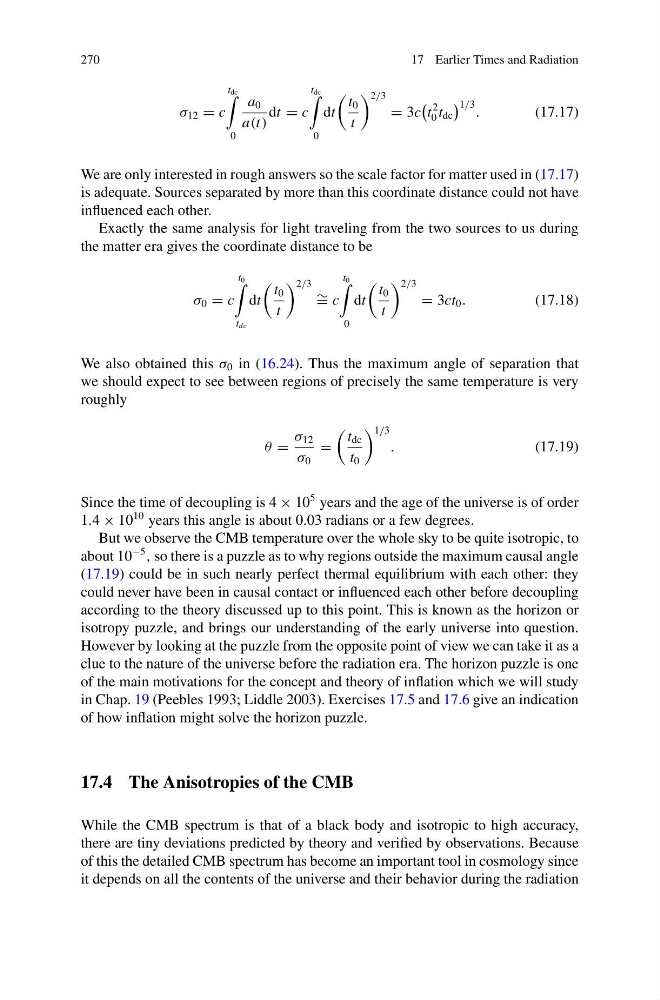
We are only interested in rough answers so the scale factor for matter used in (17.17)
is adequate. Sources separated by more than this coordinate distance could not have
influenced each other.
Exactly the same analysis for light traveling from the two sources to us during
the matter era gives the coordinate distance to be
σ 0 = c
t 0
t dc
dt
t 0
t
2/3 ∼ = c
t 0
0
dt
t 0
t
2/3
= 3ct 0 .
(17.18)
We also obtained this σ 0 in (16.24). Thus the maximum angle of separation that
we should expect to see between regions of precisely the same temperature is very
roughly
θ =
σ 12
σ 0
=
t dc
t 0
1/3
.
(17.19)
Since the time of decoupling is 4 × 10
5 years and the age of the universe is of order
1.4 × 10
10 years this angle is about 0.03 radians or a few degrees.
But we observe the CMB temperature over the whole sky to be quite isotropic, to
about 10
−5
, so there is a puzzle as to why regions outside the maximum causal angle
(17.19) could be in such nearly perfect thermal equilibrium with each other: they
could never have been in causal contact or influenced each other before decoupling
according to the theory discussed up to this point. This is known as the horizon or
isotropy puzzle, and brings our understanding of the early universe into question.
However by looking at the puzzle from the opposite point of view we can take it as a
clue to the nature of the universe before the radiation era. The horizon puzzle is one
of the main motivations for the concept and theory of inflation which we will study
in Chap. 19 (Peebles 1993; Liddle 2003). Exercises 17.5 and 17.6 give an indication
of how inflation might solve the horizon puzzle.
17.4 The Anisotropies of the CMB
While the CMB spectrum is that of a black body and isotropic to high accuracy,
there are tiny deviations predicted by theory and verified by observations. Because
of this the detailed CMB spectrum has become an important tool in cosmology since
it depends on all the contents of the universe and their behavior during the radiation
17 Earlier Times and Radiation
σ 12 = c
t dc
0
a 0
a(t)
dt = c
t dc
0
dt
t 0
t
2/3
= 3c
t
2
0 t dc
1/3 .
(17.17)
We are only interested in rough answers so the scale factor for matter used in (17.17)
is adequate. Sources separated by more than this coordinate distance could not have
influenced each other.
Exactly the same analysis for light traveling from the two sources to us during
the matter era gives the coordinate distance to be
σ 0 = c
t 0
t dc
dt
t 0
t
2/3 ∼ = c
t 0
0
dt
t 0
t
2/3
= 3ct 0 .
(17.18)
We also obtained this σ 0 in (16.24). Thus the maximum angle of separation that
we should expect to see between regions of precisely the same temperature is very
roughly
θ =
σ 12
σ 0
=
t dc
t 0
1/3
.
(17.19)
Since the time of decoupling is 4 × 10
5 years and the age of the universe is of order
1.4 × 10
10 years this angle is about 0.03 radians or a few degrees.
But we observe the CMB temperature over the whole sky to be quite isotropic, to
about 10
−5
, so there is a puzzle as to why regions outside the maximum causal angle
(17.19) could be in such nearly perfect thermal equilibrium with each other: they
could never have been in causal contact or influenced each other before decoupling
according to the theory discussed up to this point. This is known as the horizon or
isotropy puzzle, and brings our understanding of the early universe into question.
However by looking at the puzzle from the opposite point of view we can take it as a
clue to the nature of the universe before the radiation era. The horizon puzzle is one
of the main motivations for the concept and theory of inflation which we will study
in Chap. 19 (Peebles 1993; Liddle 2003). Exercises 17.5 and 17.6 give an indication
of how inflation might solve the horizon puzzle.
17.4 The Anisotropies of the CMB
While the CMB spectrum is that of a black body and isotropic to high accuracy,
there are tiny deviations predicted by theory and verified by observations. Because
of this the detailed CMB spectrum has become an important tool in cosmology since
it depends on all the contents of the universe and their behavior during the radiation