

17.3 The Isotropic CMB and the Horizon Puzzle
269
17.3 The Isotropic CMB and the Horizon Puzzle
As we have noted the CMB is extremely uniform and has a very precise black body
spectrum; its temperature varies by only about a part in 10
5 over all directions of
the sky. The very small variations have turned out to be very important as a probe of
the early universe, as we will presently discuss. However the uniformity presents a
problem: it tells us that the big bang fireball at decoupling time had nearly the same
temperature everywhere. When we encounter in the laboratory a system such as a
container of water with a very uniform temperature we naturally expect that it has
achieved equilibrium over a substantial period of time and the uniform temperature
is the result of the increase of entropy. But we can show that no such explanation
can hold for the fireball in the context of the cosmological theory we have developed
so far; this is because distant parts of the fireball could not have influenced each
other before decoupling due to the finite speed of light and the rapid expansion of
the universe entailed by the scale factor obtained in Sect. 17.2.
Explicitly we will show that according to the theory as developed so far we should
not expect two regions of the sky to have precisely the same CMB temperature if
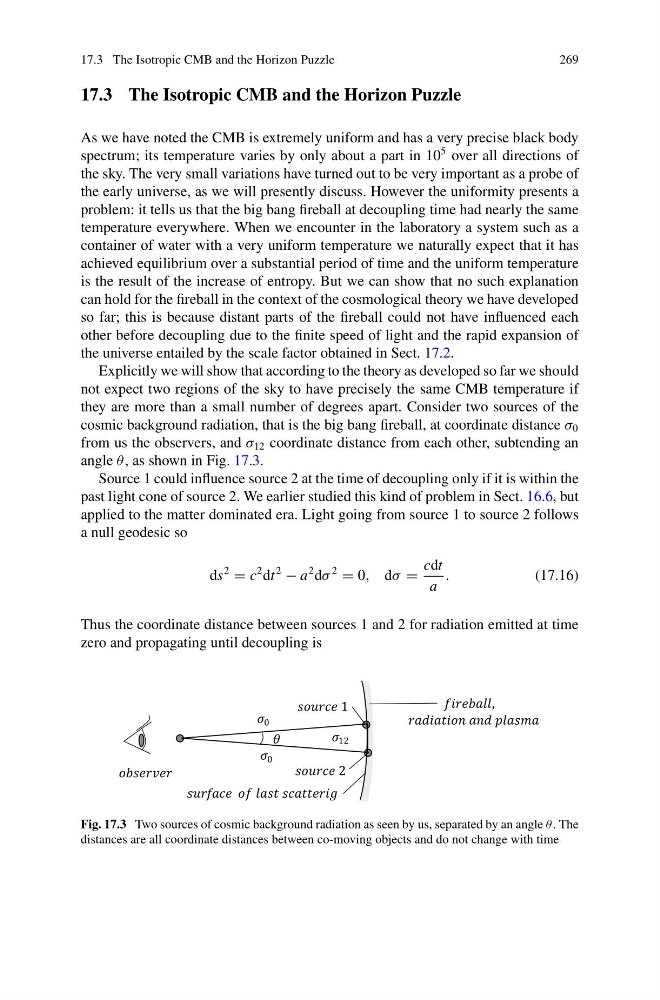
they are more than a small number of degrees apart. Consider two sources of the
cosmic background radiation, that is the big bang fireball, at coordinate distance σ 0
from us the observers, and σ 12 coordinate distance from each other, subtending an
angle θ , as shown in Fig. 17.3.
Source 1 could influence source 2 at the time of decoupling only if it is within the
past light cone of source 2. We earlier studied this kind of problem in Sect. 16.6, but
applied to the matter dominated era. Light going from source 1 to source 2 follows
a null geodesic so
ds
2
= c
2 dt
2
− a
2 dσ
2
= 0, dσ =
cdt
a
.
(17.16)
Thus the coordinate distance between sources 1 and 2 for radiation emitted at time
zero and propagating until decoupling is
Fig. 17.3 Two sources of cosmic background radiation as seen by us, separated by an angle θ. The
distances are all coordinate distances between co-moving objects and do not change with time
269
17.3 The Isotropic CMB and the Horizon Puzzle
As we have noted the CMB is extremely uniform and has a very precise black body
spectrum; its temperature varies by only about a part in 10
5 over all directions of
the sky. The very small variations have turned out to be very important as a probe of
the early universe, as we will presently discuss. However the uniformity presents a
problem: it tells us that the big bang fireball at decoupling time had nearly the same
temperature everywhere. When we encounter in the laboratory a system such as a
container of water with a very uniform temperature we naturally expect that it has
achieved equilibrium over a substantial period of time and the uniform temperature
is the result of the increase of entropy. But we can show that no such explanation
can hold for the fireball in the context of the cosmological theory we have developed
so far; this is because distant parts of the fireball could not have influenced each
other before decoupling due to the finite speed of light and the rapid expansion of
the universe entailed by the scale factor obtained in Sect. 17.2.
Explicitly we will show that according to the theory as developed so far we should
not expect two regions of the sky to have precisely the same CMB temperature if
they are more than a small number of degrees apart. Consider two sources of the
cosmic background radiation, that is the big bang fireball, at coordinate distance σ 0
from us the observers, and σ 12 coordinate distance from each other, subtending an
angle θ , as shown in Fig. 17.3.
Source 1 could influence source 2 at the time of decoupling only if it is within the
past light cone of source 2. We earlier studied this kind of problem in Sect. 16.6, but
applied to the matter dominated era. Light going from source 1 to source 2 follows
a null geodesic so
ds
2
= c
2 dt
2
− a
2 dσ
2
= 0, dσ =
cdt
a
.
(17.16)
Thus the coordinate distance between sources 1 and 2 for radiation emitted at time
zero and propagating until decoupling is
Fig. 17.3 Two sources of cosmic background radiation as seen by us, separated by an angle θ. The
distances are all coordinate distances between co-moving objects and do not change with time